THE ASIA FOUNDATION
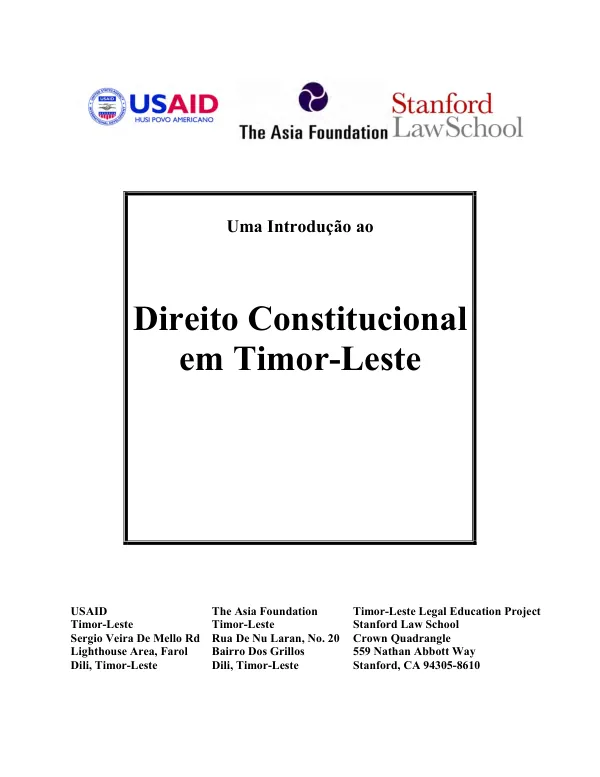
Introdução ao Direito Constitucional em Timor-Leste
The Timor-Leste Legal Education Project is a partnership between The Asia Foundation and Stanford Law School, funded by the United States Agency for International Development (USAID) through its Access to Justice Program.
2012 · 241 pages
Sign in to readA free account is required to download.
Abstract
The project aims to institutionalize ways for local actors to contribute positively to the development of national legal education in Timor-Leste. The project's objective is to provide accessible and high-quality legal education materials to the people of Timor-Leste. The project has produced a series of law textbooks, including "Introdução ao Direito Constitucional em Timor-Leste," which is the third book in the series. The book focuses on the structure and organization of the state in Timor-Leste, with a particular emphasis on the four branches of government: the President, the Parliament, the Government, and the judiciary. The book examines the rules and principles that govern the relationships between these institutions and their respective powers and limitations. The book is written in a clear and concise style, using hypothetical case studies, discussion questions, and current events to engage the reader and promote critical thinking about the laws and institutions of Timor-Leste. The book is intended to be accessible to a wide range of readers, including experienced lawyers and judges, government officials, members of civil society, Timorese law students, and the international community. The authors of the book are Alexander Weber, a graduate of Stanford Law School, and Dennys Antonialli, a lawyer with expertise in Timorese law. The book was edited by Geoffrey Swenson, the director of the TLLEP in Timor-Leste, and reviewed by Ana Mónica Carvalho, a Portuguese lawyer, to ensure accuracy and context. The book was also translated into Tetum by Timotio de Deus. The project has received significant support from the USAID, the Embassy of the United States in Dili, and the Asia Foundation. The project has also received assistance from various individuals, including Kerry Brogan, Silas Everett, Susan Marx, Julião de Deus Fátima, Gaspar H. da Silva, Carrick Flynn, and Brian Hoffman. The book is part of a broader effort to promote access to justice and the rule of law in Timor-Leste. The project aims to provide high-quality legal education materials to the people of Timor-Leste, with the goal of promoting a more just and equitable society. The book is divided into four chapters, each focusing on a different aspect of the Timorese legal system. Chapter one examines the role of the President, including the President's powers and limitations. Chapter two discusses the Government, including the Prime Minister's role and the powers and limitations of the Government. Chapter three examines the judiciary, including the role of the courts and the powers and limitations of the judges. Chapter four discusses the Parliament, including the role of the Parliament and the powers and limitations of the members of Parliament. Throughout the book, the authors use hypothetical case studies and discussion questions to engage the reader and promote critical thinking about the laws and institutions of Timor-Leste. The book is intended to be a valuable resource for law students, lawyers, and judges in Timor-Leste, as well as for the international community. The book is available in three languages: Tetum, Portuguese, and English. The book can be downloaded for free from the TLLEP website. The project has also received support from the University of Timor-Leste, including comments from the Reitor Aurélio Guterres, the Decano Tomé Xavier Jerónimo, and other professors and staff members.
Related documents