USAID
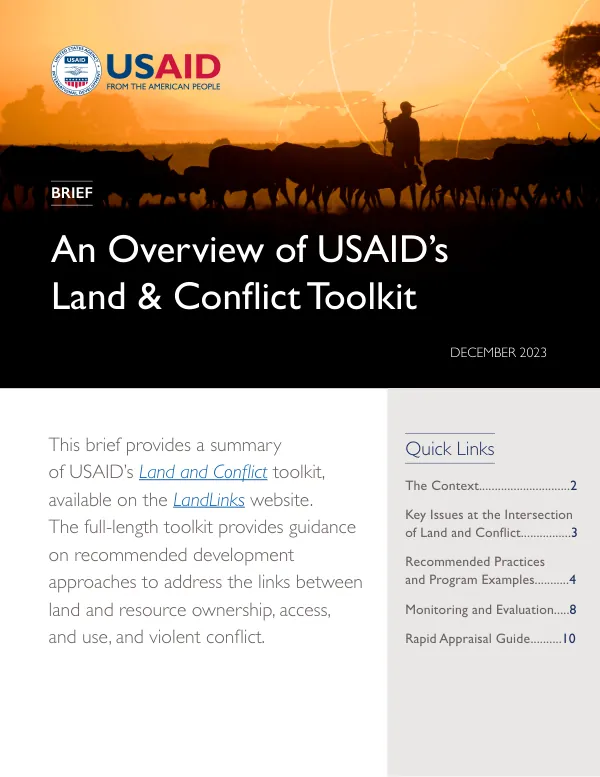
An Overview of USAID's Land & Conflict Toolkit
The Land & Conflict Toolkit, developed by USAID, provides guidance on recommended development approaches to address the links between land and resource ownership, access, and use, and violent conflict.
2023 · 12 pages
Sign in to readA free account is required to download.
Abstract
Effective land systems have impartial and reliable processes for dispute resolution, reducing the need to resort to violence. However, historical injustices related to customary land tenure, colonialism, and economic transformations have profoundly shifted land ownership and resource use in much of the world, leading to long-term exclusion and grievances. Well-governed land provides individuals and communities with enhanced perceptions of security and reduced levels of corruption, key incentives to invest in and conserve land. Functional land systems maintain efficient and transparent procedures for registering land claims, supporting land transactions, and collecting taxes in support of public service delivery and enabling economic growth. Land access and control is particularly important for marginalized groups, who are often barred from land governance and decision-making. In India, USAID partnered with PepsiCo to help local women access land for potato cultivation and to connect them to international supply chains. The public-private partnership empowered women and improved their livelihoods, while also encouraging more sustainable and climate-conscious farming practices. Effective land governance provides a cost-effective way to mitigate the risk of climate-driven conflict and also to increase resilience, supporting several goals outlined in USAID’s Climate Strategy. Key issues at the intersection of land and conflict include land tenure insecurity, land grabbing, increasing environmental degradation, human mobility, high-value natural resources, violent extremism, urbanization, and marginalized groups. These issues can lead to grievances, bad governance, and violence, and can contribute to the financing and sustaining of conflict. In post-conflict settings, actors may target land governance systems and institutions to seize property and entrench exclusionary land holding patterns, leading to dramatic shifts in power dynamics. To address these issues, USAID recommends three strategic practices: prioritizing equitable and inclusive approaches to strengthen land governance, strengthening local capacities to better address resource conflicts, and assisting displaced populations with durable solutions. These practices aim to promote inclusive and equitable land governance, reduce land-related conflicts, and support sustainable development outcomes. In Tanzania, the USAID Land Tenure Assistance (LTA) Activity supported 54 villages to conduct community-based, participatory land use planning and parcel mapping. The activity issued nearly 100,000 customary land certificates between 2015 and 2022, resulting in beneficiary households reporting feeling more tenure secure and experiencing a sharper decline in land disputes compared to other households. In Mali, the Keddo Diren Activity worked to help stabilize communities by supporting participatory and inclusive natural resource governance of dry season wetlands and rainy season upland pastures. In post-disaster and post-conflict settings, it is critical to help displaced people identify and document abandoned and damaged property, promote effective integration into host communities and voluntary restitution, and support plans to reduce risks of long-term displacement. Inclusive approaches that provide tenure security and adequate livelihoods for both displaced persons and host communities are important to promote peace and sustainable development outcomes.
Related documents
Documents in this collection
 2021
2021USAID DEC
Remote Developmental Evaluation: A Guide for Funders and Practitioners
Open record
USAID DEC
Design, Implementation, Monitoring, and Evaluation of Cross-Cultural HIV-Related Mental Health and Psychosocial Assistance Programs: A User’s Manual for Researchers and Program Implementers (Adult Version)
Open record