FUTURES GROUP INTERNATIONAL, LLC
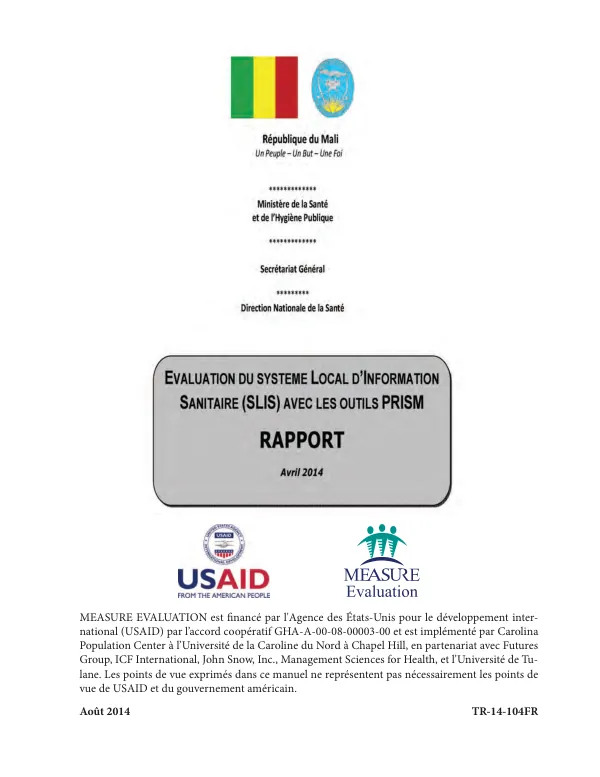
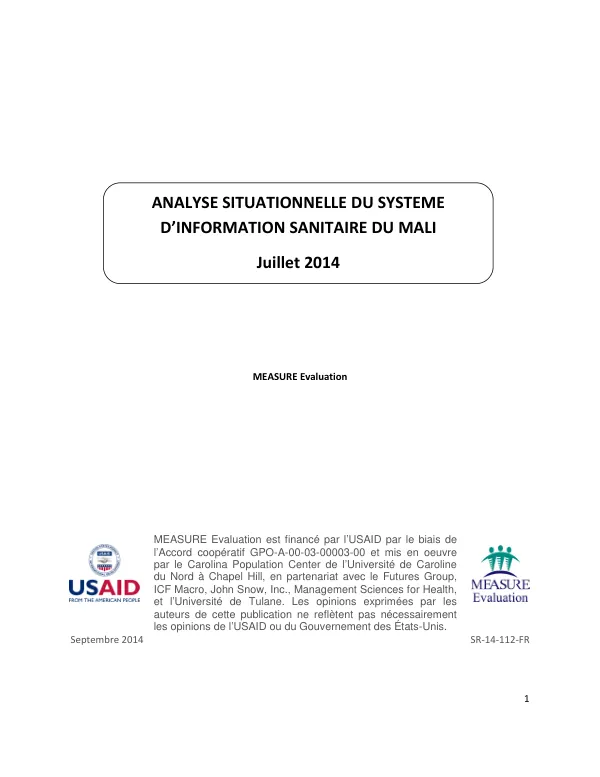
Analyse Situationnelle du Système d'Information Sanitaire du Mali
The analysis situational of the Mali's health information system (SIS) was conducted in July 2014 by MEASURE Evaluation, a project funded by USAID.
2014 · 21 pages
Sign in to readA free account is required to download.
Abstract
The study aimed to improve the SIS in Mali by identifying the strengths and weaknesses of the system, as well as the level of engagement of the public and private sectors in its management. The study used a qualitative approach, with a semi-structured questionnaire that was sent to various institutions and partners involved in the SIS. The questionnaire was divided into three sections: utilization of data management tools, coordination, and engagement. The study found that the partners generally supported the updating of tools for family planning and reproductive health, sexually transmitted infections (STIs)/HIV, malaria, nutrition, and community activities, taking into account national protocols for disease management. The study also found that the partners provided technical assistance for the development of monthly reports and epidemiological bulletins. However, the study noted that the utilization and promotion of data culture remained weak at all levels of the health pyramid. The study identified several challenges facing the SIS in Mali, including the irregularity of data publication and sharing with partners, the lack of use of health information as a planning and management tool, and the limited participation of the private sector in the system. The study also noted that the reform of the health sector and the support for development had a significant impact on the SIS. The study recommended several actions to improve the SIS in Mali, including the development of a national health information system, the strengthening of data management and analysis capacities, and the promotion of data culture among health professionals. The study was conducted in collaboration with various institutions and partners, including the Ministry of Health, the USAID/Mali, the UNICEF/Mali, the UNFPA/Mali, and the MCHIP. The study's findings and recommendations are intended to inform the development of a national health information system in Mali and to improve the management of health information in the country. The study's methodology involved the use of a semi-structured questionnaire that was sent to various institutions and partners involved in the SIS. The questionnaire was divided into three sections: utilization of data management tools, coordination, and engagement. The study also collected data on the level of engagement of the public and private sectors in the management of the SIS. The study's results showed that the partners generally supported the updating of tools for family planning and reproductive health, STIs/HIV, malaria, nutrition, and community activities, taking into account national protocols for disease management. The study also found that the partners provided technical assistance for the development of monthly reports and epidemiological bulletins. However, the study noted that the utilization and promotion of data culture remained weak at all levels of the health pyramid. The study also identified several challenges facing the SIS in Mali, including the irregularity of data publication and sharing with partners, the lack of use of health information as a planning and management tool, and the limited participation of the private sector in the system. The study recommended several actions to improve the SIS in Mali, including the development of a national health information system, the strengthening of data management and analysis capacities, and the promotion of data culture among health professionals. The study's findings and recommendations are intended to inform the development of a national health information system in Mali and to improve the management of health information in the country.