TETRA TECH
Analysis of Court Practice of Reinstatement of Dismissed Civil Servants
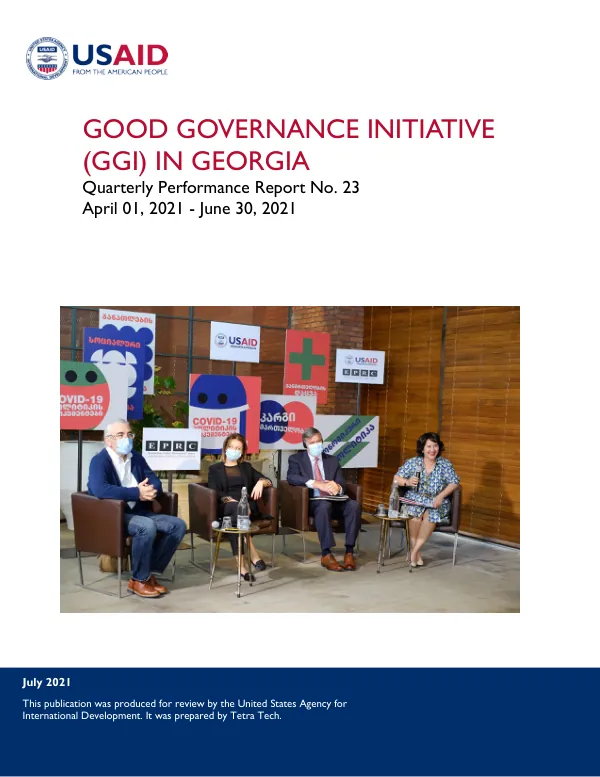
The research on reinstatement of dismissed civil servants in Georgia was conducted by the Innovations and Reforms Center (IRC) with the support of the USAID Good Governance Initiative (GGI) under the project "External Monitoring of Public Administration Reform."
2021 · 19 pages
Sign in to readA free account is required to download.
Abstract
The research aimed to study the dynamics of employee dismissal from the civil service and court disputes related thereto, as well as to identify the corresponding tendencies regarding the circumstances and legal grounds for dismissal, judicial proceedings, and the outcome thereof. The research objectives included identifying the most common legal grounds for dismissal from civil service, the proportion between appeals against dismissal decisions and granted claims, the average timeframe from dismissal to reinstatement or redress payment, and the practice of continuation of reinstated employees' work in the civil service. The research methodology involved desk research, in-depth interviews, and analysis of court judgments, normative acts, and statistical data requested from public institutions. According to the data provided by the LEPL Civil Service Bureau, the rate of employer-initiated servant dismissals in the civil service considerably dropped in 2017, as compared to the previous year, though the increasing tendency could be still observed in 2018-2019. The dynamics of labor-related litigations against state institutions is also noteworthy, with the number of such litigations increasing almost threefold in 2018. The proportion of lodged and granted lawsuits against state institutions varied significantly between 2016 and 2019, with the proportion of granted lawsuits making 63% in 2016, 19% in 2017, 16% in 2018, and 38% in 2019. The civil servant dismissal statistics provided by the LEPL Civil Service Bureau shows that the number of individuals dismissed on employer's initiative decreased from 2,500 in 2016 to 1,852 in 2020, while the number of lawsuits lodged against state institutions increased from 709 in 2016 to 1,619 in 2018. The number of granted lawsuits against state institutions also increased from 1718 in 2017 to 1619 in 2018. The research also involved in-depth interviews with 10 individuals, including dismissed persons and human rights advocates, which provided valuable insights into the problems and barriers faced by dismissed civil servants when seeking restitution of their violated rights. The analysis of the data obtained from various sources identified key findings and recommendations for improving the reinstatement mechanism. The research findings indicate that the reinstatement mechanism in Georgia is often ineffective, with many dismissed civil servants facing significant barriers when seeking reinstatement. The research recommends introducing a personal responsibility mechanism, introducing additional mechanisms for ensuring enforcement of judicial decisions, and refining the restitution mechanism to improve the reinstatement process. The research also highlights the importance of improving the data collection and analysis process to better understand the dynamics of employee dismissal and reinstatement in Georgia. The research suggests that the LEPL Civil Service Bureau and other public institutions should improve their data collection and analysis processes to provide more accurate and comprehensive data on employee dismissal and reinstatement. Overall, the research provides valuable insights into the reinstatement mechanism in Georgia and highlights the need for improvements to ensure that dismissed civil servants receive fair and timely reinstatement.