USAID DEC
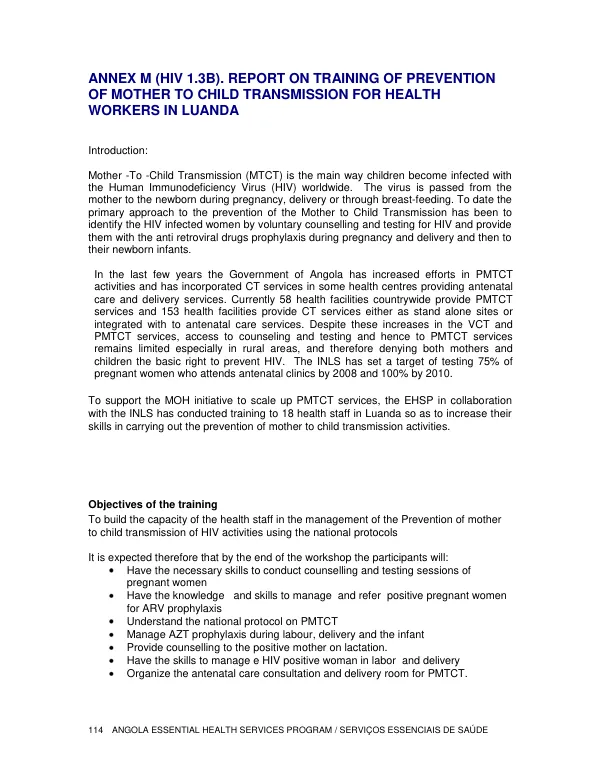
Angola Essential Health Services Program / Serviços Essenciais de Saúde ANGOLA ESSENTIAL HEALTH SERVICES PROGRAM / SERVIÇOS ESSENCIAIS DE SAÚDE ANNEX M (HIV 1.3B). REPORT ON TRAINING OF PREVENTION OF MOTHER TO CHILD TRANSMISSION FOR HEALTH WORKERS IN LUANDA
Sign inUSAID DEC
Angola Essential Health Services Program / Serviços Essenciais de Saúde ANGOLA ESSENTIAL HEALTH SERVICES PROGRAM / SERVIÇOS ESSENCIAIS DE SAÚDE ANNEX M (HIV 1.3B). REPORT ON TRAINING OF PREVENTION OF MOTHER TO CHILD TRANSMISSION FOR HEALTH WORKERS IN LUANDA
The Angola Essential Health Services Program, in collaboration with the National Institute of Laboratory Services (INLS), conducted a training program for health workers in Luanda to enhance their skills in preventing mother-to-child transmission (PMTCT) of HIV.
2011 · 4 pages
Sign in to readA free account is required to download.
Abstract
The training aimed to build the capacity of health staff in managing PMTCT activities using national protocols. The training program consisted of 18 health staff from three health centers in Luanda, including Hoji ya Henda, Paz, and Samba. The participants underwent a 5-day theoretical session, which covered topics such as the epidemiology of HIV and AIDS, ethics and confidentiality, counseling and testing, and antiretroviral therapy. The facilitators used adult learning methodology, combining group discussions, lectures, dramatizations, and demonstrations. The practical sessions were conducted at Samba and Cajueiros health centers, where participants conducted counseling and testing sessions under the guidance of experienced counselors. They also familiarized themselves with delivery procedures and algorithms used for prophylaxis for HIV-positive pregnant women and the management of exposed newborns. The training program included a pre-test and post-test to evaluate the participants' knowledge. Continuous evaluation was conducted through questions and answers sessions and direct observations. The participants were also required to organize the PMTCT services in their respective health facilities, including the availability of rapid test kits, ARVs, delivery kits, and forms. The training program aimed to increase the skills of health workers in PMTCT activities, ultimately reducing the transmission of HIV from mother to child. The program's success was measured by the participants' ability to conduct counseling and testing sessions, manage HIV-positive pregnant women, and provide antiretroviral therapy. The Angola Essential Health Services Program has made significant efforts to scale up PMTCT services, with 58 health facilities providing PMTCT services and 153 health facilities providing counseling and testing services. The program's goal is to test 75% of pregnant women attending antenatal clinics by 2008 and 100% by 2010. The training program is a crucial step in achieving this goal and reducing the transmission of HIV from mother to child in Angola. The training program's curriculum included topics such as the prevention of mother-to-child transmission, antiretroviral therapy, and counseling and testing. The participants were also required to fill out data collection forms, flowgrams, and algorithms, and to conduct counseling and testing sessions among themselves. The evaluation of the training program showed that the participants' knowledge improved significantly after the training. The program's success was also measured by the participants' ability to organize the PMTCT services in their respective health facilities and to provide antiretroviral therapy to HIV-positive pregnant women. The Angola Essential Health Services Program's efforts to scale up PMTCT services are crucial in reducing the transmission of HIV from mother to child. The training program is a significant step in achieving this goal and improving the health outcomes of mothers and children in Angola.
Related documents