CATHOLIC RELIEF SERVICES ORGANIZATION
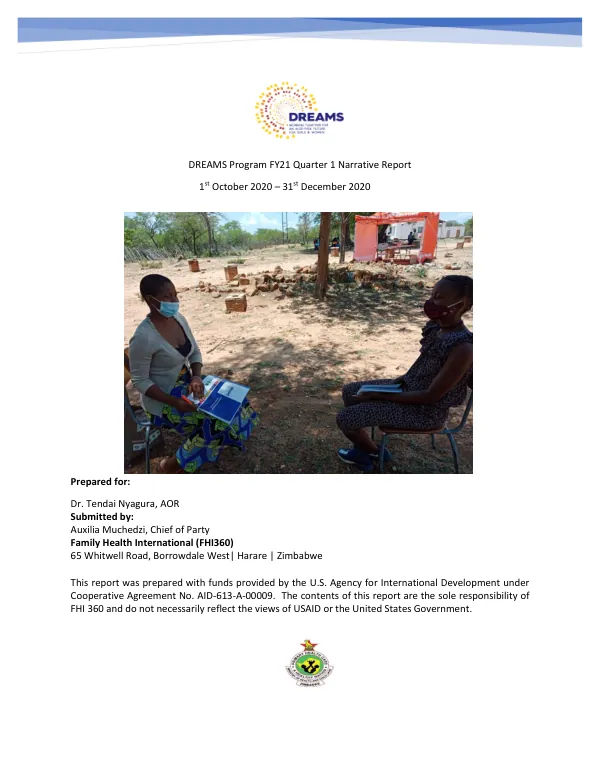
DREAMS Program FY21 Quarter 1 Narrative Report
The DREAMS Program FY21 Quarter 1 Narrative Report highlights the implementation of the Determined, Resilient, Empowered, AIDS-free, Mentored, and Safe women (DREAMS) program in 12 priority high HIV burden districts in Zimbabwe.
2021 · 28 pages
Sign in to readA free account is required to download.
Abstract
The program, funded by the U.S. Agency for International Development (USAID), aims to reach the most vulnerable adolescent girls and young women (AGYW) aged 9 to 24 with evidence-based HIV and sexual violence prevention curriculum and needs-based sexual and reproductive health and HIV prevention services. Implementation of the program took place within the context of rising COVID-19 infections in Zimbabwe, which negatively affected the program's group-based model. In response, the program developed guidance and standard operating procedures for implementation in the context of the pandemic. A minimum package of services was determined, comprising HIV and sexual violence prevention sessions, Adolescent Sexual and Reproductive Health (ASRH) and Prevention services, and Economic Strengthening interventions for AGYW. The school program could not take off as planned, and the program adopted a Community School Program (CSP) that integrates education in emergencies and COVID-19 infection prevention and control (IPC). The CSP aims to provide education and support to AGYW in a safe and controlled environment. During the reporting period, the DREAMS Program introduced new screening and enrolment procedures and tools that facilitate the identification of the most vulnerable AGYW. However, staff training, mentoring, and support (quality assurance) on these tools slowed down the enrolment processes. The program has made significant progress in reaching priority populations with a comprehensive HIV prevention package. In COP 20, the FHI360 program started implementing the full package of DREAMS services in 6 new priority, high HIV burden districts of Matabeleland South province, bringing the successful DREAMS program to a total of 12 districts in Zimbabwe. The 6 expansion districts (Beitbridge, Bulilima, Gwanda, Insiza, Mangwe, and Matobo) and the partial maintenance districts (Bulawayo, Chipinge, Gweru, Makoni, Mazowe, and Mutare) were ranked as very high HIV burden districts. The program has made significant progress in reaching AGYW in these districts, with a total of 2,500 AGYW screened and enrolled in the program during the reporting period. The program has also made significant progress in providing HIV and sexual violence prevention services to AGYW. A total of 1,500 AGYW received HIV testing services, and 500 AGYW received post-exposure prophylaxis (PEP) services. The program has also provided economic strengthening interventions to 1,000 AGYW, including vocational training and microfinance support. The program has also made significant progress in promoting gender norms change among AGYW. A total of 500 AGYW participated in gender norms change activities, including peer education and community mobilization. The program has also made significant progress in providing family planning services to AGYW. A total of 500 AGYW received family planning services, including contraceptive counseling and provision. The program has also made significant progress in providing pre-exposure prophylaxis (PrEP) services to AGYW. A total of 200 AGYW received PrEP services, including counseling and provision. The program has also made significant progress in providing post-gender-based violence services to AGYW. A total of 100 AGYW received post-gender-based violence services, including counseling and support. The program has also made significant progress in reaching AGYW in Matabeleland South province. A total of 1,000 AGYW were screened and enrolled in the program during the reporting period, and 500 AGYW received HIV testing services. The program has also made significant progress in promoting community norms change among AGYW. A total of 500 AGYW participated in community norms change activities, including peer education and community mobilization. The program has also made significant progress in providing economic strengthening interventions to AGYW. A total of 1,000 AGYW received economic strengthening interventions, including vocational training and microfinance support. The program has also made significant progress in promoting community norms change among AGYW. A total of 500 AGYW participated in