ABT ASSOCIATES
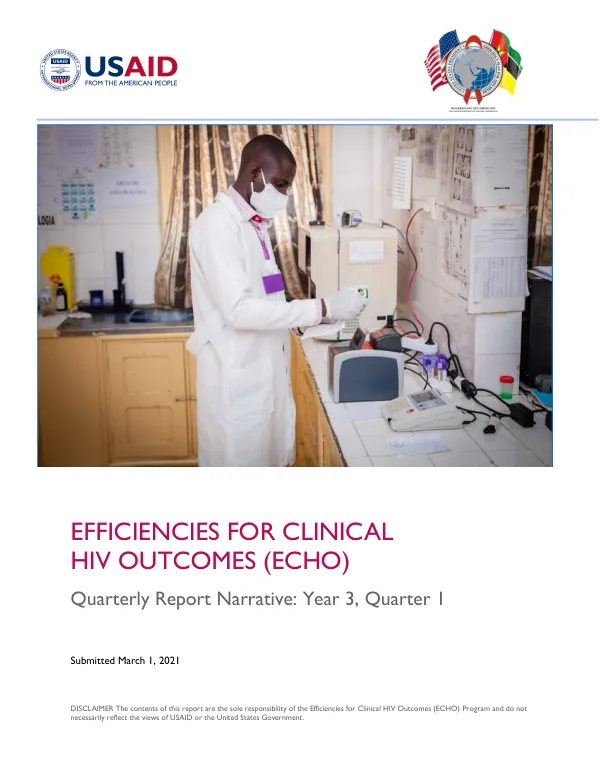
Quarterly Report Narrative: Year 3, Quarter 1
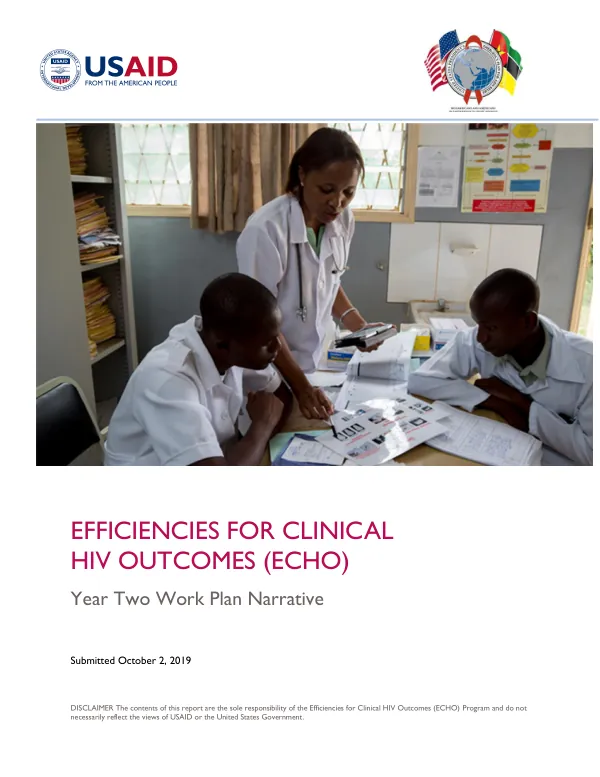
HIV index testing yield in Mozambique has been a priority area for the Efficiencies for Clinical HIV Outcomes (ECHO) program.
2021 · 21 pages
Sign in to readA free account is required to download.
Abstract
In Year 3, Quarter 1 (Y3Q1), ECHO focused on increasing early retention rates among those at high risk of dropping out, returning patients lost-to-follow-up (LTFU), and expanding and better targeting testing as a means for increasing TX_NEW. These strategies have been successful in growing the number of individuals on treatment, but the potential for continued growth of ECHO's treatment cohort will be limited in the future by two factors: identifying new patients has been rarer than expected, and potential TX_CURR gains from increased retention and LTFU are nearly exhausted. ECHO's top priorities in Y3Q1 were to increase the yield for HIV testing by 1 percentage point in Tete, Manica, and Niassa, and 2 percentage points in Sofala, increase the percentage of children adopting optimized regimens by 20 percentage points, increase early retention rates to 90%, and increase male engagement in the uptake of services by 10%. Technical support to health providers, disaggregating weekly data analysis by sex and age, patient file reviews, and other related efforts have improved results in these areas. However, longer-term investments will be needed to sustain gains. The project has made progress in areas such as TB, Cervical Cancer Prevention (CECAP), adult care and treatment, adolescent care and treatment, gender-based violence (GBV), and other technical areas. ECHO has implemented activities related to TB, CECAP, adult care and treatment, adolescent care and treatment, GBV, and other technical areas. The project has made progress in these areas despite cyclones and floods, the COVID-19 pandemic, and armed conflict posing serious challenges in provinces with over two-thirds of ECHO's treatment cohort. ECHO has worked on TPT completion, resuming community outreach activities, GBV, and quality of CECAP services, and preparing for new initiatives such as antiretroviral therapy (ART) distribution through private pharmacies, community health workers (APEs), mobile brigades, and machine learning with the Data.fi project to improve reintegration of patients LTFU. The project has increased investments in Innovation, Learning, and Adapting (IL&A) and improved the area's connection with service delivery challenges in the field, resulting in several game-changing solutions. ECHO has made significant progress in its priority areas, including increasing the yield for HIV testing, increasing the percentage of children adopting optimized regimens, increasing early retention rates, and increasing male engagement in the uptake of services. The project has also made progress in areas such as TB, CECAP, adult care and treatment, adolescent care and treatment, GBV, and other technical areas. Despite challenges posed by cyclones and floods, the COVID-19 pandemic, and armed conflict, ECHO has continued to implement activities and prepare for new initiatives to improve HIV outcomes in Mozambique. The project has implemented several strategies to improve HIV outcomes, including technical support to health providers, disaggregating weekly data analysis by sex and age, patient file reviews, and other related efforts. ECHO has also increased investments in IL&A and improved the area's connection with service delivery challenges in the field, resulting in several game-changing solutions. The project has made significant progress in its priority areas and has continued to implement activities and prepare for new initiatives to improve HIV outcomes in Mozambique. ECHO's progress in its priority areas has been significant, with significant increases in the yield for HIV testing, the percentage of children adopting optimized regimens, early retention rates, and male engagement in the uptake of services. The project has also made progress in areas such as TB, CECAP, adult care and treatment, adolescent care and treatment, GBV, and other technical areas. Despite challenges posed by cyclones and floods, the COVID-19 pandemic, and armed conflict, ECHO has continued to implement activities and prepare for new initiatives to improve HIV outcomes in Mozambique.