USAID DEC
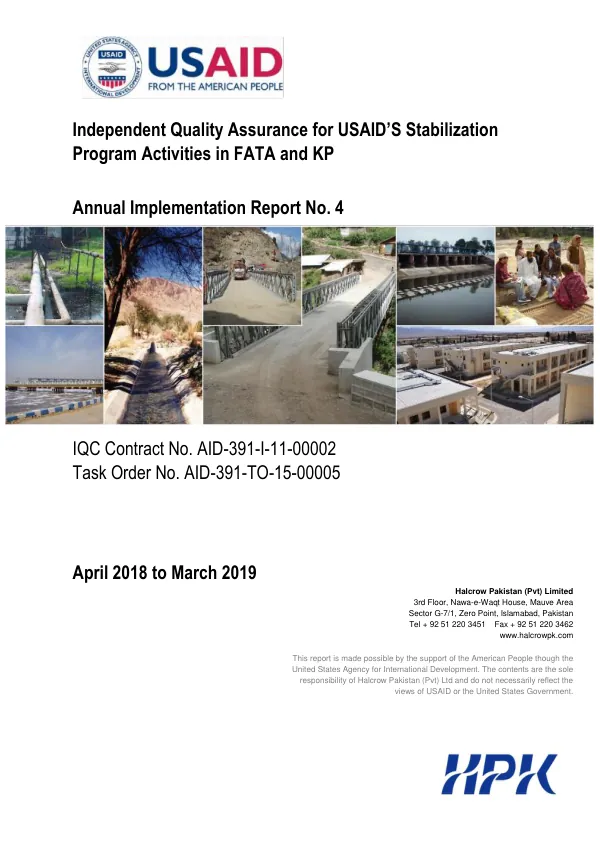
Annual Implementation Report No. 4: Independent Quality Assurance for USAID’s Stabilization Program Activities in FATA and KP
Sign inUSAID
Annual Implementation Report No. 4: Independent Quality Assurance for USAID’s Stabilization Program Activities in FATA and KP
The main objective of the USAID Stabilization Program Activities in FATA and KP is to provide Architect-Engineer Services for Independent Quality Assurance.
2019 · 88 pages
Sign in to readA free account is required to download.
Abstract
Halcrow Pakistan (Pvt.) Ltd. is responsible for providing these services, which commenced in April 2015 and were scheduled to conclude on March 31, 2019. However, due to ongoing works under the Khyber Pakhtunkhwa Reconstruction Program (KPRP) and upcoming projects under the FATA Infrastructure Program (FIP), Halcrow Pakistan suggested a "No Cost" extension to the Task Order, which was approved by USAID. The main sectors of focus for the program include Buildings, Roads, Power, and Water. The sub-projects assigned to Halcrow Pakistan have been categorized into three zones: North, South, and Centre. The North Zone comprises districts in Malakand Division and Bajaur Agency, while the South Zone includes North/South Waziristan, Mohmand, Khyber, Orakzai, and Kurram Agencies, as well as Frontier Regions of Peshawar, Kohat, and Tank. The program has undergone several changes, with USAID enhancing the projects list by adding new projects under FIP and KPRP. These sub-projects include rehabilitation and reconstruction of roads, education buildings, rehabilitation of damaged electrical infrastructure, and construction of solar-based tube wells for irrigation and water supply. The main objective of the Annual Implementation Report (AIR) No. 4 is to provide a preview of the overall status of various ongoing and upcoming sub-projects in the sectors of Buildings, Roads, Power, and Water. The report covers the performance period from April 1, 2018, to March 31, 2019, and is submitted pursuant to Task Order deliverables under Clause F.5.1.3. The report comprises an introduction to the projects, results achieved during the fourth year of project implementation, problems encountered, and actions suggested to enhance qualitative and quantitative values of the works. The report also includes a preview of public events, such as collecting feedback from local communities directly benefiting from the USAID stabilization program. The main elements of the program include General Management and Administrative Support, Design Quality Assurance and Cost Review, and Construction Quality Assurance. The report highlights the results achieved in these areas, including the establishment of field offices, construction quality assurance, inspections, and testing, as well as third-party inspections and environmental compliance. The report also identifies significant implementation problems in the Building, Road, Power, and Water sectors, including issues with building sector projects, road sector projects, power sector projects, and water sector projects. The report suggests actions to be taken by Halcrow Pakistan to address these problems and enhance the qualitative and quantitative values of the works. The report concludes by highlighting the achievements of the program and the challenges faced during the fourth year of implementation. It also provides recommendations for future improvements and enhancements to the program. The program has been implemented in three zones: North, South, and Centre. The North Zone comprises districts in Malakand Division and Bajaur Agency, while the South Zone includes North/South Waziristan, Mohmand, Khyber, Orakzai, and Kurram Agencies, as well as Frontier Regions of Peshawar, Kohat, and Tank. The report highlights the importance of the program in providing Architect-Engineer Services for Independent Quality Assurance and its role in enhancing the qualitative and quantitative values of the works. It also emphasizes the need for continued support and funding to ensure the successful implementation of the program.
Related documents
Documents in this collection
 2021
2021USAID DEC
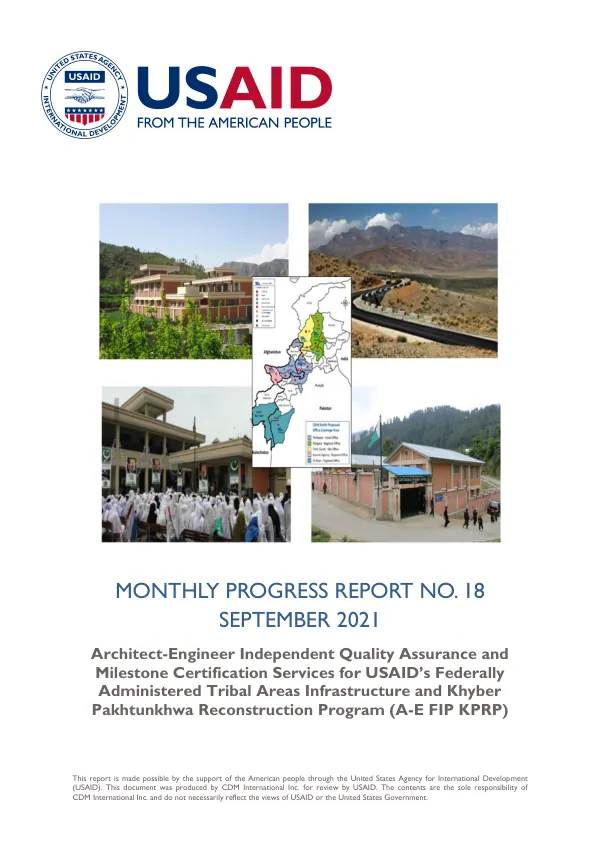
Monthly Progress Report No. 18 - September 2021: Architect-Engineer Independent Quality Assurance and Milestone Certification Services for USAID’s Federally Administered Tribal Areas Infrastructure and Khyber Pakhtunkhwa Reconstruction Program (A-E FIP KPRP)
Open record 2021
2021USAID DEC