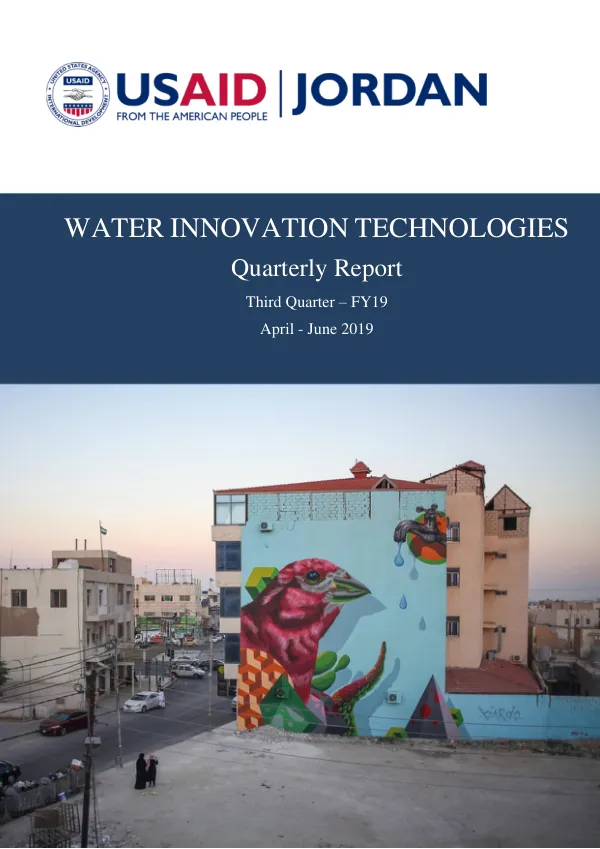
MERCY CORPS INTERNATIONAL
Annual Performance Report: Fiscal Year 2019 - October 1, 2018 to September 30, 2019
The Water Innovation Technologies (WIT) Project's efforts in Fiscal Year 2019 showed significant progress in increasing water conservation in Jordan.
2019 · 42 pages
Sign in to readA free account is required to download.
Abstract
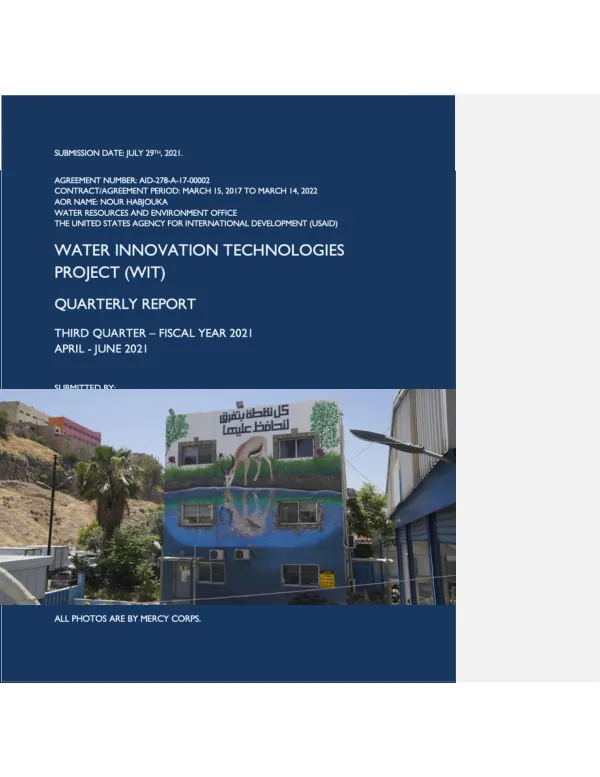
The project's objective is to increase water efficiency in the agricultural sector, community, and household levels. The project's theory of change states that if barriers to the adoption of water-saving technologies are systematically broken down at multiple levels, with different groups of water users and market actors, adoption of water-saving technologies will increase. The project's Agriculture Component continued to raise farmer awareness by disseminating the results of the 13 demonstration sites and communicating early adopters' experiences. This led to an increase in farmer interest in adopting water-saving technologies and irrigation systems. The project supported two irrigation suppliers in implementing field days in Azraq and Mafraq, where 112 farmers and other stakeholders learned about the benefits of advanced irrigation technologies. However, the project found that on-farm improvements were limited by a lack of understanding of optimized irrigation systems. To address this, the project began working with irrigation suppliers and other market actors to improve their delivery of after-sales services and advisory services. This will help reduce problems in the field and respond to farmers' irrigation needs. At the household level, the project continued to work with suppliers of various water-saving technologies, including reverse osmosis (RO) filters, rainwater harvesting tanks, and water reuse systems. The project implemented awareness sessions with six community-based organizations (CBOs), targeting 4,155 participants. These sessions aimed to educate household-level beneficiaries about the benefits of water-saving practices and technologies. The project also launched the "Hold Water" street art initiative, which resulted in six murals in the northern hills of Jordan. The initiative aimed to spark conversations about water scarcity in Jordan and the importance of water-saving practices. Additionally, the project implemented the Loan Management System (LMS) for its CBO-driven loan product, with 55 loans disbursed from Ajloun and Mafraq governorates by the end of the year. The project also initiated rehabilitation works on several water reservoir restoration projects, including the Queen Rania Lake/Ajloun pond and the Bwiadah Ramsha Dam in Irbid. These projects will help collect and conserve water for future use. Overall, the WIT Project's efforts in Fiscal Year 2019 demonstrated significant progress in increasing water conservation in Jordan. The project's focus on water efficiency in the agricultural sector, community, and household levels has led to increased adoption of water-saving technologies and practices. The project's achievements in Fiscal Year 2019 include: * 3,996,241 m³ of water saved * 4,155 participants in awareness sessions * 55 loans disbursed through the Loan Management System * 6 murals created through the "Hold Water" street art initiative * Rehabilitation works initiated on several water reservoir restoration projects The project's future plans include continuing to work with irrigation suppliers and market actors to improve their delivery of after-sales services and advisory services. The project will also focus on supporting financial institutions to develop products tailored for farmers to adopt water-saving technologies.