USAID/REGIONAL DEVELOPMENT MISSION FOR ASIA
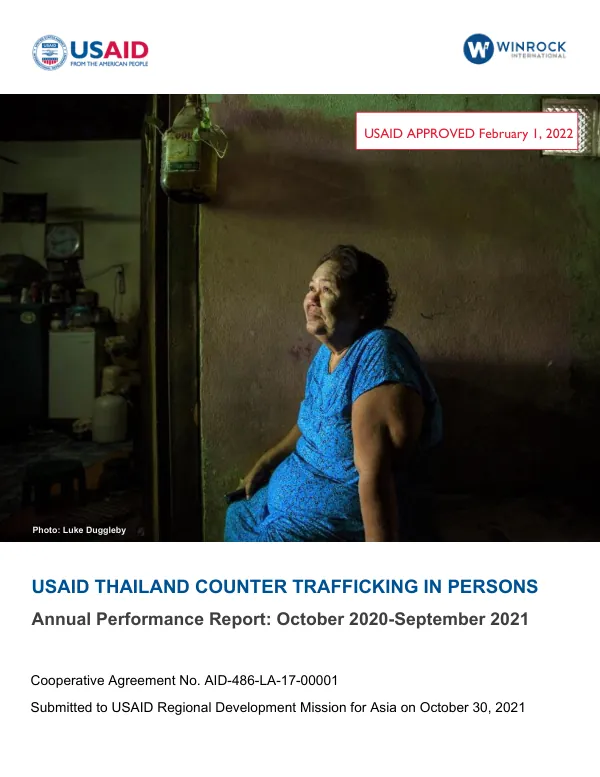
Annual Performance Report: October 2020-September 2021
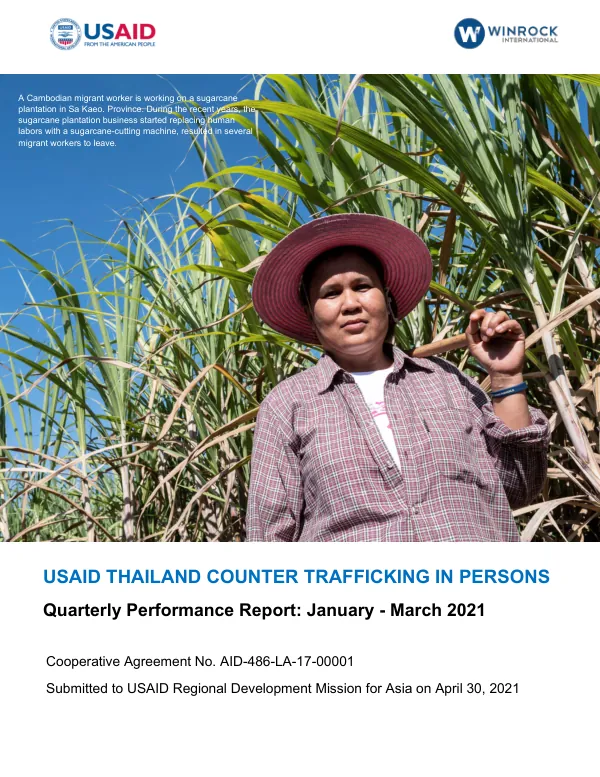
The USAID Thailand Counter Trafficking in Persons (CTIP) program, funded by Cooperative Agreement No.
2021 · 151 pages
Sign in to readA free account is required to download.
Abstract
AID-486-LA-17-00001, aimed to reduce demands and incentives for trafficked labor in Thailand. The program's theory of change emphasized the importance of improving ethical standards and practices among employers and businesses, as well as increasing consumer awareness and engagement on labor migration policies. The program focused on several key areas, including the Sustainable Sugarcane Partnership, which drove labor transparency in the Thai sugarcane supply chain through the use of Verifik8. The partnership with Mars Petcare aimed to reduce forced labor in Thailand's seafood industry, with four workstreams focused on connectivity at sea, establishing effective response protocols, pilot responsible recruitment, and cross-cutting government and industry engagement. The program also implemented a national campaign, "Inside Khonnok," to change Thai behaviors and attitudes on migrant workers through social and behavior change communication. Additionally, the program provided media training to young journalists to shift media reporting towards migrant workers. The program's efforts to increase engagement on labor migration policies included a 2022 workplan meeting with government stakeholders and a collective report on the Ministry of Labor's revised prohibited jobs lists. The program's intermediate result 2 aimed to empower at-risk populations to safeguard their rights. This was achieved through several sub-intermediate results, including increasing awareness and understanding of rights among most at-risk populations, improving the content and accessibility of the Thailand Migrant Protection Resource Toolkit, and increasing rights awareness through the Senior Officials Meeting. The program also provided technical and case management training for Raks Thai's staff, empowered volunteers to increase rights awareness and protect their communities, and enhanced TIP prevention through collaboration and the use of media. The program's intermediate result 3 focused on strengthening protection systems, including the identification of trafficked persons, support services, and voice of at-risk populations. The program established district-level anti-trafficking in persons committees, built the capacity of provincial multi-disciplinary teams, and enhanced services of LGBTQI TIP shelters in Thailand. The program also implemented a monitoring, evaluation, and learning framework, which included learning and adaptive management, WINTIP-INFO MIS rollout and strengthening, guideline and protocol development, and data quality assessment. The program's efforts resulted in several key outcomes, including a 27% increase in household income among program participants compared to the control group, improved food security indicators across all target communities, and increased engagement on labor migration policies by key stakeholders. The program's success was also reflected in the establishment of district-level anti-trafficking in persons committees, the building of capacity of provincial multi-disciplinary teams, and the enhancement of services of LGBTQI TIP shelters in Thailand.