USAID DEC
Innovation Technologies to Identify and Measure Oil and Gas Sector Methane Emissions in Southeast Asia: Workshop and Roundtable Discussion Summary Report
Sign inDELOITTE CONSULTING, LLP
Innovation Technologies to Identify and Measure Oil and Gas Sector Methane Emissions in Southeast Asia: Workshop and Roundtable Discussion Summary Report
Southeast Asia Smart Power Program Innovation Technologies to Identify and Measure Oil and Gas Sector Methane Emissions in Southeast Asia: Workshop and Roundtable Discussion Summary Report.
2023 · 9 pages
Sign in to readA free account is required to download.
Abstract
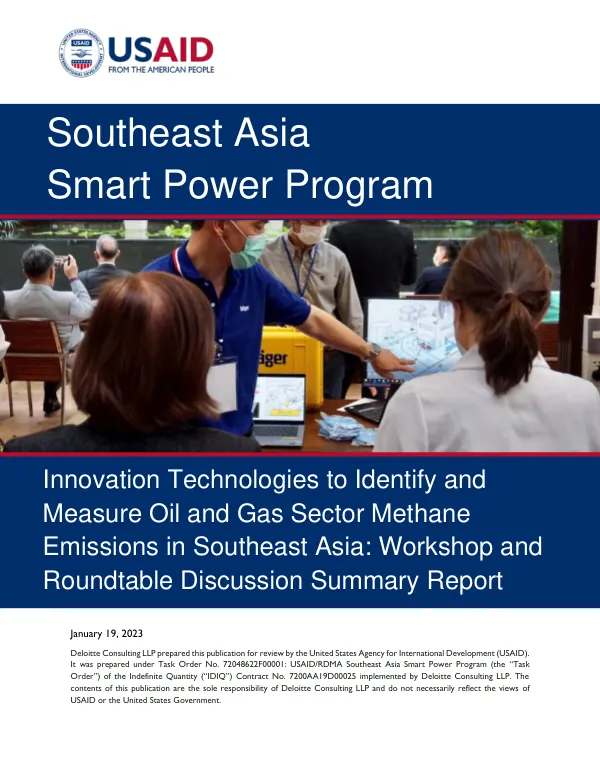
The workshop, organized by the United States Agency for International Development (USAID) Southeast Asia Smart Power Program (SPP), in partnership with the Association of Southeast Asian Nations (ASEAN) Centre for Energy (ACE), and in collaboration with PETRONAS, PTT, and the Asia Natural Gas & Energy Association, was held in Bangkok, Thailand, on December 7-8, 2022. The event brought together 123 participants from 42 organizations, including the private sector, governments, and public sector institutions from Indonesia, Malaysia, Thailand, the United States, and Vietnam. The workshop focused on innovative technologies to identify and measure oil and gas sector methane emissions in Southeast Asia. Day One featured a hybrid workshop with presentations from technology leaders and industry experts on current and emerging technological approaches to measuring and monitoring methane emissions across the oil and gas value chain. The workshop's closing session included an interactive technology showcase, featuring demonstrations of leading methane emission detection technologies available in Southeast Asia. On Day Two, 57 participants continued to engage in facilitated roundtable discussions to explore and develop voluntary initiatives and activities to promote methane detection, quantification, and reductions in the region. The objectives of the roundtable discussion were to identify and define common voluntary actions that would have the largest impact on reducing methane emissions over a three-year timeline and discuss avenues and opportunities for collaboration to implement the identified actions. Key takeaways from the workshop and roundtable discussions include supportive directions towards methane emission reduction. ASEAN country commitments to combat climate change are reflected in their national policies with specific greenhouse gas (GHG) reduction targets, such as carbon neutrality and net-zero. Some countries, including Indonesia, Malaysia, and Vietnam, have advanced ambitious action to address methane emissions by joining the Global Methane Pledge (GMP) and agreeing to take voluntary actions to contribute to a collective effort to reduce global methane emissions by at least 30 percent from 2020 levels by 2030. Inputs from established institutions, such as ASEAN Institutions, also played a key role in natural gas optimization. Two regional institutions, ACE and the ASEAN Council on Petroleum (ASCOPE), focus on the energy sector and oil and gas optimization, respectively. These institutions have the potential to drive methane emission reductions in the region. The workshop's statement, presentation slides, recordings, and photos are available on ASEAN Centre for Energy's website. Participants suggested that future workshops cover topics such as the Oil and Gas Methane Partnership (OGMP) 2.0 reporting framework, financing methane projects/technologies, abatement of methane emissions, methane quantification and methods, artificial intelligence (AI) technology for early warning methane leakage, policies and regulations for supporting methane emission reductions, operator experiences with reducing emissions, more case studies in Southeast Asia, and site visits. The workshop and roundtable discussions highlighted the importance of regional collaboration to reduce oil and gas sector methane emissions in Southeast Asia. The event brought together stakeholders from the private sector, governments, and public sector institutions to explore and develop voluntary initiatives and activities to promote methane detection, quantification, and reductions in the region. The key takeaways from the workshop and roundtable discussions provide a foundation for future collaboration and action to reduce methane emissions in Southeast Asia.
Related documents
Documents in this collection
 2023
2023USAID DEC
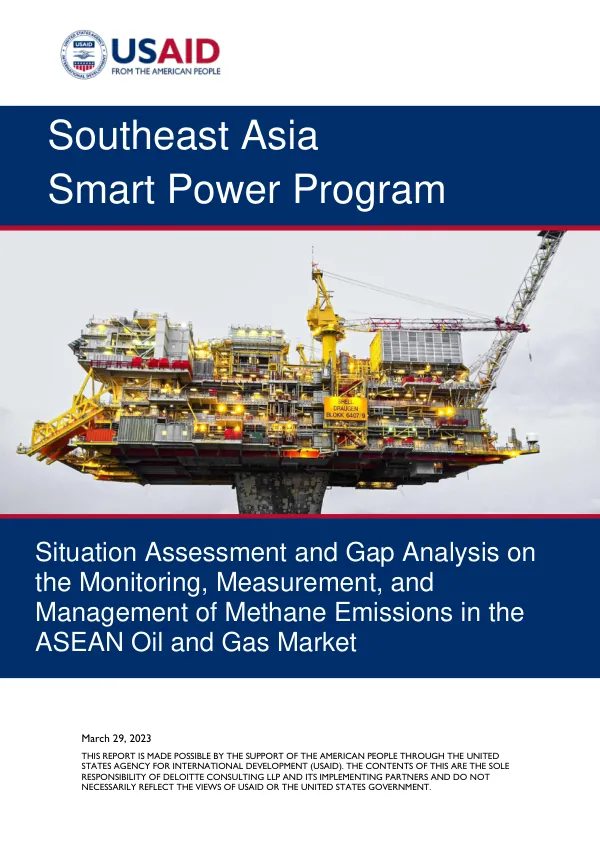
Situation Assessment and Gap Analysis on the Monitoring, Measurement, and Management of Methane Emissions in the ASEAN Oil and Gas Market
Open record 2017
2017USAID DEC