USAID DEC
Annual Program Performance Report for United States Agency for International Development, Office of Foreign Disaster Assistance
Sign inCONCERN WORLDWIDE INTERNATIONAL
Annual Program Performance Report for United States Agency for International Development, Office of Foreign Disaster Assistance
The Building a Better Response (BBR) project aims to strengthen the capacity of Non-Governmental Organization (NGO) personnel to engage with the international humanitarian architecture (IHA) in a manner that improves overall coordination and response to the needs of beneficiaries.
2012 · 19 pages
Sign in to readA free account is required to download.
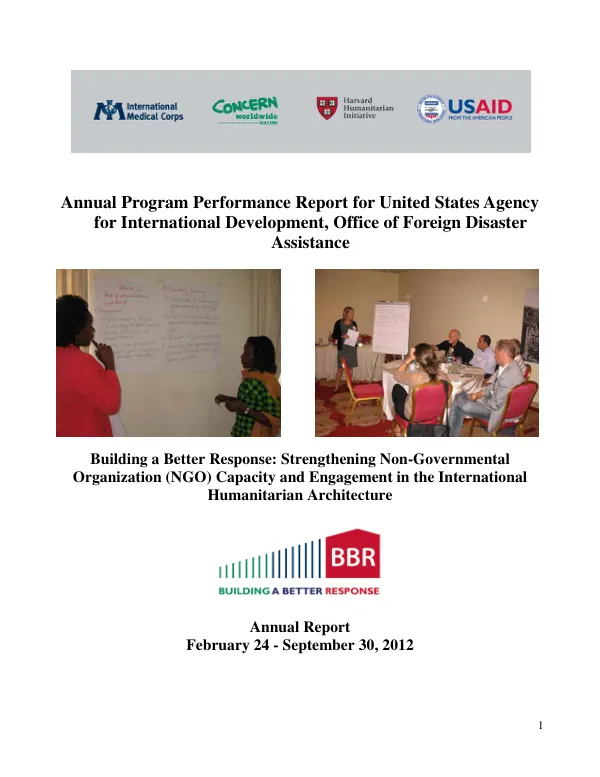
Abstract
The project is led by International Medical Corps (IMC) in partnership with Concern Worldwide and the Harvard Humanitarian Initiative (HHI). The BBR project began implementation in February 2012 and is funded by the United States Agency for International Development (USAID) through the Office of Foreign Disaster Assistance (OFDA) with a grant amount of $3,000,000.00. The project's goal is to build the capacity of NGO personnel to engage with the IHA through a consultative, multi-targeted training program. The program includes the production and dissemination of training tools that synthesize and strengthen existing learning. The content will be comprehensive and practical, as well as accessible and flexible for various categories of humanitarian practitioners. The program will also offer a certificate-based learning program on the IHA, which will enhance the professional development of NGO staff. The BBR project has made significant progress since its inception. The project has hosted NGO consultation meetings in eight countries, reaching 170 participants, and conducted individual interviews with 85 key stakeholders. An online survey was also distributed worldwide and taken by 243 individuals. The findings from these consultations have already begun to shape the curriculum development of the e-learning tool, and have created interest and buy-in from the international NGO community for the BBR project. The project has also made progress in the development of the e-learning tool. The Harvard Humanitarian Initiative has started the initial drafting of the first of the six BBR e-learning courses, which is being informed by the consultation process and by discussions with consortium partners. The online learning platform is being built out, and content will be added as the courses are reviewed and finalized. The BBR project has also made progress in the area of coordination. The number of organizations coordinating has increased from 51 in Quarter 1 to 160 in Quarter 2. The number of NGO staff members participating in consultation activities has also increased, from 340 in Quarter 1 to 431 in Quarter 2. The consultation process has been crucial in providing essential inputs into the curriculum development process, and has acted as a key means of increasing knowledge and understanding of the BBR project, ensuring critical buy-in from stakeholders and encouraging future adoption of the learning tool. The BBR project is expected to continue its progress in the second year of implementation, with extensive work on curriculum development, pilot testing, conducting of blended learning workshops, and roll-out of the BBR learning tools. The project aims to provide a cost-effective, far-reaching, and sustainable package to help increase the impact and effectiveness of NGOs within the humanitarian architecture.
Related documents
Documents in this collection
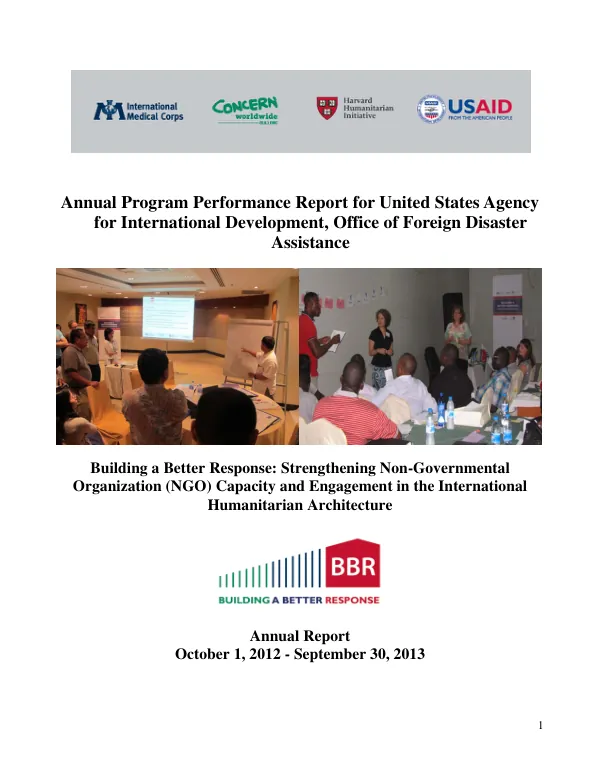 2013
2013USAID DEC
Annual Program Performance Report for United States Agency for International Development, Office of Foreign Disaster Assistance
Open record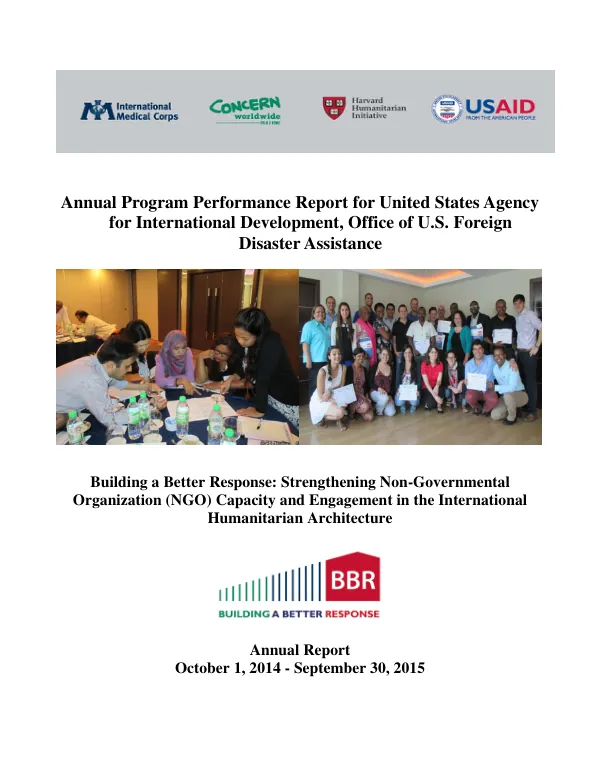 2015
2015USAID DEC