USAID DEC
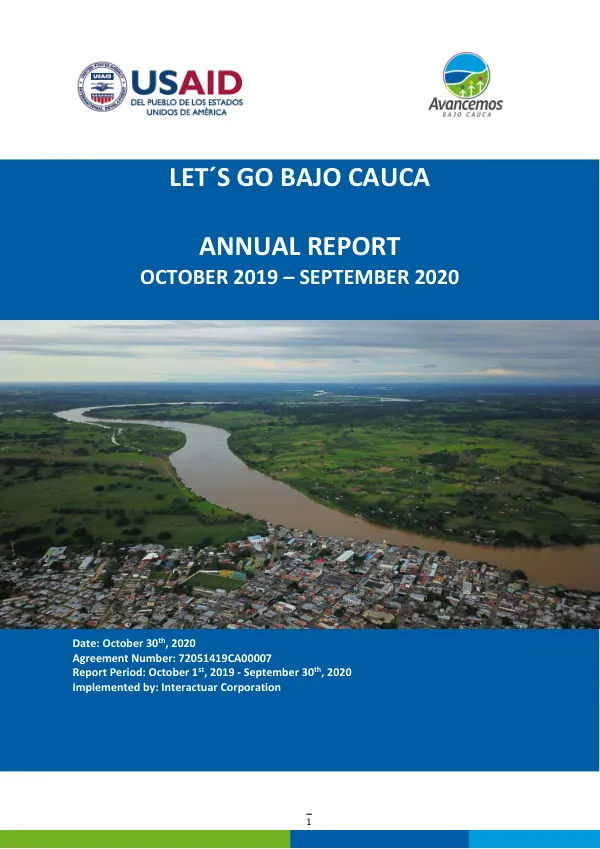
Annual Progress Report: Let's Go Bajo Cauca October 2019 – September 2020
The agricultural value chain strengthening component focused on providing technical support to agribusinesses, training, and strengthening them in specific techniques to increase efficiency and productivity.
2020 · 85 pages
Sign in to readA free account is required to download.
Abstract
Technical support was provided to beekeeping and fish farming associations, and commercial management strengthening activities were carried out with these associations. A new methodology for agribusiness training was developed, incorporating more didactic elements to adapt to the COVID-19 restrictions. The non-agricultural productive units' consultancy component successfully migrated to a 100% digital model, advising companies on their business model strengthening. Business structuring and growth stages intervention was implemented to strengthen businesses that were likely to go bankrupt or close. The commercial connections strategy allowed for the generation of relationships and deal closure with institutions in the sub-region, benefiting both Alliance member companies and external companies interested in participating in future calls. The credit and employability service components faced challenges due to the COVID-19 pandemic, resulting in a decrease in yearly planned outcomes. The closure of presential service offices affected the delivery of these services. Despite these challenges, the development of the Alliance's gender perspective strategy began, with the entire staff working on the adoption and appropriation of this approach in the different Alliance strategies. A Gender Perspective decalogue was drafted to serve as the basis for a communication campaign. The communications office played a crucial role in making the actions in the territory visible, consolidating different communication strategies into an effective media management. The results obtained during this period include consultancies to 341 beekeeping and fish farming agribusinesses and 10 associations, business development support to 94 non-agricultural production unit businesses, and credit placements for entrepreneurs in the region totaling 785 million pesos. A total of 1292 people from the six Bajo Cauca municipalities were assisted, with 61% being women and 39% young. The work plan was executed with 90% compliance, and the budget was executed with 73% compliance, totaling 3,431 million pesos. The employability route was entered by 642 people in the region, with 319 obtaining formal jobs. The gender and youth strategy application began, and new strategies were developed to respond to the challenges brought by the COVID-19 pandemic. The actions carried out in each component are described below, highlighting their achievements and challenges. The agricultural value chain strengthening component achieved significant results, including the provision of technical support to agribusinesses and the strengthening of commercial management activities. The non-agricultural productive units' consultancy component successfully adapted to the digital model, advising companies on their business model strengthening. The credit and employability service components faced challenges due to the pandemic, but the development of the Alliance's gender perspective strategy began, with a focus on adoption and appropriation of this approach in the different Alliance strategies. The communications office played a crucial role in making the actions in the territory visible, consolidating different communication strategies into an effective media management. The results obtained during this period demonstrate the Alliance's commitment to adapting to the challenges brought by the COVID-19 pandemic and continuing to deliver results in the territory.