USAID DEC
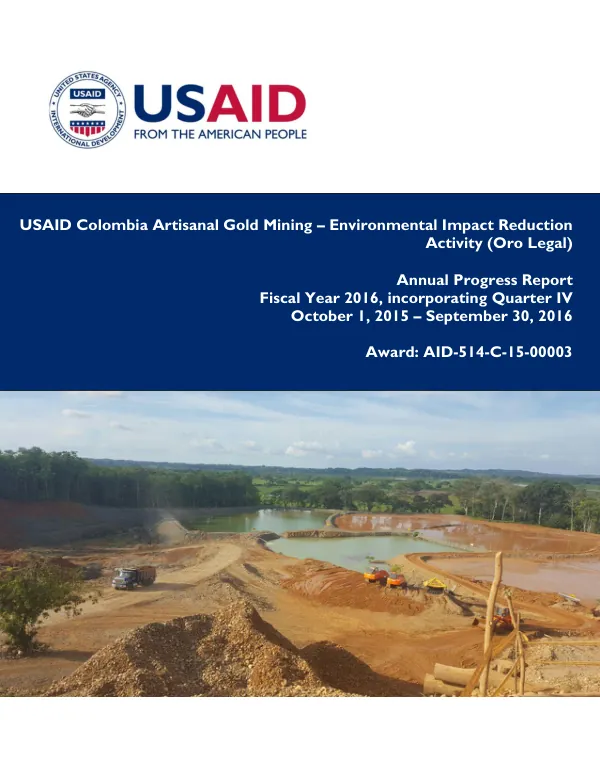
Annual Progress Report: USAID Colombia Artisanal Gold Mining – Environmental Impact Reduction Activity (Oro Legal)
Sign inCHEMONICS
Annual Progress Report: USAID Colombia Artisanal Gold Mining – Environmental Impact Reduction Activity (Oro Legal)
The Colombian Government's efforts to reduce the social and environmental impacts of artisanal gold mining activities are supported by the Artisanal Gold Mining Environmental Impact Reduction Activity (Oro Legal).
2016 · 34 pages
Sign in to readA free account is required to download.
Abstract
Implemented by Chemonics International, the five-year program aims to legalize and formalize illegal mining, build capacity, and promote sustainable alternatives. Oro Legal works closely with the Government of Colombia, non-governmental entities, communities, and the private sector to achieve its goals. During the 2016 fiscal year, Oro Legal made significant progress in its efforts to strengthen the Colombian Government's capacity to enforce gold mining legislation. The program closed the year with 32 mines legalized and 36 embarking on formalization, including a group of mines legalized under BioREDD+/Mining. A formalization protocol was developed in conjunction with the Ministry of Mines and Energy, consisting of 343 items over five technical areas. This will enable Oro Legal to establish a rigorous baseline, monitor progress, and quantify the movement of mining production units towards more responsible mining. Component II of the program worked to negotiate agreements to work on 3,878 hectares of degrading mining lands in Chocó and Antioquia, with legal, technical, and technical potential for rehabilitation. The component has established solid foundations to underpin the development of two alternative value chains: annatto and honey. These will provide viable alternatives to mining for some 1,000 families in Chocó and Antioquia, generating at least US$ 450 per month for each beneficiary. Oro Legal's operating context is characterized by a high degree of uncertainty, but the program's performance in FY1 augurs well for FY2 and beyond. The program's ability to adapt to changing circumstances and navigate complex relationships with stakeholders will be crucial in achieving its ambitious goals. The program's objectives are to build effective governance capacity for gold mining activities, strengthen the Colombian government's capacity to enforce gold mining legislation, enhance participation of artisanal gold miners and their associations in mining formalization programs, and provide technical assistance to artisanal miners. Key accomplishments during the quarter include developing good working relationships with stakeholders, including public sector bodies, the private sector, small mines, municipal governments, and Afro-Colombian communities. Oro Legal's relationships with the Ministry of Mines and Energy and the Mining Secretariat of the Government of Antioquia have been functional, but not particularly close. The program is expected to benefit from the imminent signing of an MOU between USAID and the MME, which will facilitate a more constructive dialogue between the parties. The program's progress in FY1 has been strong, with a significant increase in technical activity in both Component I and Component II. Expenditures during the last quarter totaled $X, bringing cumulative expenditures for the year to $Y, which exceeded the projected budget for FY1 by $Z. The program's financial performance is expected to continue to be strong in FY2 and beyond. Oro Legal has established a solid foundation for its future success, with a diverse group of stakeholders and a clear understanding of the challenges and opportunities facing the program. The program's ability to adapt to changing circumstances and navigate complex relationships with stakeholders will be crucial in achieving its ambitious goals.
Related documents