USAID DEC
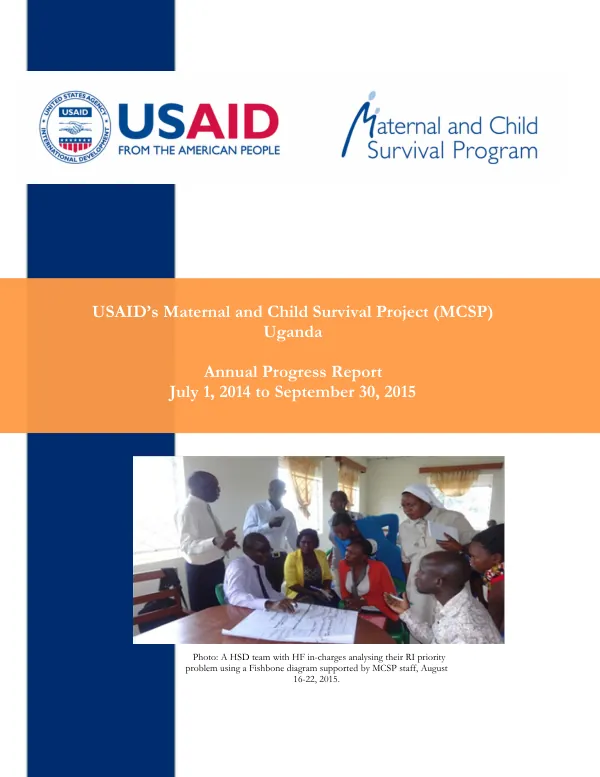
Annual Progress Report: USAID’s Maternal and Child Survival Program (MCSP) in Uganda
Sign inUNITED NATIONS CHILDREN'S FUND
Annual Progress Report: USAID’s Maternal and Child Survival Program (MCSP) in Uganda
The Uganda National Expanded Programme on Immunization (UNEPI) has been working to strengthen its routine immunization (RI) system through affordable, proven approaches.
2015 · 20 pages
Sign in to readA free account is required to download.
Abstract
The USAID Maternal and Child Survival Program (MCSP) in Uganda aims to support this effort by providing technical assistance to UNEPI and its partners. MCSP is a global cooperative agreement that introduces and supports high-impact health interventions in priority countries to end preventable child and maternal deaths. The immunization coverage in Uganda has remained in the range of 78-82% for DPT3 over the past five years, according to WHO and UNICEF estimates. However, the 2011 DHS indicated that approximately half of children (52%) aged 12-23 months were fully vaccinated, compared to 46% in 2006. Penta1/DPT1 coverage was estimated at 93%, suggesting strong demand for and initial use of immunization, but Penta3/DPT3 was at 71%, indicating a high dropout rate and suboptimal levels of protection from vaccine-preventable diseases. To address these concerns, the Ministry of Health (MOH)/UNEPI and its development partners prepared a two-year revitalization plan for immunization (2012-2014) addressing five immunization program areas: service delivery, vaccine supply and quality, logistics, data management, and communications. As part of USAID's contribution to implementing this plan, MCHIP provided technical assistance to strengthen UNEPI and operationalize the Reaching Every Child (REC) strategy, which includes the introduction of Quality Improvement (QI) elements. In 2014, USAID's MCSP was introduced to scale up MCHIP's work to five to ten additional districts and continue to provide technical support to UNEPI at the national level for five years. During the first full year of MCSP implementation in Uganda, immunization achievements can be summarized under each objective as follows. MCSP supported the MOH/UNEPI to review the national training manual in collaboration with other EPI partners. The national training manual for pre- and in-service health workers now includes the most recent EPI information, including proven REC-QI approach methodologies and tools. MCSP also supported the MOH/UNEPI, along with other partners, to write and process approval for the Uganda Immunization Policy in 2014. Additionally, MCSP supported printing of over 600 copies to facilitate MOH/UNEPI's dissemination of the Policy. MCSP supported the MOH/UNEPI to publish three quarterly newspaper pullouts that provide routine immunization (RI) performance feedback to districts, policymakers, public, and other stakeholders. This has proved to be a critical catalyst for mobilizing action towards improved immunization coverage. MCSP also conducted a National Training of Trainers course on the REC-QI approach and tools, providing training to 41 health workers and refresher training to 39 health workers from MOH/UNEPI, districts, and EPI partners. The MOH/UNEPI and partners, including MCSP, conducted a national combined EPI Review and used the findings to update the national Comprehensive Multi-Year Plan (cMYP) for Immunization. MCSP successfully completed the complete rollout of the REC-QI approach in five districts, focusing on building the capacity of health personnel to better manage routine immunization services. The districts showed improved performance in routine immunization, with some districts reversing declining trends. The MCSP also supported the MOH/UNEPI to conduct a national assessment of the immunization system, which identified areas for improvement and provided recommendations for strengthening the system. The assessment highlighted the need for improved data management, logistics, and communication systems to support the immunization program. MCSP is working with the MOH/UNEPI to implement the recommendations and improve the immunization system in Uganda. The MCSP has also supported the MOH/UNEPI to develop a plan to improve the quality of immunization services, including the introduction of quality improvement teams and the use of quality improvement tools. The plan aims to improve the quality of immunization services and increase vaccination coverage in Uganda. The MCSP is working with the MOH/UNEPI to implement the plan and improve the immunization system in Uganda. The MCSP has also supported the MOH/UNEPI to develop a plan to improve the logistics system for immunization, including the introduction of a new logistics management information system. The plan aims to improve the efficiency and effectiveness of the logistics system and increase vaccination coverage in Uganda. The MCSP is working with the MOH/UNEPI to implement the plan and improve the immunization system in Uganda. Overall, the MCSP has made significant progress in supporting the MOH/UNEPI to strengthen its routine immunization system in Uganda. The program has improved the capacity of health personnel, increased vaccination coverage, and improved the quality of immunization services. The MCSP will continue to work with the MOH/UNEPI to implement the recommendations of the national assessment and improve the immunization system in Uganda.
Related documents