USAID DEC
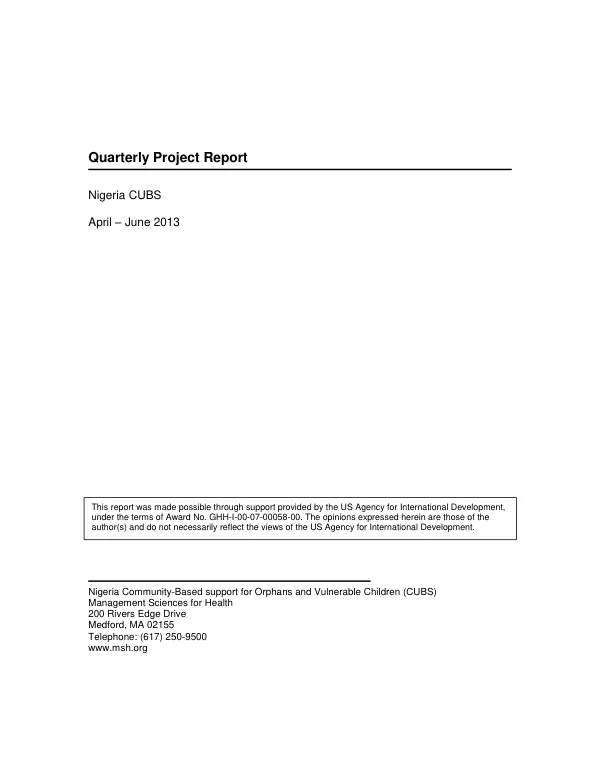
Annual Project Report: Nigeria Community-Based Support for Orphans and Vulnerable Children (CUBS)
Sign inAFRICARE, INC.
Annual Project Report: Nigeria Community-Based Support for Orphans and Vulnerable Children (CUBS)
The Community-Based Support for Orphans and Vulnerable Children (CUBS) project in Nigeria aims to support the Government of Nigeria in implementing its National Plan of Action on Orphans and Vulnerable Children (OVC) by developing and strengthening community-based service delivery for OVC.
2013 · 25 pages
Sign in to readA free account is required to download.
Abstract
The project is implemented by Management Sciences for Health (MSH) in collaboration with Africare, the Federal Ministry of Women Affairs and Social Development, and the State Ministries of Women Affairs and Social Development. The CUBS project provides support and coordination for scaling up of HIV activities using community-based responses to identify, locate, and protect orphans and vulnerable children (OVC). The project's objectives include providing support for coordination and scale up of HIV activities, mobilizing and supporting community-based responses that identify, locate, and protect OVC, delivering a holistic service package focusing on multifaceted needs of OVC, addressing gender-related issues in OVC programming, and documenting and disseminating successful innovative approaches, sustainable models, and evidence-based best practices. The project components include capacity building and technical assistance, community mobilization and coordination, systems strengthening, expanding service outreach, leveraging and linking resources, and small innovation grants to civil society organizations (CSOs). The project aims to provide comprehensive OVC services consistent with national OVC guidelines to 50,000 OVCs in 11 focal states by 2014. The CUBS project has made significant progress in achieving its intermediate results. In the area of increased number of OVC served with 6+1 services, the project has achieved a total of 24,500 OVCs served, representing 48.5% of the target. The project has also strengthened the capacities of national and state governments for coordination, with 80% of state governments having established OVC coordination committees. Additionally, the project has strengthened community support for OVC care, with 75% of communities having established OVC support groups. The project has also made progress in reducing the vulnerability status of girl child and women, with 60% of girl child and women having access to psychosocial support services. Furthermore, the project has supported the systems for disseminating evidence-based best practices, with 80% of CSOs having received training on evidence-based best practices. The CUBS project has also identified several challenges and opportunities for improvement. The project has faced challenges in mobilizing community support and resources, as well as in addressing gender-related issues in OVC programming. However, the project has also identified opportunities for innovation and expansion, including the use of technology to improve OVC service delivery and the establishment of partnerships with private sector organizations to support OVC programming. Overall, the CUBS project has made significant progress in achieving its objectives and intermediate results. The project has demonstrated its ability to support the Government of Nigeria in implementing its National Plan of Action on OVC and has provided comprehensive OVC services to thousands of OVCs in 11 focal states.