USAID DEC
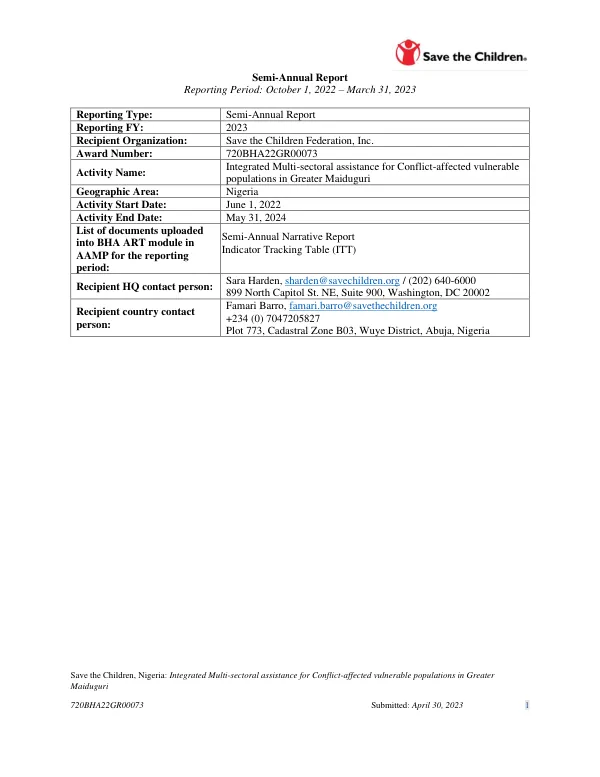
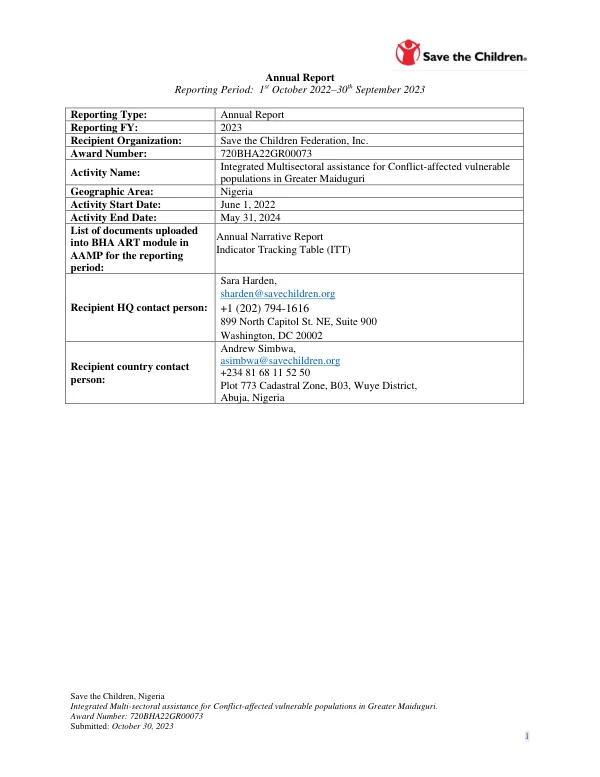
Annual Report: Integrated Multi-sectoral assistance for Conflict-affected vulnerable populations in Greater Maiduguri
Sign inSAVE THE CHILDREN FEDERATION/US
Annual Report: Integrated Multi-sectoral assistance for Conflict-affected vulnerable populations in Greater Maiduguri
The Integrated Multi-sectoral assistance for Conflict-affected vulnerable populations in Greater Maiduguri, implemented by Save the Children, Nigeria, aimed to provide comprehensive support to vulnerable populations in the region.
2023 · 124 pages
Sign in to readA free account is required to download.
Abstract
The program, funded by the Bureau of Humanitarian Assistance (BHA), was launched in June 2022 and is set to conclude in May 2024. The geographic area of focus is Greater Maiduguri, with a primary focus on Internally Displaced Persons (IDPs) and host communities. The program's overall performance is measured through various indicators, including food security, nutrition, protection, and economic recovery. Sector 1, Food Assistance, provided emergency food assistance to over 10,000 individuals, while Sector 2, Economic Recovery and Market Systems (ERMS), supported the establishment of Village Savings and Loan Associations (VSLAs) and provided training on entrepreneurship and business management. Sector 3, Village Savings and Loan Association (VSLA), established 20 VSLAs, reaching over 1,000 members, and Sector 4, Multipurpose Cash Assistance (MPCA), provided cash assistance to over 5,000 individuals. The program also focused on nutrition, with Sector 5, Nutrition, implementing the Management of Acute Malnutrition (MAM) program, which reached over 2,000 children under five. Sector 6, Protection, provided psychosocial support to over 3,000 individuals, while Sector 7, Water, Sanitation and Hygiene (WASH), constructed water points and latrines, benefiting over 5,000 individuals. Sector 8, Shelter and Settlement, provided shelter assistance to over 1,000 individuals, and Sector 9, Health, provided primary health care services to over 10,000 individuals. Participation and Accountability to Affected Populations (AAP) was a key component of the program, with community feedback mechanisms in place to ensure that the needs and concerns of affected populations were addressed. Risk Management was also a critical aspect of the program, with measures in place to mitigate potential risks and ensure the safety of staff and beneficiaries. Coordination with other humanitarian actors was also essential, with the program working closely with other organizations to ensure a coordinated response to the needs of affected populations.