USAID DEC
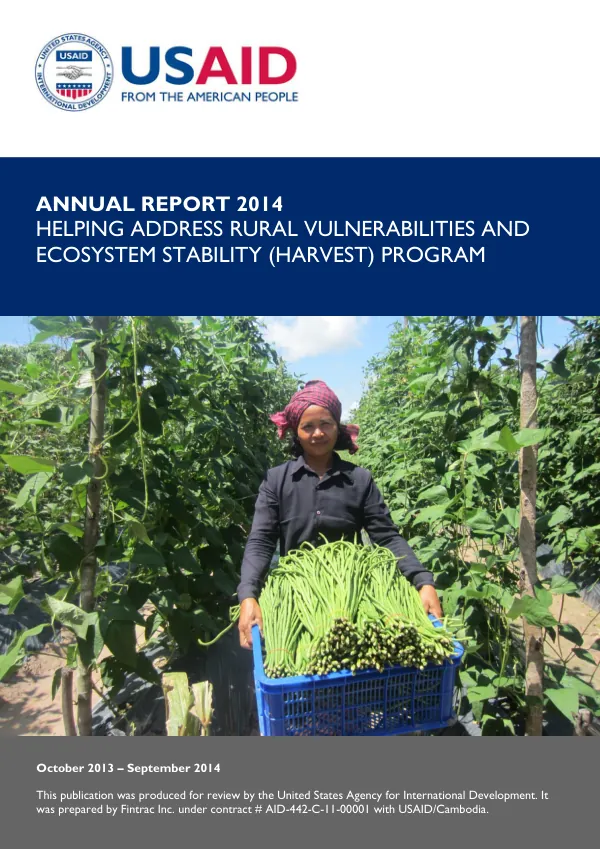
Annual Report 2014: Helping Address Rural Vulnerabilities and Ecosystem Stability (HARVEST) Program
Sign inFINTRAC
Annual Report 2014: Helping Address Rural Vulnerabilities and Ecosystem Stability (HARVEST) Program
Cambodia HARVEST is a five-year food security program focused on increasing incomes for 70,000 rural Cambodian households as part of the United States Feed the Future and Global Climate Change initiatives.
2014 · 105 pages
Sign in to readA free account is required to download.
Abstract
The program expanded its reach this year to include thousands of new households, adding 10,873 demonstration clients as it transitioned to Phase 2 and began implementing USAID's scaling up initiative. A new survey found that more than 7,000 farmers who are not direct clients are replicating the program's good agricultural practices on their land, a sign of the program's growing influence. Clients and farmer beneficiaries in rice, horticulture, and aquaculture continued to see impressive productivity and sales increases, strengthening food security in their communities and improving the living standards of their families. Nutrition activities increased dietary diversity at the household level and improved the health of vulnerable children, while new village-based groups used an innovative, community-focused approach that strengthened food security and nutrition and spurred micro-enterprise development. Nearly a million hectares of land continued to benefit from better conservation and management, including watersheds that are a vital source of food security and protected areas that are home to globally significant biodiversity. The program's highlights this year include 30,238 rice farmers harvesting their wet- and dry-season crops, resulting in yield increases of 50 percent and income increases of 60 percent over baseline. Fish hatcheries have increased their fingerling productivity by 457 percent and their incremental sales by 660 percent over baseline. More than half of the 14,276 farmers who have attended at least three training events have adopted Cambodia HARVEST's good agricultural practices, expanding the program's impact far beyond its client base. Additionally, 400 input suppliers have increased their revenues by 70 percent over baseline, and 21,337 people have learned about growth monitoring, leading to substantial improvements in child nutrition and health. The program is working to increase the availability of food in order to meet the everyday dietary needs of Cambodians. Highlights include 99,098 farmers and others applying new technologies or management practices, 125 percent above the total program target of 44,100. Additionally, 37,715 hectares are under improved technologies or management practices, 75 percent more than the total program target of 21,600. The dietary diversity of women of reproductive age improved from an average of 4.6 food groups consumed to 5.6, out of the total program target of six food groups. The program is also strengthening the ability of Cambodians to generate income through economic activities to increase their capacity to purchase food. Highlights include $8.75 million in incremental sales collected at the farm level this year from rice, horticulture, and aquaculture, bringing the total to $13.96, 216 percent of the cumulative target of $6.47 million and 133 percent of the total program target of $10.5 million. Additionally, $5.07 million in incremental sales were collected at the small- and medium-sized enterprise levels this year, including rice millers and input suppliers, bringing the total to $9.57 million, meeting the total program target of $9.5 million. The program is working to protect the country's globally significant natural resources, which are an essential source of economic activity and food security for Cambodians. Highlights include 947,878 hectares now under improved natural resource management, more than double the total program target of 444,910. Additionally, 27,874 people have received training in natural resources management and/or biodiversity conservation, exceeding the total program target of 27,000. Cambodia HARVEST is strengthening the capacity of Cambodians to manage and resolve challenges related to food security and global climate change. Highlights include 36 climate change mitigation tools, technologies, and methodologies developed, tested, and/or adopted, 13 percent above the total program target of 32. Additionally, 31,815 stakeholders have increased their capacity to adapt to the effects of climate variability and change, reaching the expected annual target and 70 percent of the total program target of 45,500.