USAID DEC
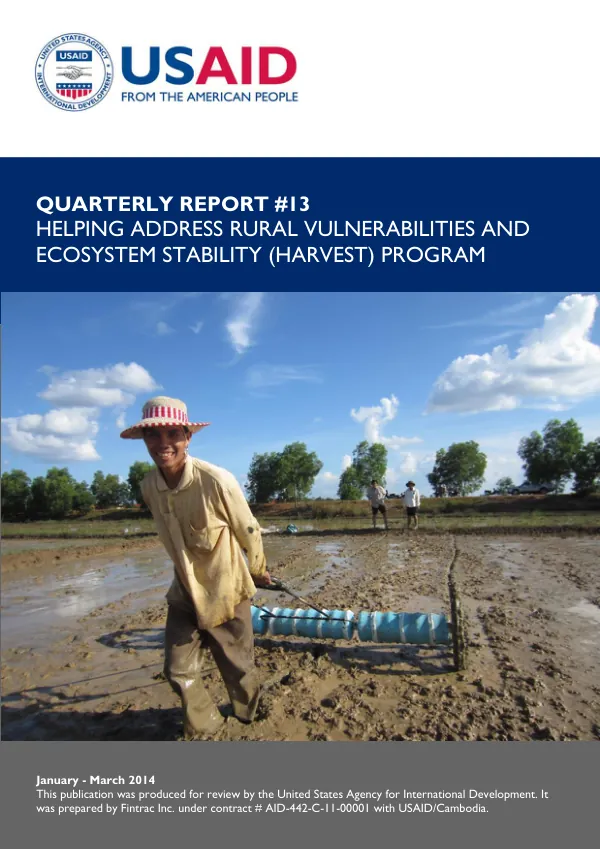
Quarterly Report #13: Helping Address Rural Vulnerabilities and Ecosystem Stability (HARVEST) Program
Sign inFINTRAC
Quarterly Report #13: Helping Address Rural Vulnerabilities and Ecosystem Stability (HARVEST) Program
Cambodia HARVEST is a five-year food security program focused on increasing incomes for 70,000 rural Cambodian households as part of the United States Feed the Future and Global Climate Change initiatives.
2014 · 78 pages
Sign in to readA free account is required to download.
Abstract
The program aims to increase food availability, access, and utilization, as well as enhance the capacity of public, private, and civil society to address food security and climate change. During the January-March 2014 quarter, Cambodia HARVEST completed the selection of Phase 2 demonstration clients and began implementing related field activities. Phase 2 will run for the remaining two years of the program and reach 7,373 demonstration clients in agriculture, aquaculture, fisheries, natural resource management, and nutrition. These activities will build on the exceptional results achieved during Phase 1 of the program, when farmers dramatically increased their productivity and sales; households consumed more diversified, nutrient-rich diets; and thousands of hectares of land benefitted from improved management and protection. The program has made significant progress in increasing food availability. A total of 37,063 farmers have applied new technologies or management practices, exceeding the targeted 36,000 and on track to meet or exceed the total program target of 44,100. Additionally, 15,130 hectares are under improved technologies or management practices, exceeding the current cumulative target of 14,000 and 70 percent of the total program target of 21,600. The dietary diversity of women of reproductive age has also improved, with an average of 5.5 food groups consumed, out of the total program target of six food groups consumed from Feed the Future's nine foods essential to dietary diversity. Cambodia HARVEST has also strengthened the ability of Cambodians to generate income through economic activities. The program linked 109 horticulture clients with 36 district- and provincial-level vegetable buyers, resulting in 114 metric tons of new sales worth $35,788. To date, these linkages have resulted in 496 metric tons of new sales worth $162,518. The program has also collected $10.2 million in incremental sales at the farm level from rice, horticulture, and aquaculture, exceeding the cumulative target of $7 million and 97 percent of the total program target of $10.5 million. In addition, the program has made significant progress in natural resource management and resilience to climate change. A total of 25,694 people have received training in natural resource management or biodiversity conservation, exceeding the current cumulative target of 23,000 and 95 percent of the total program target of 27,000. The program has also developed, tested, or adopted 33 climate change mitigation tools, technologies, and methodologies, exceeding the total program target of 32. Overall, Cambodia HARVEST has made significant progress in achieving its objectives and is on track to meet or exceed its targets. The program's activities have resulted in increased food availability, access, and utilization, as well as enhanced the capacity of public, private, and civil society to address food security and climate change.