USAID DEC
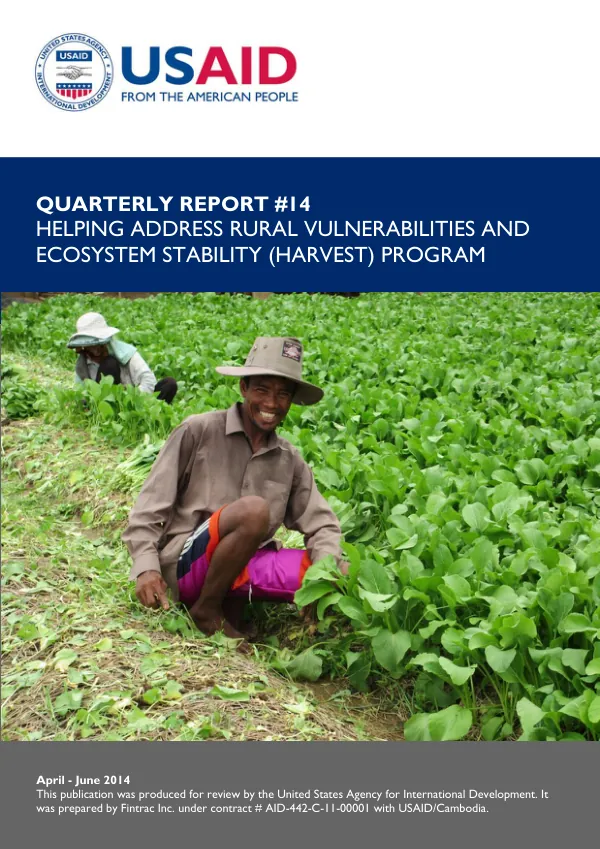
Quarterly Report #14: Helping Address Rural Vulnerabilities and Ecosystem Stability (HARVEST) Program
Sign inFINTRAC
Quarterly Report #14: Helping Address Rural Vulnerabilities and Ecosystem Stability (HARVEST) Program
Cambodia HARVEST is a five-year food security program focused on increasing incomes for 70,000 rural Cambodian households as part of the United States Feed the Future and Global Climate Change initiatives.
2014 · 80 pages
Sign in to readA free account is required to download.
Abstract
The program's fourteenth quarterly report highlights major achievements and activities for the period of April-June 2014. Cambodia HARVEST undertook several initiatives to expand its activities, including selecting 2,000 additional commercial horticulture clients in 160 new villages and hiring new program personnel to implement these activities. The program also selected an initial group of 13 recipients for Public-Private Alliance funds that will strengthen the overall agribusiness sectors of rice, horticulture, and aquaculture. The program's successes in important areas are reflected in new data collected this quarter. A replication survey found that thousands of farmers who are not receiving direct assistance are adopting Cambodia HARVEST's techniques, indicating that the program's impact reaches far beyond its client base. Additionally, the program has helped rangers in the Central Cardamoms become more effective at monitoring and patrolling, fish hatcheries become more productive, input suppliers increase their sales, and non-timber forest product groups become more profitable. Key highlights this quarter include: - Program-supported farmers and agribusinesses generated $3.1 million in incremental sales. - All 6,026 dry-season rice farmers completed their harvests, resulting in yield increases of 37 percent, income increases of 55 percent, and sales increases of $904,000. - 2,056 directly assisted commercial horticulture clients increased their productivity by 310 percent, resulting in income increases of 304 percent. - 6,462 directly assisted household vegetable clients saw yield increases of 355 percent and income increases of 367 percent. - 12 client fish hatcheries have to date increased their productivity by 431 percent and are producing larger and higher-quality fingerlings. - 55 percent of the 14,200 farmers who attended at least three training events in rice and horticulture – but are not receiving direct assistance – have replicated the program's techniques on their own land. - 10,020 program farmers have to date adopted crop diversification, leading to increased productivity, fewer pests and diseases, and improved resilience to climate change. - 14,723 people have to date learned about growth monitoring, leading to substantial improvements in child nutrition. - 38 non-timber forest product groups have to date increased their sales by 369 percent, resulting in profit increases of 490 percent. - Rangers at the Central Cardamoms Protected Forest have increased their effectiveness by 31 percent, according to a World Bank assessment tool. Cambodia HARVEST is working to increase the availability of food to meet the everyday dietary needs of Cambodians. Key highlights include: - 49,630 farmers have applied new technologies or management practices, 13 percent above the total life of the program target of 44,100. - 21,020 hectares are under improved technologies or management practices, 97 percent of the total life of the program target of 21,600. - The dietary diversity of women of reproductive age improved from an average of 4.6 food groups consumed to 5.6, out of the total program target of six food groups consumed from Feed the Future's nine foods essential to dietary diversity. The program is strengthening the ability of Cambodians to generate income through economic activities to increase their capacity to purchase food. Key highlights include: - Cambodia HARVEST linked 307 horticulture clients with 81 district- and provincial-level vegetable buyers this quarter, resulting in 147 metric tons of new sales worth $40,803. - $12.1 million in incremental sales have been collected at the farm level from rice, horticulture, and aquaculture, 15 percent above the total life of the program target of $10.5 million. - $8 million in incremental sales have been collected at the small- and medium-sized enterprise levels, 114 percent of the cumulative target of $7 million and 84 percent the total program target of $9.5 million. The program is working to protect the country's globally significant natural resources, which are an essential source of economic activity and food security for Cambodians. Key highlights include: - 27,084 people have received training in natural resource management or biodiversity conservation, exceeding the total life of the program target of 27,000. - 947,878 hectares in areas of biological significance are under improved management, more than double the total life of the program target of 444,910. Cambodia HARVEST is strengthening the capacity of Cambodians to manage and resolve challenges related to food security and global climate change. Key highlights include: - 36 climate change mitigation tools, technologies, and methodologies have been developed, tested, or adopted, 13 percent above the total program target of 32. - 22,722 stakeholders have increased their capacity to adapt to the effects of climate variability and change, 126 percent of the cumulative