USAID DEC
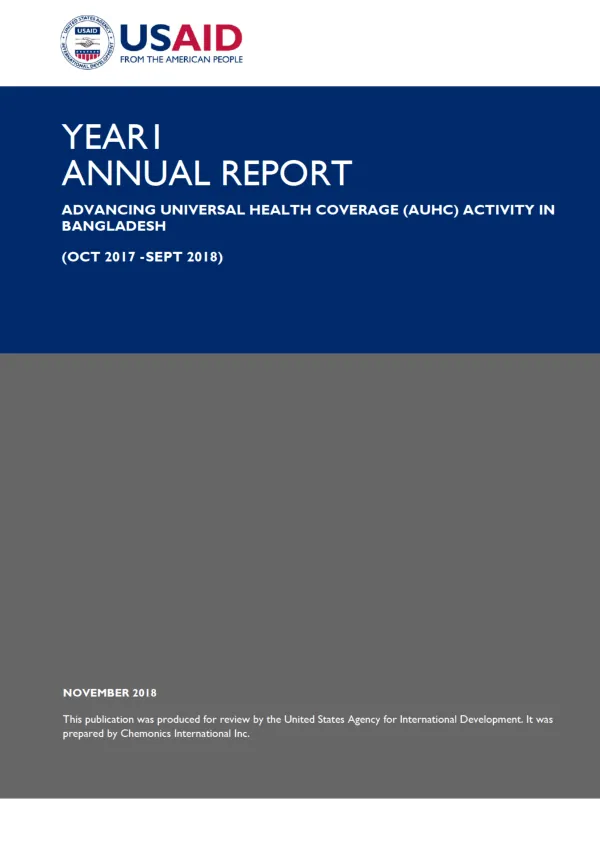
Annual Report: Advancing Universal Health Coverage (AUHC) Activity in Bangladesh (Oct 2017-Sept 2018)
Sign inCHEMONICS
Annual Report: Advancing Universal Health Coverage (AUHC) Activity in Bangladesh (Oct 2017-Sept 2018)
Advancing Universal Health Coverage (AUHC) Activity in Bangladesh began in October 2017 and concluded in September 2018.
2018 · 57 pages
Sign in to readA free account is required to download.
Abstract
The program aimed to improve access to and quality of essential health services for the poor and vulnerable populations in Bangladesh. The USAID/Bangladesh office sponsored the activity, with Chemonics International Inc. as the primary contractor and several local partners, including Ad Din, Green Delta, Population Services International (PSI), and ThinkWell LLC. The program focused on five key results: transforming the Smiling Sun Network into a centrally managed, sustainable private social enterprise; expanding access to and uptake of the essential service package; developing sustainable financial systems to facilitate expanded coverage and ensure equitable access to health services; improving the quality of care; and drawing improved program strategies from lessons learned. The program's geographic focus was on Bangladesh, with a specific emphasis on the poor and vulnerable populations. The Smiling Sun Network was transformed into a centrally managed single entity, known as the Surjer Hashi Network (SHN), which became a sustainable private social enterprise. The SHN implemented standardized corporate operating systems, including electronic management information systems, health network quality improvement systems, and electronic medical records. The network also improved its financial sustainability and cost efficiency through a business strategy that focused on value-based payments. The program expanded access to and uptake of the essential service package, which included maternal health, tuberculosis, eye care, nutrition, family planning, and other essential services. The SHN referral system and satellite and CSP assessment were also implemented to improve service delivery. The program also increased informed demand for essential services through social behavior change communication. The program developed sustainable financial systems to facilitate expanded coverage and ensure equitable access to health services. Subsidy funding was operationalized to cover the poor, and a prepayment/insurance package was developed and made available. The program also secured an optimal client mix to balance financial sustainability and the pro-poor mandate. The program improved the quality of care through several initiatives, including improved customer experience, continual quality improvement systems, and staff satisfaction and motivation schemes. The program also implemented adverse event reporting and service delivery tools to improve quality of care. The program drew improved program strategies from lessons learned through research, analysis, and documentation. The program captured learning through documentation, research, and analysis, and applied this learning to activities. The program also developed a learning framework to support the development of the electronic medical record and management information system. Overall, the AUHC Activity in Bangladesh made significant progress in improving access to and quality of essential health services for the poor and vulnerable populations in Bangladesh. The program's achievements in transforming the Smiling Sun Network, expanding access to essential services, developing sustainable financial systems, improving quality of care, and drawing improved program strategies from lessons learned demonstrate its commitment to advancing universal health coverage in Bangladesh.