POPULATION SERVICES INTERNATIONAL/DKT INTERNATIONAL
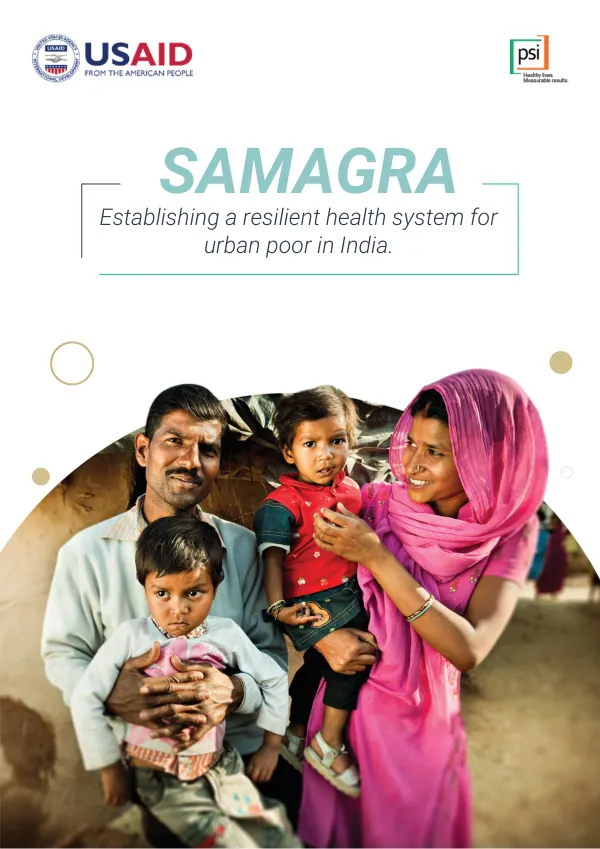
Samagra: Establishing a Resilient Health System for Urban Poor in India
Urbanization in India is rapidly increasing, with the country expected to be more urban than rural by 2046.
2021 · 4 pages
Sign in to readA free account is required to download.
Abstract
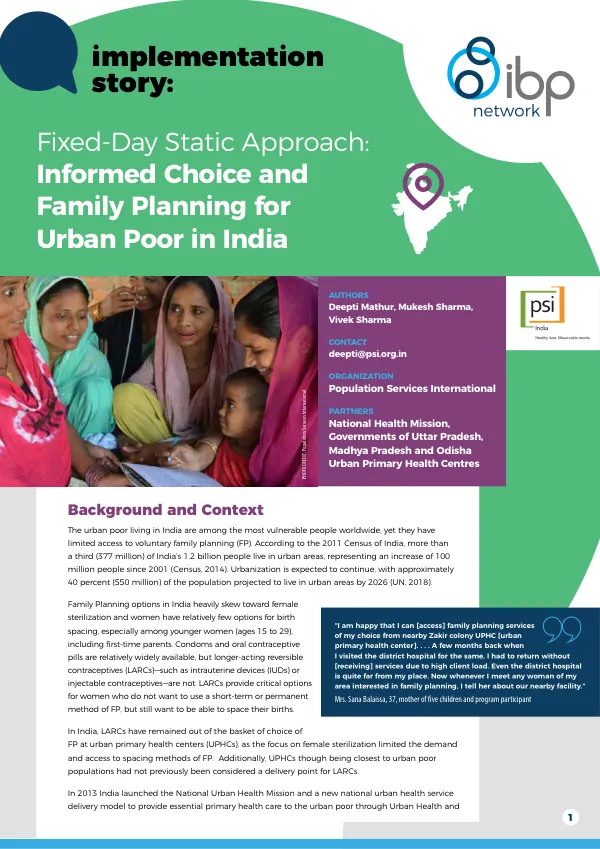
This shift has put significant pressure on urban governance systems, resulting in large gaps in the provision of basic amenities such as housing, drinking water, sewerage, and access to health services. The urban poor are disproportionately affected, with conditions in slums often unfit for human habitation. As a result, inhabitants suffer from a poor quality of life, and universal health coverage remains an unfinished agenda. The urban poor in India face numerous health challenges, including a lack of access to affordable and quality healthcare, high unmet need for family planning, limited access to immunization, and low quality of maternal care. Malnutrition among children is also a significant concern, as is the increased vulnerability to communicable diseases such as tuberculosis (TB), multi-drug resistant TB (MDR-TB), and non-communicable diseases (NCDs). Social exclusion of certain vulnerable groups and limited access to clean drinking water and poor sanitation further exacerbate these issues. The social determinants of health play a critical role in shaping the health outcomes of the urban poor. Key challenges include limited access to quality education, job insecurity among informal workers, complex governance systems, unplanned expansion of cities, and a lack of access to safe drinking water facilities. Gender-based violence, reproductive health issues, and urbanization are also significant concerns. The Samagra project aims to establish a resilient health system for the urban poor in India. Funded by USAID, the project seeks to construct a model for urban health by applying user-centric approaches to improve primary health outcomes in urban India. The long-term vision of Samagra is to be a one-stop-solution centre/resource centre on urban health in India. The project's objectives include improving access to affordable quality primary health services, addressing barriers related to social determinants of health, promoting gender equality, improving governance for urban health, and reducing out-of-pocket expenditure. Samagra is currently operational in five cities in India, with plans to scale up to 50 cities in the next five years. The project will operate as an accelerator hub, building upon evidence-based approaches with local implementing partners. It will scale proven interventions that increase demand for reproductive, maternal, newborn, child, and adolescent health (RMNCH+A), TB, and COVID-19 information, products, and services. The project will also embed high-impact interventions in urban health programs, such as Smart City, Ayushman Bharat, and National Health Mission. To achieve its objectives, Samagra will use innovative solutions to transform traditional approaches. It will incubate solutions addressing social determinants of health, such as gender-based violence, air pollution, water, sanitation, and hygiene (WASH), and malnutrition. The project will also provide technical assistance at the national, state, and city levels for strengthening urban health systems. Comprehensive primary health care (CPHC) service delivery will be improved by strengthening the urban primary health centre (UPHC) - health and wellness centers and referral systems. Public and private sector partnerships will be leveraged, and departments focused on social determinants of health will be engaged. Academia and think tanks involved in improving urban governance for efficient delivery of primary health care will also be involved.