USAID DEC
Index testing innovations in complex settings: Lessons from the Democratic Republic of the Congo
Sign inPATH
Index testing innovations in complex settings: Lessons from the Democratic Republic of the Congo
The Integrated HIV/AIDS Project in Haut Katanga and Lualaba, funded by PEPFAR, aims to achieve epidemic control in the Democratic Republic of the Congo.
2019 · 9 pages
Sign in to readA free account is required to download.
Abstract
The project operates in 16 health zones across two provinces, providing comprehensive HIV services. Initial assessments identified complexities in finding HIV-positive individuals, with a yield of 4.1% from April through June 2017, and 4.9% in Lualaba compared to 3.8% in Haut Katanga. To improve facility-level case finding and increase testing efficiency, IHAP-HK/L introduced index case testing in June 2017. This approach involves testing the partners and children of HIV-positive individuals to identify new cases. From July 2017 through May 2018, 2,419 individuals were tested, with 26.6% testing HIV-positive. All 645 people who tested HIV-positive were enrolled on treatment. The yield varied by province, with Lualaba showing a higher yield of 30.8% compared to Haut Katanga's 23.5%. Facility-based index case testing results showed a steady increase in yield over time, from 16.9% in July 2017 to 27.8% in April-May 2018. The project also expanded HIV testing services at community-level, including PoDi+ sites and PLHIV support groups. In June 2018, 5,377 people were tested, with 427 testing HIV-positive (7.9%). Index case testing results showed that more biological children than sexual partners were tested, but a higher percentage of HIV-positive people were identified among sexual partners of PLHIV. Promising solutions for reaching partners of HIV-positive individuals include rolling out assisted partner notification through peer educators, expanding provision of HIV testing services at PoDi+ sites and PLHIV support groups, and intensifying targeted home-based testing. These approaches have shown promising results, with 5.1% seropositivity at PoDi+ sites and 13.8% at PLHIV support groups from April through June 2018. The project has also received support from various organizations, including the National Program for the Fight against HIV/AIDS, PEPFAR, USAID/Democratic Republic of Congo, World Health Organization, and PATH.
Related documents
Documents in this collection
 2014
2014USAID DEC
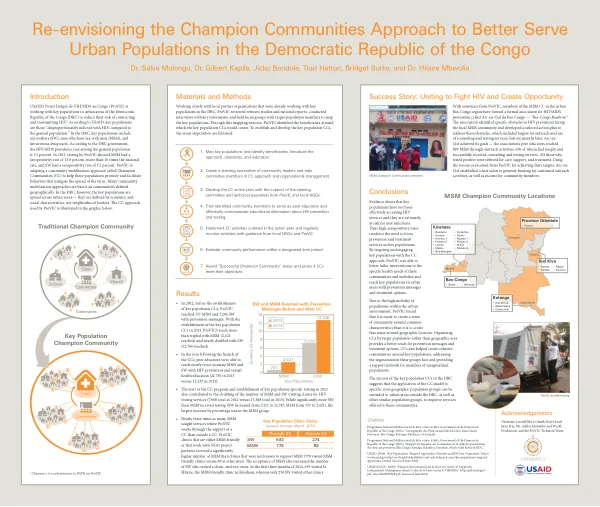
Re-envisioning the Champion Communities Approach to Better Serve Urban Populations in the Democratic Republic of the Congo
Open record 2014
2014USAID DEC