USAID DEC
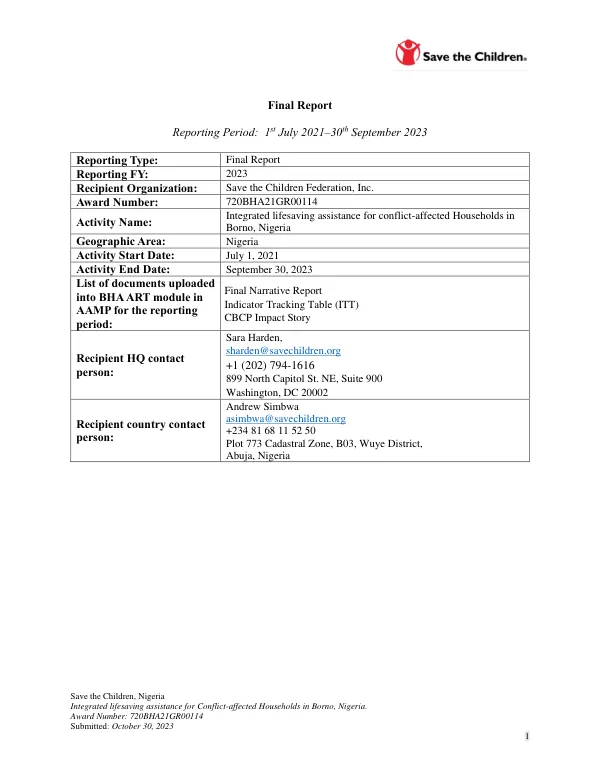
Final Report: Integrated lifesaving assistance for Conflict-affected Households in Borno, Nigeria
Sign inSAVE THE CHILDREN FEDERATION/US
Final Report: Integrated lifesaving assistance for Conflict-affected Households in Borno, Nigeria
The Integrated Lifesaving Assistance for Conflict-affected Households in Borno, Nigeria program is a humanitarian initiative funded by USAID's Bureau for Humanitarian Assistance (BHA).
2023 · 27 pages
Sign in to readA free account is required to download.
Abstract
The program aimed to provide lifesaving assistance to vulnerable households in four critical conflict-affected areas in Borno state: Jere, Konduga, Mafa, and MMC LGAs. The program was implemented by Save the Children (SC) in collaboration with two local partners, Ekklesiyar Yan'uwa a Nigeria (EYN) and Green Concern for Development (Greencode). Food assistance was provided to 49,230 households, comprising 308,684 individuals, with 143,317 males and 165,367 females. The assistance was delivered through unconditional restricted e-vouchers, which enabled households to purchase essential food items. Additionally, a subset of households received income-generating activity (IGA) assistance to help them generate monthly income and meet their food needs. The program also implemented water, sanitation, and hygiene (WASH) activities directly within program locations, while coordinating with other implementing partners to avoid duplication and ensure a holistic package for vulnerable households. Protection activities were also implemented to support the well-being of vulnerable households. The program's objectives were to provide survival food needs, clean water, nutrition, and protection services to vulnerable households. The program's activities were designed to support households in transitioning off food assistance and becoming self-sufficient. The program's achievements demonstrate its effectiveness in providing lifesaving assistance to vulnerable households in Borno state. The program's implementation was marked by several key interventions, including the provision of unconditional restricted e-vouchers, income-generating activity (IGA) assistance, WASH activities, and protection services. These interventions were designed to address the complex needs of vulnerable households and support their transition to self-sufficiency. The program's achievements were significant, with 49,230 households receiving food assistance and 308,684 individuals benefiting from the program. The program's impact was also evident in the provision of WASH services, which improved the health and well-being of vulnerable households. The program's protection activities also contributed to the well-being of vulnerable households, particularly women and children. The program's success was due to the effective collaboration between SC and its local partners, EYN and Greencode. The program's implementation was also facilitated by the coordination with other implementing partners, which ensured a holistic package of services for vulnerable households. The program's achievements demonstrate its effectiveness in providing lifesaving assistance to vulnerable households in Borno state. The program's impact was also evident in the improvement of food security indicators, with households receiving food assistance showing significant improvements in their food consumption scores. The program's protection activities also contributed to the reduction of gender-based violence and other forms of exploitation. Overall, the Integrated Lifesaving Assistance for Conflict-affected Households in Borno, Nigeria program was a critical humanitarian initiative that provided lifesaving assistance to vulnerable households in Borno state. The program's achievements demonstrate its effectiveness in addressing the complex needs of vulnerable households and supporting their transition to self-sufficiency.
Related documents