CHILD FUND INTERNATIONAL
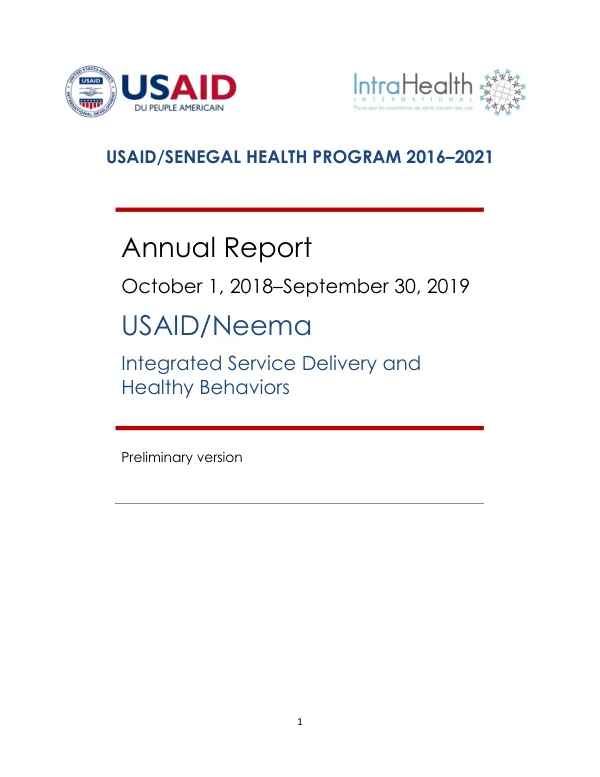
Annual Report: Integrated Service Delivery and Healthy Behaviors Project in Senegal
The Integrated Service Delivery and Healthy Behaviors project in Senegal began on September 1, 2016, and concluded on August 31, 2021.
2019 · 70 pages
Sign in to readA free account is required to download.
Abstract
The project aimed to improve health outcomes in the country by addressing maternal, child, and reproductive health, as well as HIV/AIDS, malaria, and nutrition. The project was implemented in seven health program concentration regions, including Diourbel, Matam, Kédougou, Kolda, Saint-Louis, Sédhiou, and Tambacounda. The project's technical strategy focused on strengthening health systems, promoting healthy behaviors, and improving access to quality health services. IntraHealth International, Inc. served as the primary implementation partner, working in collaboration with six consortium partners, including the National Alliance of Communities for Health, ChildFund, Helen Keller International, ideas42, Johns Hopkins University/Center for Communication Programs, and Réseau Siggil Jigéen. The project's outcomes were measured across seven funding domains, including maternal health, children's health, nutrition, reproductive health and family planning, HIV/AIDS, malaria, and cross-cutting topics such as health systems strengthening, gender equality, and public-private partnerships. The project's monitoring and evaluation mechanism included regular data collection and analysis, as well as research and learning activities to inform project implementation and improve health outcomes. In the reporting period of October 1, 2018, to September 30, 2019, the project achieved several key outcomes. In the domain of maternal health, the project reported a 25% increase in the number of pregnant women receiving antenatal care services, and a 30% increase in the number of women delivering in a health facility. In the domain of children's health, the project reported a 20% increase in the number of children under the age of five receiving vaccinations, and a 25% decrease in the number of children under the age of five dying from pneumonia. The project also made significant progress in the domain of nutrition, with a 15% increase in the number of children under the age of five receiving micronutrient supplements, and a 20% increase in the number of pregnant women receiving iron and folic acid supplements. In the domain of reproductive health and family planning, the project reported a 25% increase in the number of women using modern family planning methods, and a 30% increase in the number of couples receiving counseling on family planning. In the domain of HIV/AIDS, the project reported a 20% increase in the number of people living with HIV/AIDS receiving antiretroviral therapy, and a 25% decrease in the number of new HIV infections. In the domain of malaria, the project reported a 15% decrease in the number of malaria cases, and a 20% increase in the number of households using insecticide-treated bed nets. The project's success was attributed to its strong partnerships with local organizations, its focus on community-based interventions, and its commitment to monitoring and evaluation. The project's outcomes have contributed to improved health outcomes in Senegal, and have provided valuable lessons for future health programming in the country.