USAID DEC
Strengthening the Prevention and Management of Acute Malnutrition in Senegal’s Matam Region
Sign inACTION CONTRE LA FAIM
Strengthening the Prevention and Management of Acute Malnutrition in Senegal’s Matam Region
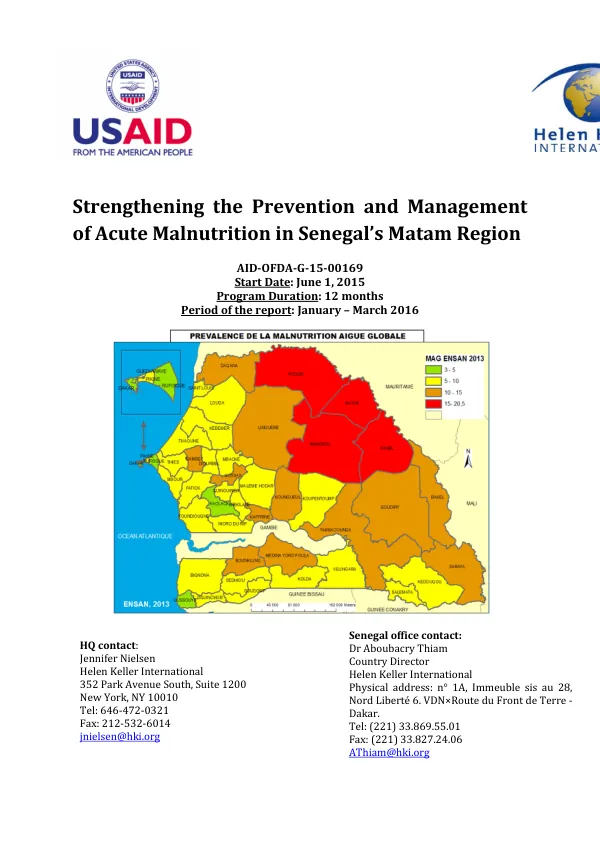
In Senegal's Matam Region, the prevalence of global acute malnutrition (GAM) was found to be greater than 15% in a SMART survey conducted in June-July 2014.
2016 · 10 pages
Sign in to readA free account is required to download.
Abstract
The Government of Senegal is providing assistance to households affected by food insecurity, acute malnutrition, and a deficit of biomass production. Partners like Action Contre la Faim (ACF) and Union pour la Solidarité et l'Entraide (USE) are strengthening treatment of severe acute malnutrition (SAM). The "Strengthening the Prevention and Management of Acute Malnutrition in Senegal's Matam Region" project, implemented by Helen Keller International (HKI), aims to strengthen the capacity of health workers and communities to implement the national protocol for the community management of acute malnutrition (CMAM) and to promote adoption of essential nutrition and hygiene actions in three health districts. The project started in June 2015 and is coordinated by HKI-Senegal in collaboration with the medical authorities for Matam region. The project's sector 1 focuses on nutrition, with the objective of strengthening the capacity of health workers and communities to prevent and treat acute malnutrition through CMAM and behavior change related to essential nutrition and hygiene actions. In the management of moderate acute malnutrition (MAM), the number of sites managing MAM services increased from 66 in quarter 1 to 66 in quarter 3. The number of beneficiaries admitted to MAM services also increased, with 7,149 children under 6-23 months and 15,469 children under 24-59 months admitted in quarter 3. In the management of severe acute malnutrition (SAM), the number of health care providers and volunteers trained in prevention and management of SAM increased from 1,070 in quarter 1 to 1,070 in quarter 3. The number of sites established or rehabilitated for inpatient and outpatient care also increased, with 4 sites in quarter 1 and 15 sites in quarter 3. The number of children admitted for treatment of SAM with complications increased from 266 in quarter 1 to 996 in quarter 3. The project's sector 3 focuses on nutritional education and behavior change, with the objective of promoting adoption of essential nutrition and hygiene actions in communities. In quarter 3, 62,438 beneficiaries received nutritional education through radios, and 1,441 beneficiaries received nutritional education through group discussions and interpersonal communication.