USAID
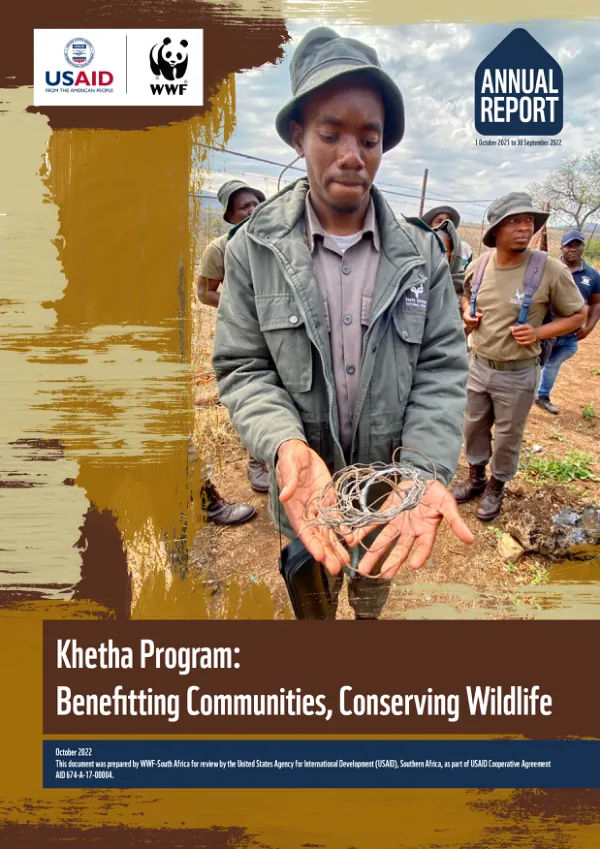
Annual Report: Khetha Innovation Nodes
The Great Limpopo Transfrontier Conservation Area (GLTFCA) is one of the most extensive networks of conservation areas in Africa, home to a diverse array of species, including African elephants and white and black rhinos.
2023 · 80 pages
Sign in to readA free account is required to download.
Abstract
These species are valued economically, socially, culturally, and aesthetically, but are threatened by illegal wildlife trade, driven by ongoing demand from consumer countries. In the past year, collaboration between communities, government, and civil society has improved through jointly analyzing and developing plans to address human-wildlife conflict and park management. Efforts have focused on improving the wellness, safety, and ability of community practitioners to work effectively in building relationships between people and protected areas. For example, training in gender-based harassment highlighted the importance of safe working environments, and research into the capacity needs of community practitioners has provided a greater understanding of how to support these critical roles. Ranger wellness has also been improved through ranger leadership training, benchmarking ranger incentives, and providing ranger field kits. A ground-breaking study has created a better understanding of the risks and impact of corruption on the effectiveness of the ranger corps in the Kruger National Park. Research into the dynamics of illegal wildlife trade and training of relevant police departments, prosecutors, and judges in Mozambique and magistrates in South Africa has strengthened capacity to successfully prosecute wildlife criminals. The Great Limpopo Transfrontier Conservation Area Elephant Management Framework was approved, the first of its kind in southern Africa, allowing countries to collaborate on elephant management. Collaborative learning has been facilitated through workshops in communities, including research and awareness symposiums and community storytelling workshops. Khetha learning and experiences have been shared on various platforms, local, transboundary, and international. Learning, reflection, and adaptive management have been cornerstones of the program's approach. High-level reflections and strategic shifts have shaped work under each objective, leading to a deeper understanding of the complex system of the GLTFCA and its issues. Socio-economic issues, including inequality, poverty, historical grievances, lack of employment, and corruption, have been identified as contributing to resentment and justification of engaging in illegal activities, including wildlife trafficking. To improve relationships between people and wildlife, approaches and underlying assumptions have been critically examined when engaging communities to reduce wildlife crime. In South Africa, protected areas affected by wildlife trafficking are often near densely populated, peri-urban communities where traditional and state governance mechanisms are in decline. A rethinking of community engagement is necessary, considering the complex contexts. Wildlife trafficking policy frameworks have been examined to increase crime prevention, detection, prosecution, and collaboration. The issue has been viewed through a criminality lens alongside a conservation lens, highlighting the involvement of transnational organized crime driving wildlife trafficking. Storytelling has been a key mechanism for change, enabling platforms to voice people-centric stories that add depth and humanity to the complex system. The GLTFCA is a complex system where wildlife and people live in harmony and conflict. Efforts to address wildlife trafficking have been strengthened through research, training, and collaboration. A deeper understanding of the root causes of illegal wildlife trade has been gained, and a more nuanced approach to tackling wildlife trafficking has been developed.
Related documents