USAID
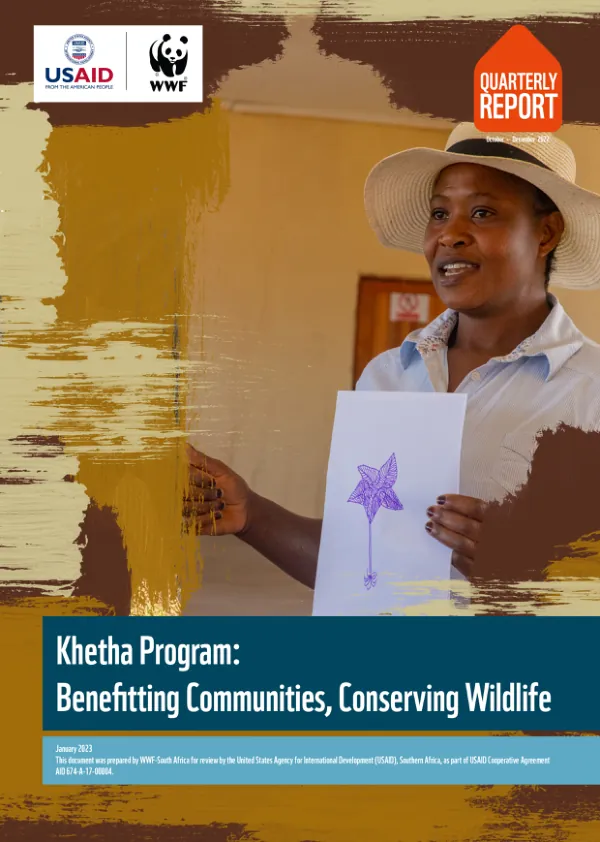
Quarterly Report: Khetha Program
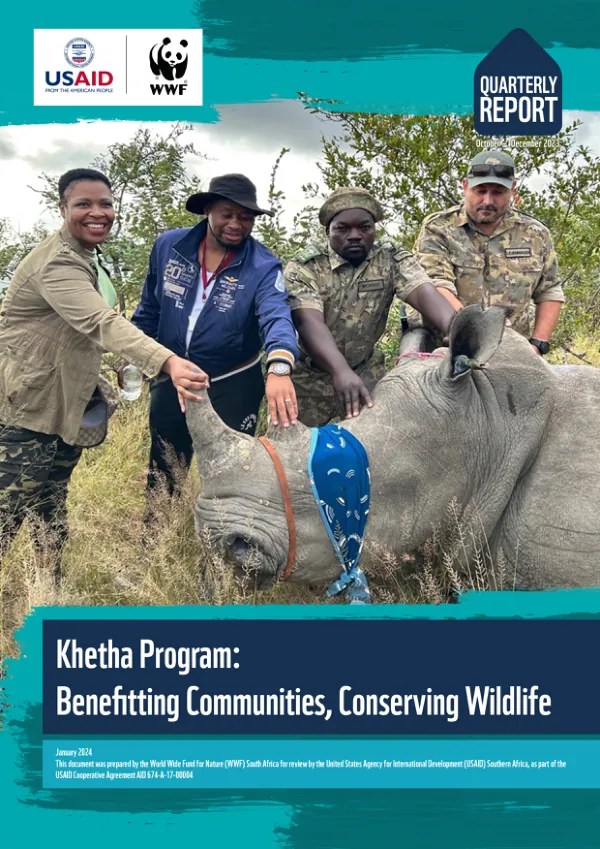
The Khetha program is a collaborative initiative between WWF South Africa and partners aimed at halting the impacts of wildlife trafficking on key populations of flagship species and communities around protected areas in the Mozambican and South African landscape of the GLTFCA.
2023 · 42 pages
Sign in to readA free account is required to download.
Abstract
The program's goal is to contribute to positive growth rates in black and white rhino populations and maintain positive growth rates for elephants in the focal area by September 2024. The program's objectives include supporting innovative partnerships and novel approaches within civil society, communities, private sector, and government in at least four innovation nodes in GLTFCA to improve relationships between people and wildlife, by September 2024. Additionally, the program aims to support the implementation of critical wildlife trafficking policy frameworks for South Africa and Mozambique to increase crime prevention, detection, prosecution, and collaboration, by September 2024. The GLTFCA is one of the most extensive networks of conservation areas in Africa and home to a spectacular array of species, including key populations of African elephants and white and black rhinos. These species play critical roles in natural systems, but they are also valued economically, socially, culturally, and aesthetically. Illegal wildlife trade (IWT) remains a major threat facing these species, driven by ongoing demand from consumer countries. Trends indicate poaching and trade are once again increasing following a brief respite linked to travel restrictions during the COVID-19 lockdowns. The Khetha program has been actively working to address these challenges through various initiatives. In the fourth quarter of the year, the program hosted the annual Khetha Community Practitioners Conference, which brought together community engagement practitioners from across the Greater Kruger to share their experiences and learning. The conference focused on community engagement practitioners' wellbeing, with a discussion on their safety and security at work and in their communities. The program also facilitated several stakeholder engagements to inform the development of an initial land use management plan, a draft ecological and restoration plan, and a rangeland extension training and capacity development plan. These plans are essential for the success of the wildlife economy project. In partnership with the Kruger to Canyons Biosphere Region, the program hosted two workshops in two communities neighboring the Kruger National Park, utilizing the Safe Systems tool to assess the drivers of human-wildlife conflict and develop action plans to address the challenges. The program has also been working to support the wellness of rangers in the project area. This quarter, the program trained another 12 rangers from the provincial and private reserves on the Braveheart curriculum at the Southern Africa Wildlife College. The program also concluded fieldwork for a Most Significant Change evaluation to assess the impact of the training. In addition, the program has been partnering with the Greater Kruger Environmental Protection Foundation to pilot a youth sports program to influence pro-conservation behavior. The program met with local football associations to understand their reach, challenges, and opportunities to increase their positive social impact. The project will be launched in the Welverdiend area next quarter. The program has also been working to support the development of a communications strategy for the Great Limpopo Transfrontier Conservation Area Cooperative Agreement. The program used this opportunity to influence the protected area network to diversify their communication around conservation and illegal wildlife trade. In partnership with the GEF 6 program, the program ran a social media campaign, profiling nine rural women from the Greater Kruger in various occupations, playing an important role in their communities. The program has made significant progress in achieving its objectives, and the team is proud of their achievements. The program will continue to work towards consolidating their collective learning in Year Six and achieving their goal of contributing to positive growth rates in black and white rhino populations and maintaining positive growth rates for elephants in the focal area by September 2024.