USAID
Annual Report: Khetha Program Implementation
The Khetha program is a community-based initiative aimed at improving the relationship between local people and protected areas in the Greater Kruger area.
2023 · 82 pages
Sign in to readA free account is required to download.
Abstract
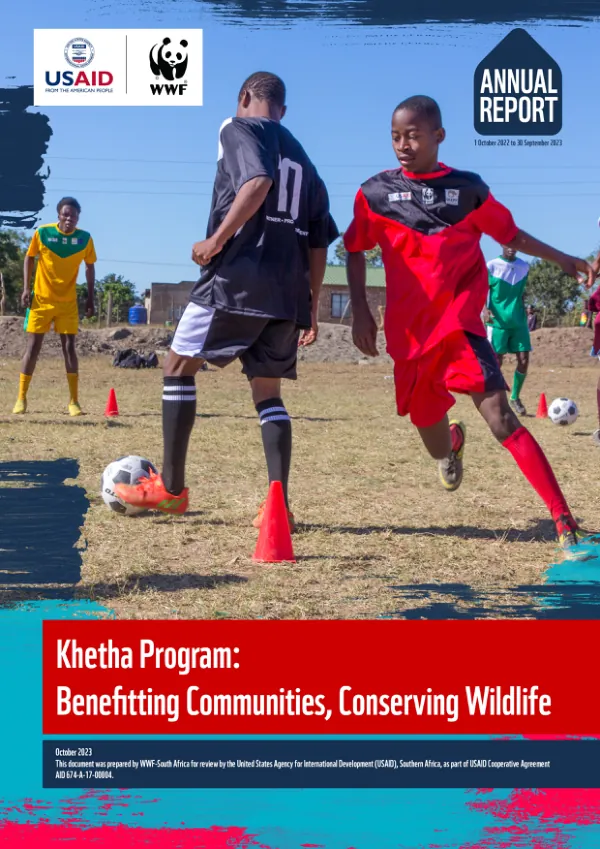
The program's core objective is to enhance community-park relations and community-based approaches to address wildlife crime. Community Engagement Practitioners play a vital role in mediating relationships between parks and communities, and the program continues to profile and capacitate their work. The program has strengthened bonds with known partners and explored novel connections, with a focus on improving livelihoods through the development of a wildlife economy project and innovative finance mechanisms in South Africa and Mozambique. The distribution of funds from sustainable wildlife use to communities in Mozambique is also a key area of focus. Additionally, the program continues to address Human-Wildlife Conflict through the development and implementation of action plans emerging from the Safe Systems methodology. A youth sports program has been initiated to engage young people, provide safe spaces to deter them from criminal activities, and educate them about conservation and wildlife crime. Research is also being conducted to better understand the complex landscape in which the program operates. The program has continued its cutting-edge work to develop leadership skills within the ranger services, providing legal support and training that positively impacts ranger morale and wellness. The program has also supported the establishment of remuneration structures and alignment with qualifications and experience for rangers. Training for various law enforcement entities is being provided to improve capacity along the illegal wildlife trade chain. Furthermore, the program continues to support the development and implementation of the Integrity Management Plan to mitigate corruption and its impacts within ranger services. Khetha is actively fostering collaboration, communication, and coordination among diverse stakeholders through learning exchanges, media training, community engagement, and refined communication strategies. This is aimed at building a more inclusive and effective collective response to wildlife crime. Leadership skills are recognized as critical to the successful implementation of every aspect of the program's work, and the program continues to support leaders working in law enforcement and those on the crucial interface between protected areas and local communities. The Khetha team has been immersed in a complex system, continually questioning assumptions and being open to changing perspectives. The learning process has involved abstract conceptual understanding as well as granular insights into specific program practices and activities, which has helped the team navigate the complex challenges that have arisen. The program looks forward to harnessing its learning to inform its strategies and actions as it tackles the challenges and opportunities that await in Year Seven. The program's geographic focus is on the Greater Kruger area, which spans across South Africa and Mozambique. The program's work is guided by the principles of community engagement, leadership development, and collaboration among diverse stakeholders. The program's activities are aimed at improving community-park relations, addressing wildlife crime, and enhancing livelihoods through the development of a wildlife economy project and innovative finance mechanisms. The program's timeframes are not explicitly stated, but it is mentioned that the program has been implemented for six years, with a focus on Year Seven. The program's recommendations are not explicitly stated, but it is clear that the program aims to continue its work in improving community-park relations, addressing wildlife crime, and enhancing livelihoods through the development of a wildlife economy project and innovative finance mechanisms.
Related documents