UNIVERSITY OF DAR ES SALAAM
Annual Report: Skills Development in Textiles for Rural Income Generation
The Skills Development in Textiles for Rural Income Generation project, implemented by Kyela College for Skills and Technology (KCoST), aimed to deliver skills on textile technologies, including garment design and fashion design, complemented with entrepreneurial skills for job creation.
2013 · 11 pages
Sign in to readA free account is required to download.
Abstract
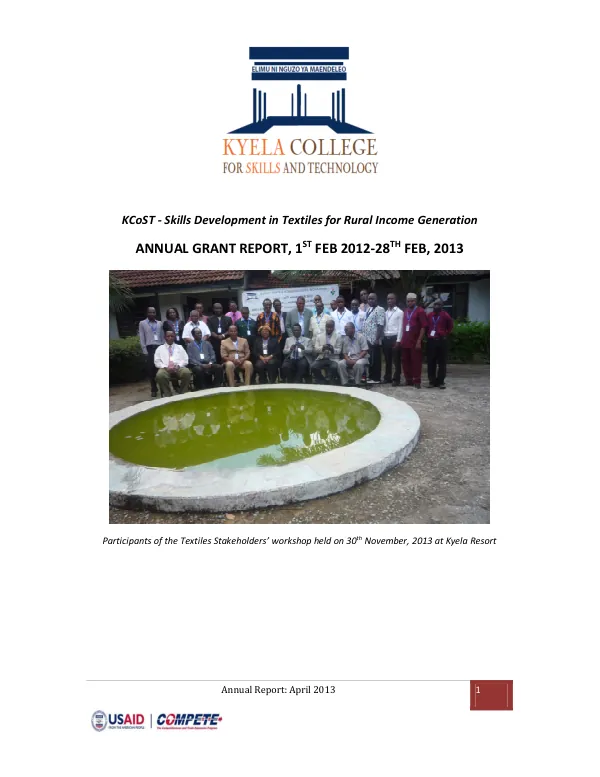
The project was funded by a grant from the Compete Program and was operational from February 1, 2012, to February 28, 2013. The project's main objective was to develop skills in textiles for rural income generation, and the implementation of costed activities was tracked for a period of 13 months. The project involved various tasks, including equipment search, stakeholders' workshop, course advertisement, equipment procurement, installation of equipment, course materials, conduct training, and industrial practical training. Equipment search was conducted to source equipment using the internet, emails, and telephone calls. The equipment sourced included sewing machines, overlock machines, cutting machines, set squares, knitting machines, and power generators. Consumables such as sewing and knitting spares, scissors, and other materials were also procured. A stakeholders' workshop was conducted on April 13-14, 2012, to create awareness and sensitize textile industrialists and NGOs about the College's activities. The workshop was attended by about 30 stakeholders from various large-scale textile manufacturing companies, small and medium enterprises, and government institutions. Inputs from the workshop group discussions were adopted and used to polish the draft curriculum. Course advertisement was implemented using local and national media, including radios, newspapers, and a College website. The website was developed to publicize and create awareness about the existence of the College and to advertise for student admissions and stakeholders' workshops. Equipment procurement involved the procurement of laboratory equipment, teaching materials, and a generator. The generator was purchased to ensure constant and adequate supply of electricity, and its installation eased problems caused by power supply outages. Installation of equipment was completed, and all the procured teaching machines were operational. The availability of training equipment made the delivery of courses more motivating to students and complemented real-time industrial situations. Course materials were prepared by visiting lecturers from the University of Dar es Salaam, who also provided guidance on curricula development and delivery assistance. The University of Dar es Salaam signed a memorandum of understanding with KCoST to provide guidance and delivery assistance. Conduct training was the main activity of the project, and it was conducted in two semesters, each taking 17 weeks with two weeks set for semester examinations and the remaining 15 weeks used for lectures. The first semester started in February 2012 and ended in mid-June 2012. Industrial practical training (IPT) was conducted to provide students with hands-on experience in textile technologies. The IPT was conducted in collaboration with textile industrialists and NGOs, and it provided students with the opportunity to apply theoretical knowledge in practical situations. The project's evaluation exercise was conducted towards the end of the project to assess its effectiveness and identify areas for improvement. The evaluation exercise revealed that the project had achieved its main objective of developing skills in textiles for rural income generation. The project's outcomes included the development of a draft curriculum, the procurement and installation of equipment, the conduct of training, and the provision of industrial practical training. The project's impact was significant, and it contributed to the development of skills in textiles for rural income generation. The project's outcomes and impact were achieved through the effective implementation of costed activities, and the project's success was due to the collaboration and coordination among stakeholders, including KCoST, the University of Dar es Salaam, textile industrialists, and NGOs.