USAID DEC
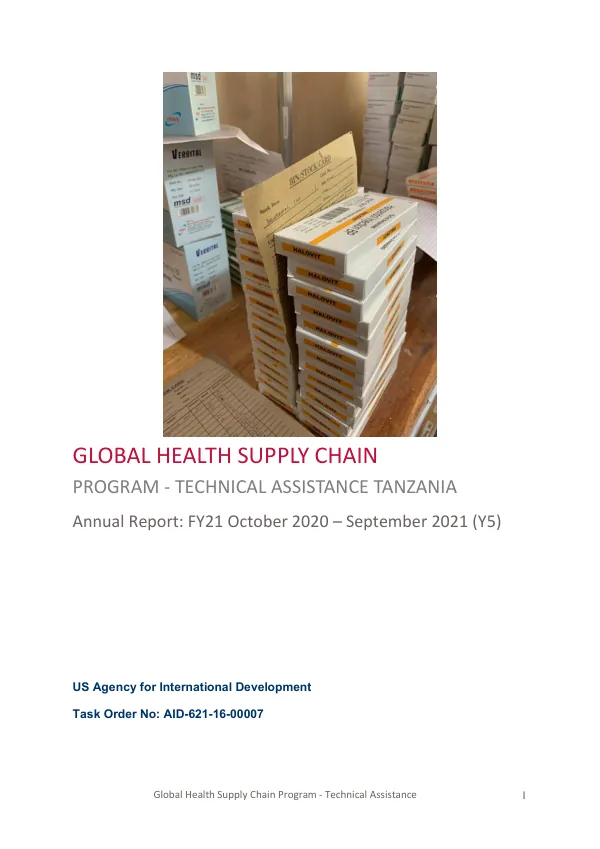
Global Health Supply Chain Program - Technical Assistance Annual Report: FY21 October 2020 – September 2021 (Y5)
Sign inMANAGEMENT SCIENCES FOR HEALTH
Global Health Supply Chain Program - Technical Assistance Annual Report: FY21 October 2020 – September 2021 (Y5)
The Global Health Supply Chain Program - Technical Assistance in Tanzania is a five-year initiative that began in 2016 with funding from the US Agency for International Development.
2021 · 79 pages
Sign in to readA free account is required to download.
Abstract
The program's primary objective is to strengthen the health supply chain system in Tanzania, with a focus on improving the delivery of health commodities in service sites. The program's workstream accomplishments are categorized into four objectives. Objective 1 focuses on providing strategic planning and implementation assistance to the Ministry of Health, Community Development, Gender, Elderly, and Children (MOHCDGEC) and the President's Office Regional Administration and Local Government (PORALG). This objective includes interventions such as assisting leadership to operationalize strategic plans, planning for transition from donor-funded support, and further clarifying operating procedures. Objective 2 aims to improve the delivery of health commodities in service sites by strengthening supply chain management information systems (MIS), streamlining quantification, and improving supply chain agility to respond to health priorities. The program has made significant progress in this area, with the implementation of the eLMIS support transition and the redesign of the logistics system. Objective 3 focuses on broadening stakeholder understanding and engagement of the supply chain system. This includes institutionalizing data use and improving data quality, supporting the MOH RBF unit in implementing and improving the results-based financing (RBF) scheme, and assisting MOHCDGEC to budget for health commodities. The program has also implemented an e-learning platform to enhance stakeholder engagement and capacity building. Objective 4 aims to strengthen enabling environments to improve supply chain performance. This includes solidifying the Local Medical Stores (LMS) role in information sharing and oversight, establishing a culture of collaboration and information sharing, and strengthening governance and accountability. The program has made significant progress in this area, with the establishment of a culture of collaboration and information sharing among stakeholders. The program has also faced implementation challenges, risks, and mitigation measures. These include stock out rates for tracer commodity groups, stock out rates for tracer commodities, and stocked according to plan. The program has implemented various mitigation measures to address these challenges, including the implementation of a risk matrix and a root cause analysis by tracer commodity group. The program has achieved significant results, including a 27% increase in household income among program participants compared to the control group. The program has also strengthened stakeholder engagement and capacity building, with the implementation of an e-learning platform and the establishment of a culture of collaboration and information sharing among stakeholders. The program's geographic focus is Tanzania, with a specific emphasis on the Songwe region. The program's timeframes are from October 2020 to September 2021, with a focus on the fifth year of implementation. The program's recommendations include continued support for the MOHCDGEC and PORALG to strengthen the health supply chain system, as well as continued investment in stakeholder engagement and capacity building.
Related documents