UNIVERSITY OF DAR ES SALAAM
Format for Quarterly and Final Completion Reports for COMPETE Grants
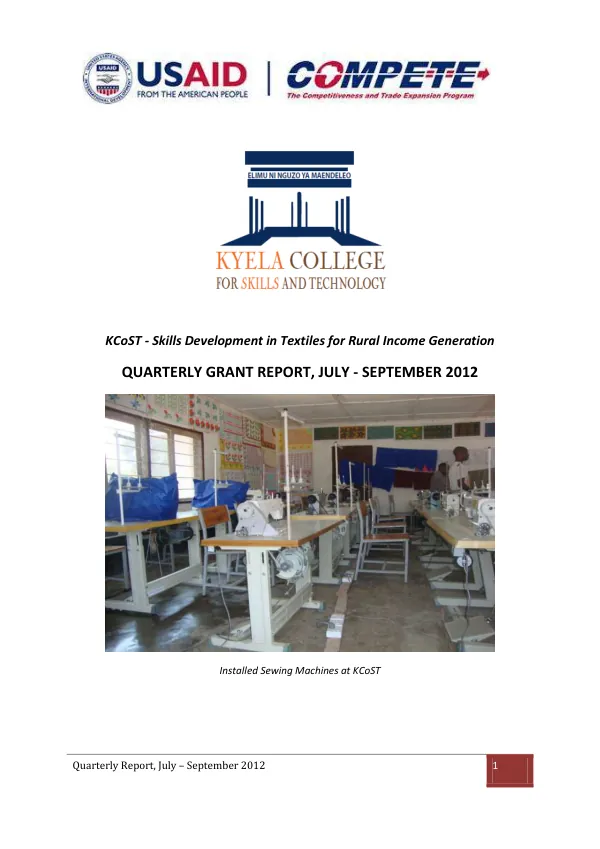
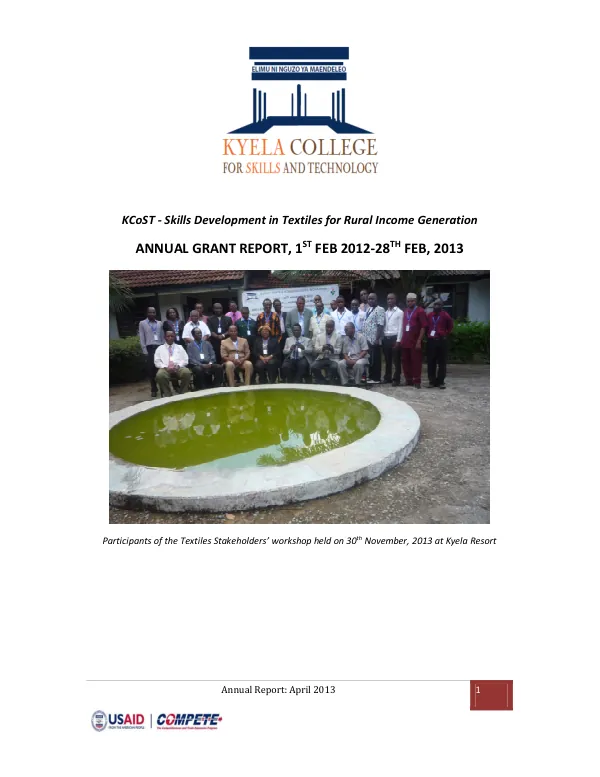
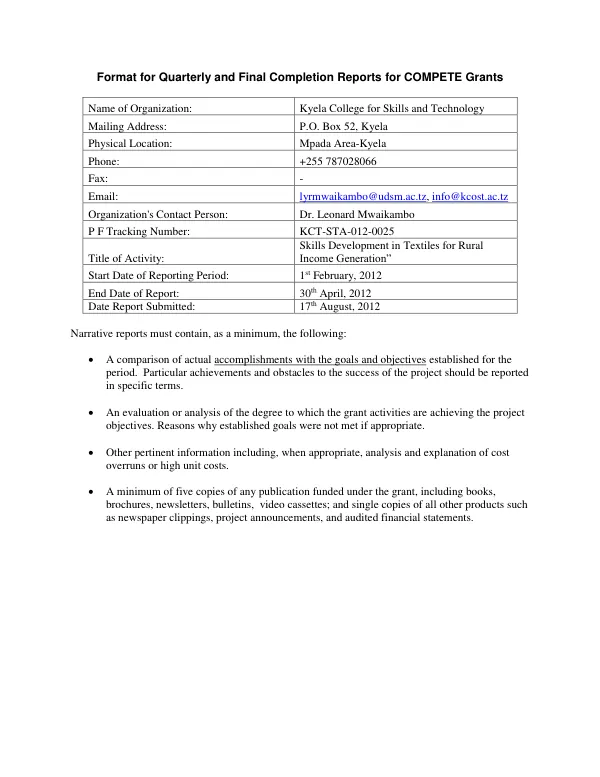
The Skills Development in Textiles for Rural Income Generation project, implemented by Kyela College for Skills and Technology (KCoST), aimed to enhance skills in textiles for rural income generation.
2012 · 8 pages
Sign in to readA free account is required to download.
Abstract
The project was funded by COMPETE Grants and commenced on February 1, 2012. The reporting period covered in this document spans from February 1, 2012, to April 30, 2012. The project's main objective was to develop skills in textiles for rural income generation, with a focus on training and capacity building. The project involved various activities, including equipment search, stakeholders' workshops, course advertisement, equipment procurement, installation of equipment, course materials preparation, conduct of training, visitation of staff and students, programme accreditation, textile cluster formation, training of trainers, course evaluation, and stakeholders' workshop 2. Task 1, equipment search, was completed on time, with no obstacles encountered. Task 2, stakeholders' workshop 1, was also completed as planned, but it was underbudgeted, and funds had to be reallocated from other activities. Task 3, course advertisement, was executed as planned, with no obstacles reported. Task 4, equipment procurement, was carried out within the planned time, with no obstacles encountered. However, Task 5, installation of equipment, was partially completed due to underbudgeting. The construction of the hut for the generator had not yet been done, and it was expected to start in August 2012. Task 6, course materials preparation, was ongoing, with most of the course materials prepared in power point format by guest lecturers from the University of Dar es Salaam. Task 7, conduct of training, was completed, with teaching of the 2012 batch starting in January 2012 and lasting for nine months. Task 8, visitation of staff, was ongoing, with staff visiting students on industrial training in Morogoro, Tanga, and Arusha. Task 9, visitation of students, was also ongoing, with students visiting textile mills in Arusha, Morogoro, and Tanga. Task 10, programme accreditation, was partially completed, with advance copies of the curricula submitted to NACTE. However, accreditation was not obtained in June, except for the submission of draft curricula to the accreditation authority. Task 11, textile cluster formation, was progressing as planned, with one cluster formed and more to follow towards the end of the project. Task 12, training of trainers, was planned to take place during the last two months of the project, but experiencing difficulties in securing suitable external colleges. Task 13, course evaluation, had partially started by commissioning a consultant to prepare a business plan. Task 14, stakeholders' workshop 2, was planned to take place during the last quarter of the project and was progressing well, with no obstacles reported. The project's achievements included the completion of various tasks, such as equipment search, stakeholders' workshop 1, course advertisement, equipment procurement, and conduct of training. However, the project faced some challenges, including underbudgeting, lack of offers from industry for industrial training, and difficulties in securing suitable external colleges for training of trainers. The project's geographic focus was on rural areas in Tanzania, with a specific focus on the Kyela region. The project's timeframes were from February 1, 2012, to December 2012, with the reporting period covering from February 1, 2012, to April 30, 2012. The project's recommendations included the need for additional funding for stakeholders' workshop 2 and the importance of securing suitable external colleges for training of trainers.
![Tanzania Public Sector Systems Strengthening Plus (PS3+) Year 3 [Fiscal Year 4] Quarter 3 Report](https://covers.devme.ai/gen/149103.webp)