USAID DEC
Quarterly Report, July – September 2012: Skills Development in Textiles for Rural Income Generation
Sign inUNIVERSITY OF DAR ES SALAAM
Quarterly Report, July – September 2012: Skills Development in Textiles for Rural Income Generation
The Skills Development in Textiles for Rural Income Generation project, implemented by Kyela College for Skills and Technology (KCoST), aims to deliver skills on textile technologies, including garment design and fashion design, complemented with entrepreneurial skills for job creation.
2012 · 9 pages
Sign in to readA free account is required to download.
Abstract
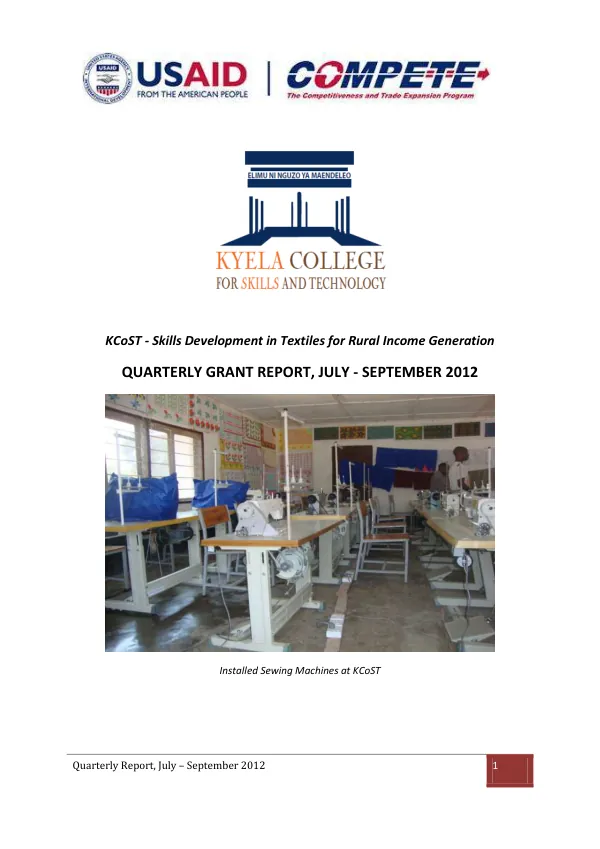
The project's main objective is to equip students with practical skills and knowledge to enhance their employability and contribute to the growth of the textile industry in rural areas. During the period of July to September 2012, KCoST made significant progress in various project activities. The procurement of laboratory equipment, including sewing machines, over lock machines, and cutting machines, was completed, providing an enabling environment for students to practice and enhance their skills delivery. The equipment has been installed, and a generator has been provided to ease power cut-out problems during lecture and practical time. Course materials, essential for effective course delivery, were prepared, but the production of teaching manuals is taking time due to the staff's engagement with teaching at the University of Dar es Salaam. The staff responsible for producing the manuals are revisiting the incentive package to raise it to around USD 400 per manual, instead of the current flat figure of USD 2000 for the nine subject areas. Training was conducted in two semesters, with a four-week industrial practical training between semesters. Admission of students took place between January and February, with a total of 58 students being admitted, 30 males and 28 females. The college is planning to reschedule the academic year to start in March each year to provide room for a large number of students to apply for the training. Industrial practical training took place from 30th July to 24th August 2012, where a total of 58 students went to various textile mills in Arusha, Morogoro, and Tanga. The training was carried out successfully, and the students were satisfied with the training. Guest lecturers from the University of Dar es Salaam visited students on industrial training to supervise and attend to any problems that either the students or the host companies experienced during the IPT. The curriculum documents for NTA level 4 have been prepared and submitted to the National Council for Technical Education (NACTE) for preliminary review. Documents for NTA levels 5 and 6 have also been submitted, and KCoST hopes to extend its course offerings to these levels in the near future. The accreditation, however, awaits visitation to the KCoST in Kyela by a team from NACTE. The textile cluster formation activity is progressing as planned, with one cluster formed and more to follow towards the end of the project. The training of trainers activity has not yet been done due to difficulties in securing suitable external colleges for short-course training. The team is considering the possibility of engaging possible advisers, particularly from Mauritius. Overall, KCoST has made significant progress in various project activities, and the project is on track to achieve its objectives. The college is committed to delivering high-quality training and equipping students with practical skills and knowledge to enhance their employability and contribute to the growth of the textile industry in rural areas.