USAID
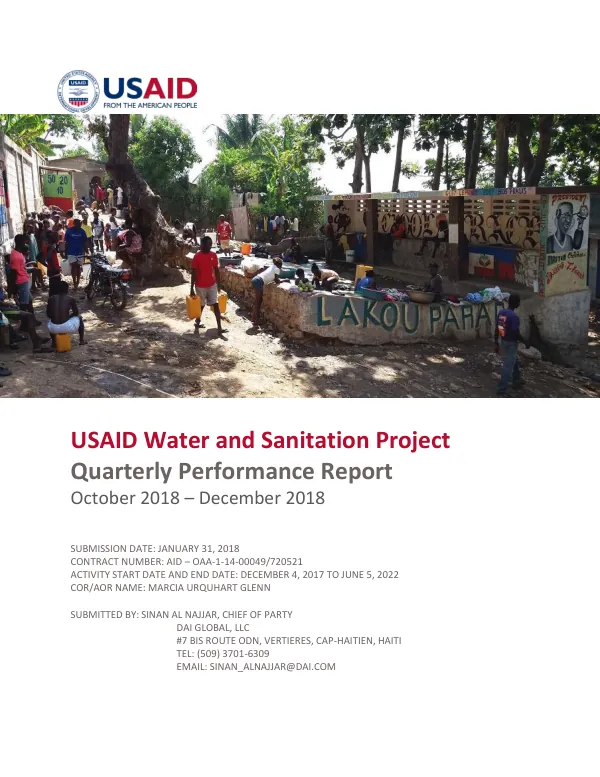
Quarterly Performance Report: USAID Water and Sanitation Project
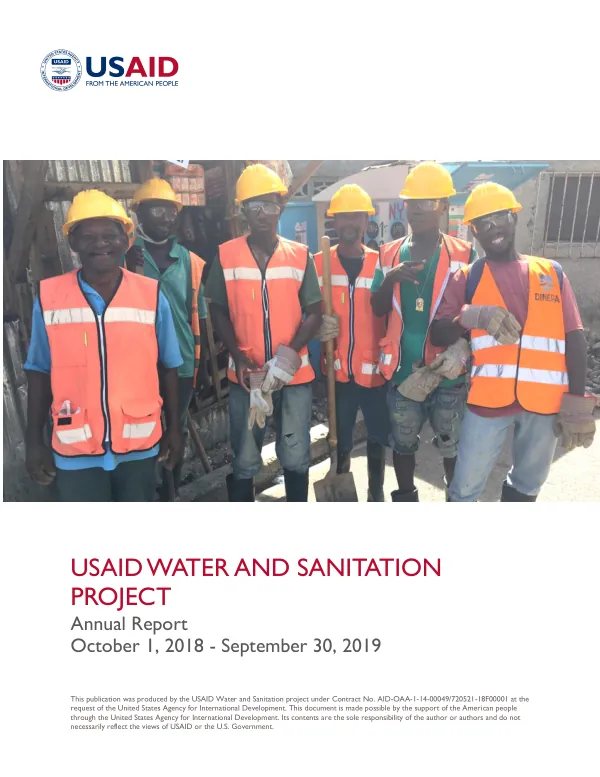
The USAID Water and Sanitation Project was launched on December 4, 2017, with the overarching objective of increasing access to water and sanitation services in Haiti on a sustainable basis.
2019 · 20 pages
Sign in to readA free account is required to download.
Abstract
The project targets urban areas where water and sanitation services needs are the greatest, specifically in areas hard hit by the cholera outbreak and by Hurricane Matthew. The five targeted areas are Cap-Haïtien, Croix-des-Bouquets, Mirebalais, Les Cayes, and Jérémie. The project is organized in three mutually reinforcing components to support its objectives: Component 1 - Increased access to sustainable water supply services, Component 2 - Increased access to sustainable sanitation services, and Component 3 - Strengthened enabling environment for sustainable delivery, operation, and maintenance of water, sanitation, and hygiene (WASH) services. Additionally, the Project has an Enterprise Acceleration Fund (EAF) to stimulate the water and sanitation services market and promote the strengthening of local actors integral to providing these services. The project's main stakeholder is Haiti's National Directorate of Potable Water and Sanitation (DINEPA), the branch of the Haitian government tasked with ensuring water and sanitation services for its citizens. Through close collaborations with DINEPA and by focusing on private sector solutions, the USAID Water and Sanitation Project aims to reach its goal of helping 250,000 people to gain access to basic or improved water services and 75,000 people to gain access to basic or improved sanitation services. The project's main achievements this quarter include completing the procurement for the water system improvement in Petite-Anse/Fort St Michel in Cap Haïtien and launching it for the two solar powered pumps in Les Cayes. The project also started the technical assistance activities in Les Cayes and Jérémie to reduce non-revenue water losses, provided training and technical assistance to all four targeted urban water utilities, and created private sector sanitation associations in all five targeted areas. The project submitted the following deliverables to USAID: the technical, financial, training and monitoring and evaluation reports for the second quarter of this fiscal year, and the draft assessment reports for Cap Haïtien, Les Cayes, Jérémie, and Canaan. The project's activities under Component I are focused on providing basic or improved water to 250,000 people by building the capacity of the CTEs and their support structures to provide water on a sustainable basis. The project completed the design of the first two projects during the previous quarter: the Repairs to the F10 Pumping Station in Cap Haïtien and the Installation of Two Hybrid Solar Pumps in Les Cayes. The project also started the technical assistance activities in Les Cayes and Jérémie to reduce non-revenue water losses, provided training and technical assistance to all four targeted urban water utilities, and created private sector sanitation associations in all five targeted areas. The project's main focus is providing technical assistance to help the CTEs to manage themselves on a cost recovery basis, while also funding infrastructure improvements that help generate revenues and reduce operating costs. The project aims to reach its goal of helping 250,000 people to gain access to basic or improved water services and 75,000 people to gain access to basic or improved sanitation services.