USAID DEC
Annual Results Report: Emergency Assistance to Conflict-Affected Population in Central Kasai Province, Democratic Republic of the Congo
Sign inUSAID
Annual Results Report: Emergency Assistance to Conflict-Affected Population in Central Kasai Province, Democratic Republic of the Congo
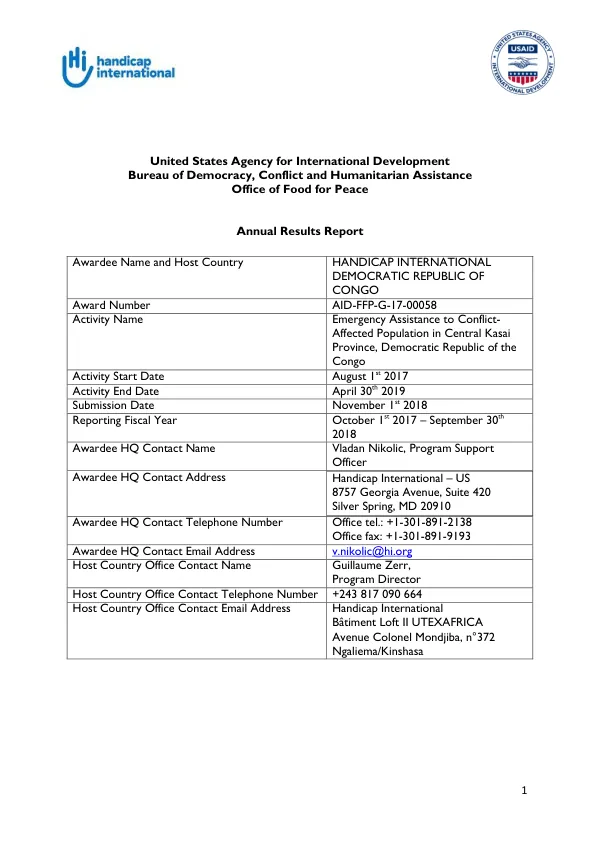
The Emergency Assistance to Conflict-Affected Population in Central Kasai Province, Democratic Republic of the Congo, was a project implemented by Handicap International, funded by the United States Agency for International Development (USAID) through the Office of Food for Peace.
2018 · 10 pages
Sign in to readA free account is required to download.
Abstract
The project aimed to alleviate food insecurity in the Kasaï-Central Province, which was affected by violence and displacement of local communities. The project targeted 8,500 households in 67 villages in Demba and Dimbelenge territories, providing them with two-time food assistance covering three months of their food needs. The project's selection criteria were based on the number of burned houses, victims, displacement, and impact on host families. A community committee was established in each village, comprising seven members chosen by the community, to oversee the targeting process. The committee members were trained on the targeting process, and a protocol of collaboration was signed between Handicap International and the committee members to formalize their collaboration. An exhaustive census was conducted to identify households, and beneficiary cards were given to each household identified. The project's main output was the distribution of three-month food rations to 8,500 households in Demba and Dimbelenge territories. As of the end of September 2018, a total of 8,500 households had received two food rations, covering half of their food requirements for a period of 1.5 months. The distribution process involved rehabilitation and cleanup of distribution sites, information distribution to beneficiaries and distribution committees, food supply to distribution sites, and display of banners at each distribution site. The distribution process was carried out in two phases, with each phase covering half of the food requirements for a period of 1.5 months. At each distribution site, identity checks were carried out by distributors with the support of community committee members to ensure that only eligible beneficiaries received the food assistance. The project also ensured that households with special needs, such as pregnant women, received priority assistance. The project's logistics team oversaw the procurement processes for food supplies, and trucks made available for humanitarian operations by Handicap International/Atlas Logistique with funding from the Pooled Fund were used to transport the food to distribution sites. The project's community mobilizers played a crucial role in informing beneficiaries and distribution committee members about the distribution schedule and quantities of food per beneficiary household. The project's food distribution process was successful, with all 5,700 households planned to receive assistance served. A total of around 1,280 metric tons of food were distributed, with each household receiving about 75.3 kg of food. The project's implementation was constrained by logistical issues and possible tensions resulting in unequal assistance to households, but the project's team ensured that all households received the same ration to avoid huge discrepancies in terms of assistance. The project's impact was significant, with 8,500 households benefiting from the food assistance. The project's food security indicators improved, with households receiving assistance showing higher levels of food security compared to those not receiving assistance. The project's success was due to the effective collaboration between Handicap International and the community committee members, as well as the project's logistics team, which ensured that the food assistance was delivered to the most vulnerable households in a timely and efficient manner.