USAID DEC
Annual Results Report FY 2020 – October 2019 – September 2020: Food Assistance for Displaced, Returnees and Expelled Congolese (FADREC-II)
Sign inADVENTIST DEVELOPMENT AND RELIEF AGENCY INTERNATIONAL
Annual Results Report FY 2020 – October 2019 – September 2020: Food Assistance for Displaced, Returnees and Expelled Congolese (FADREC-II)
The FADREC-II project is a food security intervention in the Kamonia territory of the Kasai province in the Democratic Republic of Congo.
2020 · 16 pages
Sign in to readA free account is required to download.
Abstract
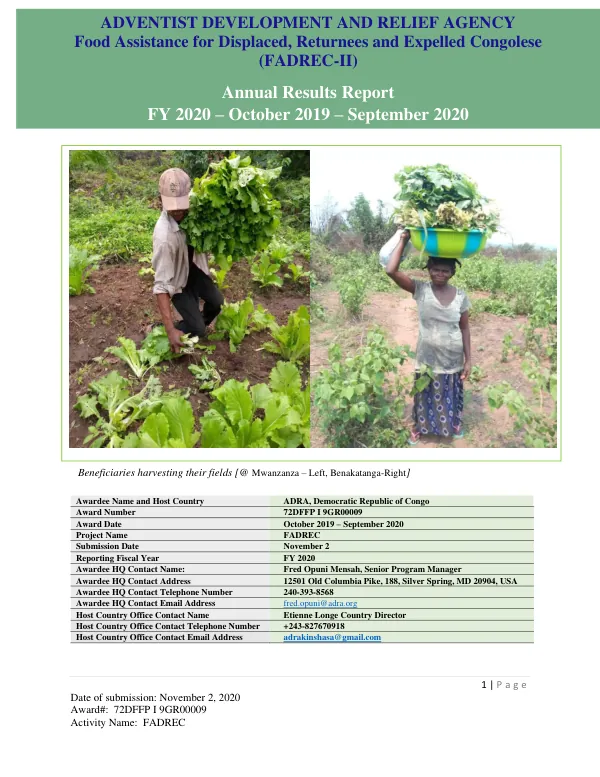
The project's objective is to contribute to alleviating hunger through monthly food distribution and building community resilience by engaging the beneficiaries in agricultural activities. The FADREC-II project was funded by the USAID/FFP and implemented by ADRA. USAID/FFP provided a total of 4,457 MT of food commodities that was transferred to identified beneficiaries. The intervention spans over 12 months (October 2019 – September 2020) and took place in the Kamonia territory. The project targeted 17,025 households (102,150 beneficiaries) in the health areas of Mayanda, Mungamba, Mukuanjanga, Katopa, Muyombo, Tshimeya, and Sala-Mbote. The project provided food commodities (Maize Meal Flour, Beans, Vegetable Oil, and Iodized Salt) together with agricultural seeds and tools. Some of the key achievements during FY 20 include the recruitment and staffing of various positions, successful procurement and transportation of food commodities, distribution of food commodities to 102,150 individuals, distribution of 4,456.79 MT of food commodities, establishment of 15 field demonstration plots, and baseline, post-distribution monitoring, and endline data collection. The project also conducted monthly and quarterly meetings to review and improve service delivery to beneficiaries. Key implementation challenges include transportation of items to the various distribution sites due to poor roads, internet connectivity at the field level, beneficiary expectations to register more family members, and unpredictable weather conditions. The FADREC-II initiative targeted a total of 102,150 individual beneficiaries who were either returnees, internally displaced, or evictee Congolese. The project team worked with a detailed implementation plan to guide activity implementation to achieve set targets. During this period, the project distributed 4,456.307 MT of food commodities to all 102,150 beneficiaries as planned. A total of 14,172 beneficiary households also received agricultural seed and tools to contribute to households' resiliency. Additionally, 11,228 beneficiary households received agricultural training. The project was executed in Kamonia Territory of Kasai Province in the Democratic Republic of Congo. The number of beneficiaries targeted was 102,150 beneficiaries (17,025 households). Beneficiaries reached during the FY 20 were 102,150 beneficiaries (14,173 households). The project distributed food commodities to all 102,150 beneficiaries as planned, and a total of 14,172 beneficiary households received agricultural seed and tools. The project's geographical location is the Kamonia Territory of Kasai Province in the Democratic Republic of Congo. The project's objective is to contribute to alleviating hunger through the provision of food assistance to displaced, returned, and expelled Congolese and their host families. The number of beneficiaries targeted is 102,150 beneficiaries (17,025 households). Beneficiaries reached during the FY 20 are 102,150 beneficiaries (14,173 households). The project's output reporting includes the distribution of food commodities to all 102,150 beneficiaries as planned. A total of 14,172 beneficiary households received agricultural seed and tools to contribute to households' resiliency. Additionally, 11,228 beneficiary households received agricultural training. The project's output reporting also includes the distribution of 4,456.307 MT of food commodities to all 102,150 beneficiaries as planned.