CARE
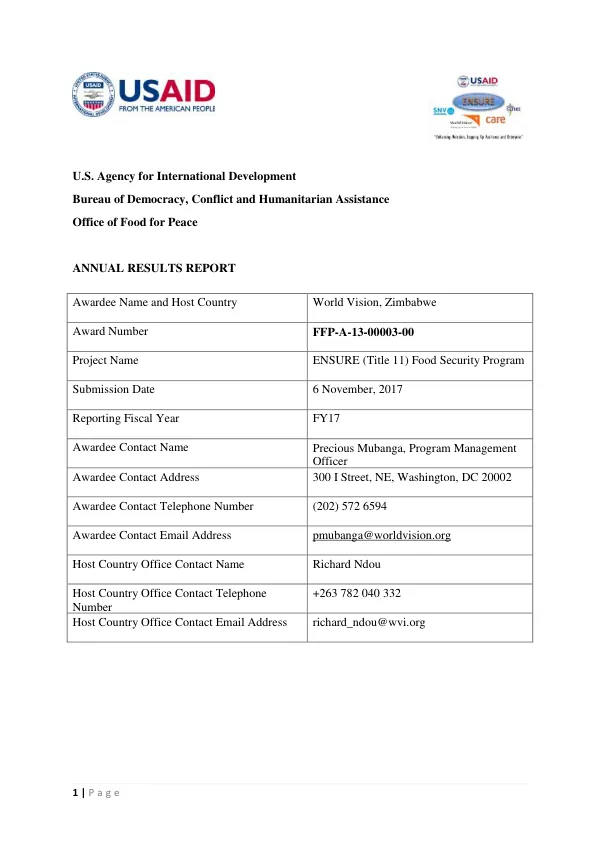
Annual Results Report: ENSURE (Title 11) Food Security Program
The Enhancing Nutrition Stepping up Resilience and Enterprise (ENSURE) program is a USAID Food for Peace Title II Development Food Security Activity (DFSA) that began in June 2013 and will end in June 2018.
2017 · 21 pages
Sign in to readA free account is required to download.
Abstract
The program is being implemented by a consortium of 4 organizations, World Vision Zimbabwe (WVZ), CARE, SNV, SAFIRE, and ICRISAT as a service provider. The program is working to empower and capacitate 58,465 vulnerable rural households in 6 districts of Manicaland and Masvingo Provinces of Zimbabwe. The program has three key strategic objectives: 1. To improve nutrition among women of reproductive age and children under the age of five, 2. To increase household income via improved agricultural production and marketing, and 3. To increase resilience to food insecurity of communities via improved disaster risk reduction and natural resource management with gender equity and women's empowerment and environmental stewardship as cross-cutting themes. During the first quarter of FY17, the program focused on alleviating severe hunger as a result of the El Nino-induced drought as well as preparations for the agricultural season. The food security situation was severe at the peak hunger period witnessed (November 2016 - March 2017). The ENSURE program responded with an emergency food provision Lean Season Assistance program (LSA) to address immediate food needs within the communities by distributing a protective ration to 315,775 vulnerable and food-insecure people from 109 wards within the program's same districts of operation. The Zimbabwean economic outlook for 2017 began on a positive note, with improved performances in the mining and agriculture sectors forecasted to bring about a 2.7% growth in the economy. However, the country encountered several macroeconomic challenges that significantly affected ENSURE program activities during the fiscal year, including a liquidity crisis, inflation and price increases, and unavailability of credit and working capital. Despite these challenges, the project's approaches proved relevant to the prevailing meteorological and economic situation. Communities found financial support, knowledge, risk sharing, motivation, and social insurance within the program's cohesive groups of praxis (producer and marketing groups, care groups, village savings and lending groups, resilience groups, and men's fora). The project's focus on integration of the 3 strategic objectives benefited households towards growth as they slowly recovered from the effects of the previous droughts. Good progress was noted during the period under review. Beneficiaries supported under Strategic Objective 1 demonstrated knowledge and ability to take advantage of high-impact value chains and improve household consumption of nutritious foods. Both SO1 and SO3 beneficiaries expanded upon existing household adaptive capacities by integrating complimentary activities for Natural Resources and Management (NRM), Water Sanitation and Hygiene (WASH), and productive asset improvement. Based on the 2017 ZIMVAC report, and in contrast to the food security situation in FY16, by the last quarter of FY17, a 266% increase in cereal production was recorded for 2017 as compared to 2016 nationally with Manicaland and Masvingo registering a 208% and 743% increases respectively. The ZimVAC Household Hunger Score forecasted that only 9% of households in Manicaland and 7.9% in Masvingo were likely to experience moderate to severe hunger until the end of the lean season. The ENSURE program's interventions and results are reported in the following sections. Strategic Objective 1: Improved Nutrition among Women of Reproductive Age and Children under 5, includes IR 1.1 – Consumption of Nutritious Food Improved, IR 1.2 – Prevalence of Diarrhoea in Children Under Five Reduced, and ENSURE Cost Modification - El Niño Drought Response Lean Season Assistance. Strategic Objective 2: Household Income Increased, includes IR 2.1 – Agricultural Productivity and Production Increased, IR 2.2 Increased Revenue from Targeted Value Chains, and IR 2.3 Percentage increase of household income from economic enterprises. Strategic Objective 3: Resilience to Food Insecurity of Communities Improved, includes IR 3.1 Community Disaster Management and Preparedness Capacities Improved, and IR 3.2 Access to and Management of Disaster Risk and Mitigation Assets Improved. The ENSURE program's direct participating households by sector are reported in a table, and challenges, successes, and lessons learned are also documented. The conclusion highlights the program's achievements and areas for improvement.
Related documents