AVENIR HEALTH
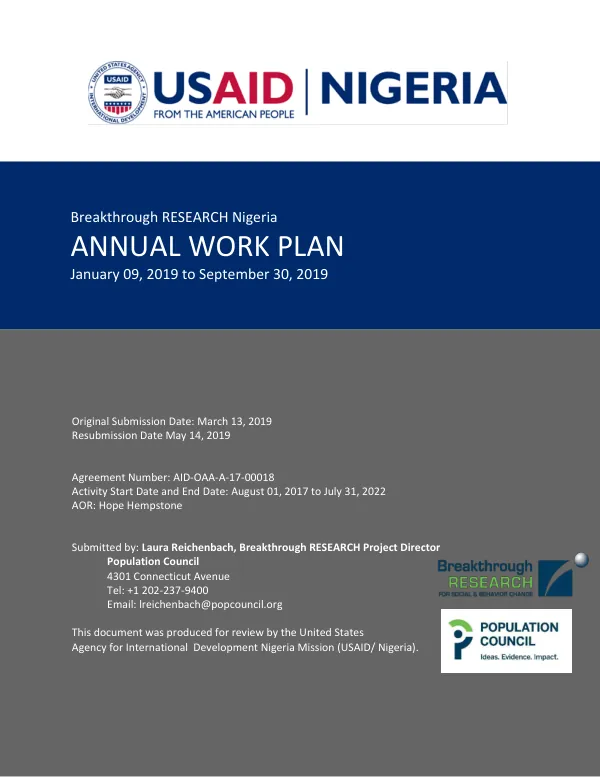
Annual Work Plan FY 2019: Breakthrough RESEARCH Nigeria
Breakthrough RESEARCH Nigeria is a project aimed at increasing the evidence for impact, feasibility, and cost-benefit of social and behavior change (SBC) interventions in Nigeria.
2019 · 24 pages
Sign in to readA free account is required to download.
Abstract
The project is a collaboration between the Population Council, Tulane University, Avenir Health, and other partners, and is funded by the United States Agency for International Development (USAID) through the Global Health Bureau. The project's overarching objective is to increase the evidence for impact, feasibility, and cost-benefit of SBC interventions, and to package and promote the use of evidence-based SBC interventions by priority audiences, including Breakthrough ACTION/Nigeria (B-A/N) and other implementing partners (IPs) in Nigeria. To achieve this objective, the project has several intermediate and sub-intermediate results, including the development and dissemination of SBC research agendas, the design and conduct of priority behavioral research, and the rigorous assessment of B-A/N's integrated program. The project will work closely with relevant stakeholders, including the Nigerian Federal, State, and Local Government Authority (LGA) levels, to review evidence that will inform program and policy development. The project will also leverage existing knowledge management and SBC community of practice platforms to disseminate evidence and data for application in programmatic decision making. The project's target beneficiaries include pregnant women and their partners, women and children within the first 1,000 days window from conception to age 2 of the child, and young children (up to 5 years old), as well as unmarried sexually active youth. Health care providers across all cadres will also be target beneficiaries, as will local, state, and federal leaders participating in the research utilization and evidence application process. The project's implementation approach will involve start-up activities, including establishing a presence and staffing and initiating technical activities, partner engagement and strategy development for leverage existing dissemination networks, implementation of baseline research, and initiation of priority implementation science. The project will focus on three states where B-A/N is implementing a multi-component, integrated SBC program (Bauchi, Kebbi, and Sokoto), and will work closely with B-A/N to design studies that promote rapid data generation to promote the systematic utilization of evidence for program implementation and adaptation. The project's results will provide decision-makers with an improved evidence-base on what works in SBC programming, and for whom and in what context. Such evidence is critical for making more informed investments and programming decisions, which will ultimately contribute to improving the health and development outcomes of women, children, and families in Nigeria. The project's activities will be guided by the USAID Country Development Cooperation Strategy for Nigeria, which aims to increase the demand for quality primary health care services. The project's evidence will inform program and policy development, particularly related to the ongoing implementation of Nigeria's health sector strategy planning, including the Nigeria National Malaria Strategic Plan (2014-2020), the 2014 Nigeria Family Planning Blueprint, and the National Family Planning Communication Plan (2017-2020). The project's results will also contribute to the achievement of Nigeria's ambitious goals of ending preventable neonatal, child, and maternal deaths; improving maternal and child nutrition; achieving a malaria-free world; and increasing the demand for family planning (FP) and reproductive health (RH) services.
Related documents