USAID DEC
Estimating the Cost of the Design, Production, and Dissemination of Social Media Videos for Social and Behavioral Change: Evidence From Merci Mon Héros in Niger and Côte d'Ivoire
Sign inAVENIR HEALTH
Estimating the Cost of the Design, Production, and Dissemination of Social Media Videos for Social and Behavioral Change: Evidence From Merci Mon Héros in Niger and Côte d'Ivoire
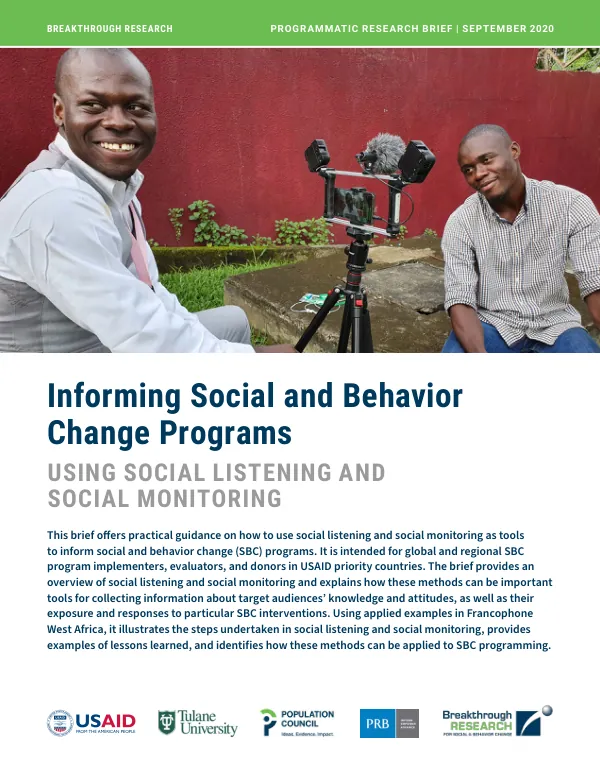
The Merci Mon Héros (MMH) campaign is a youth-led multi-media campaign in Francophone West Africa aimed at improving reproductive health and family planning outcomes.
2021 · 7 pages
Sign in to readA free account is required to download.
Abstract
The campaign includes radio, television, social media, and community events, with a focus on breaking taboos around reproductive health and family planning. One component of the project is the development of a series of youth-driven videos created to encourage both youth and adults to discuss reproductive health and family planning. The videos were designed and produced by a team of youth who participated in a video production and dissemination-specific hands-on training on filming the videos with smartphones, interviewing, and post-production. The videos were disseminated via social media platforms, including Facebook, Twitter, YouTube, and Instagram, as well as via radio, television, and community-based events in nine countries. The videos consisted of individuals recounting their experiences when someone in their life shared information about reproductive health issues and how this information helped them better understand their health and options. A costing study was conducted to capture the costs associated with the design, production, and dissemination of the MMH videos on social media in Côte d'Ivoire and Niger. The total costs to design, produce, and disseminate 11 of the campaign videos for MMH in both Côte d'Ivoire and Niger were $44,981. Unit costs were calculated using three different denominators, resulting in average unit costs of $0.16 per reach, $1.29 per engagement, and $4.27 per video view. The study found that the primary purpose of the MMH campaign was to estimate the total design, implementation, and unit costs associated with the MMH videos. Many SBC costing studies neglect estimating the design costs of SBC interventions, and even less is known regarding design costs associated with RH/FP SBC programming with and for youth. The results from this study will help fill important knowledge gaps on the costs of digital SBC interventions for health to improve coordinated investments in SBC for family planning and reproductive health. The study also examined the unit costs of MMH in Niger and Côte d'Ivoire. Unit costs are critical for budgeting and planning and defining unit costs has important implications for comparing costs across interventions. The different unit costs, based on different measures of reach, that can be used for SBC interventions delivered through social media are explored here to contribute to this new area of research. The study protocol and data collection instruments were developed by Breakthrough RESEARCH and led by Avenir Health with support from MMH key country stakeholders. The data collection questionnaire was developed based on the SBC costing guidelines. Before data collection commenced, a series of web-based consultations were conducted with the Breakthrough ACTION team in Niger and Côte d'Ivoire, designed to gather their inputs and to evaluate whether the study instruments captured all relevant data. Feedback was documented and the data collection tool was subsequently revised and finalized. The costing study primarily took an economic costing approach, focusing on the resources needed to replicate the development of videos delivering SBC messaging through social media platforms in a similar setting. Included in the costs are those associated with in-kind contributions, such as donated personnel time and meeting space, which were valued at the expected costs based on information on the value of the donation provided by Breakthrough ACTION country teams.