AVENIR HEALTH
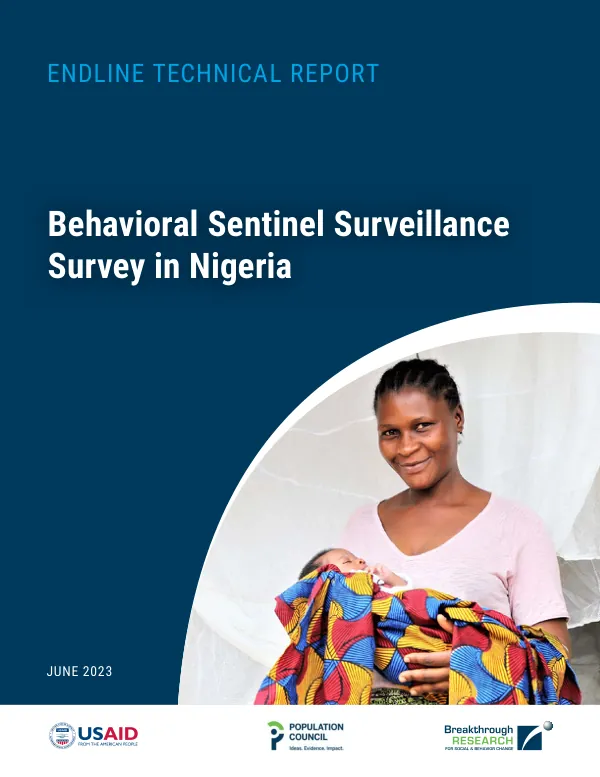
Behavioral Sentinel Surveillance Survey in Nigeria: Endline technical report
The Behavioral Sentinel Surveillance Survey in Nigeria was conducted by a consortium led by the Population Council in partnership with Avenir Health, ideas42, Institute for Reproductive Health at Georgetown University, Population Reference Bureau, and Tulane University.
2023 · 154 pages
Sign in to readA free account is required to download.
Abstract
The survey aimed to assess the impact of integrated social and behavior change (SBC) interventions on health outcomes in Nigeria. The survey was conducted in 2023 and covered a range of health topics, including family planning, maternal, newborn, and child health plus nutrition (MNCH+N), and malaria. The survey used a combination of quantitative and qualitative methods, including household surveys, focus group discussions, and in-depth interviews. The survey found that integrated SBC interventions had a significant impact on health outcomes in Nigeria. For example, the survey found that women who received integrated SBC interventions were more likely to use modern family planning methods, have higher rates of antenatal care attendance, and have lower rates of maternal and child mortality. The survey also found that integrated SBC interventions were more effective than vertical SBC interventions in improving health outcomes. Vertical SBC interventions focus on a single health issue, such as malaria or family planning, while integrated SBC interventions address multiple health issues simultaneously. The survey's findings have important implications for policymakers and program implementers in Nigeria. The results suggest that integrated SBC interventions should be prioritized in future health programming, as they have the potential to improve health outcomes more effectively than vertical SBC interventions. The survey was conducted in collaboration with the Centre for Research, Evaluation Resources and Development (CRERD) and the Breakthrough ACTION project, which is funded by the United States Agency for International Development (USAID). The survey's findings are based on data collected from a sample of over 10,000 households in Nigeria. The survey's methodology included a combination of quantitative and qualitative data collection methods, including household surveys, focus group discussions, and in-depth interviews. The survey's data were analyzed using a range of statistical techniques, including regression analysis and propensity score matching. The survey's key findings are presented in Chapter 1 of the report, which focuses on demographics and Chapter 2, which examines the impact of integrated versus vertical SBC. The report also includes a detailed methodology section, which describes the survey's design, data collection, and analysis procedures.
Related documents