USAID DEC
The business case for social and behavior change for breastfeeding and complementary feeding
Sign inAVENIR HEALTH
The business case for social and behavior change for breastfeeding and complementary feeding
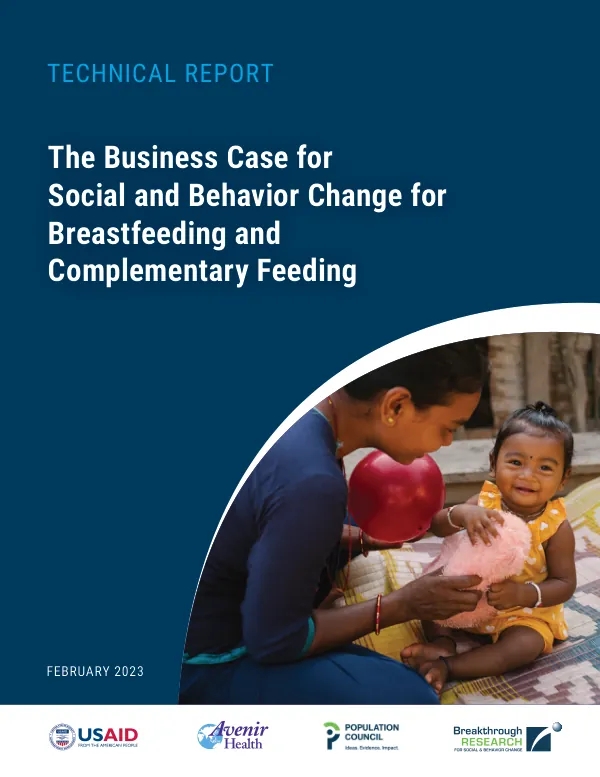
The business case for social and behavior change (SBC) for breastfeeding and complementary feeding is a technical report developed by Breakthrough RESEARCH in February 2023.
2023 · 55 pages
Sign in to readA free account is required to download.
Abstract
The report aims to examine the cost-effectiveness of SBC investments in nutrition, specifically focusing on breastfeeding and complementary feeding outcomes for children under two years old. The report begins by defining what a business case is, which is a systematic approach to evaluating the costs and benefits of an investment or intervention. The report then explains the concept of SBC, which involves changing social and behavioral norms to improve health outcomes. The analysis approach used in the report involves a literature synthesis, which examines the impact of SBC interventions on breastfeeding and complementary feeding outcomes. The report also models the cost-effectiveness of SBC interventions in two different illustrative scenarios: one in Kebbi state, Nigeria, and one in Nepal. The literature synthesis results show that SBC interventions have a significant impact on breastfeeding and complementary feeding outcomes. The report also presents the impact pathways, which describe how SBC interventions lead to improved health outcomes. The report then assesses the cost-effectiveness of SBC interventions using the incremental cost-effectiveness ratio (ICER) and the disability-adjusted life year (DALY) metric. The report models the cost-effectiveness of SBC interventions in Kebbi state, Nigeria, and Nepal. The results show that SBC interventions are cost-effective in both scenarios, with a high return on investment. The report also discusses the limitations of the analysis and concludes that SBC interventions are a valuable investment in improving breastfeeding and complementary feeding outcomes. The report references several studies and literature reviews that support the effectiveness of SBC interventions in improving breastfeeding and complementary feeding outcomes. The report also provides additional methodological details in the appendix, including the literature search and unit cost analysis. The business case for SBC for breastfeeding and complementary feeding is a valuable resource for policymakers, program managers, and researchers who are interested in improving nutrition outcomes for children under two years old. The report provides a comprehensive analysis of the cost-effectiveness of SBC interventions and highlights the importance of investing in SBC programs to improve breastfeeding and complementary feeding outcomes. The report's findings have implications for global health policy and programming. The report suggests that SBC interventions are a cost-effective way to improve breastfeeding and complementary feeding outcomes, which can lead to improved health outcomes for children under two years old. The report also highlights the importance of investing in SBC programs in low- and middle-income countries, where breastfeeding and complementary feeding rates are often low. The report's methodology and findings can be applied to other contexts and settings, providing a valuable resource for policymakers, program managers, and researchers who are interested in improving nutrition outcomes for children under two years old. The report's emphasis on the importance of SBC interventions in improving breastfeeding and complementary feeding outcomes highlights the need for continued investment in SBC programs and research. The report's conclusions are based on a comprehensive analysis of the literature and a detailed modeling of the cost-effectiveness of SBC interventions. The report's findings are consistent with other studies that have examined the impact of SBC interventions on breastfeeding and complementary feeding outcomes. The report's limitations are acknowledged, including the use of a literature synthesis and the assumption of a linear relationship between SBC interventions and health outcomes. However, the report's conclusions are based on a comprehensive analysis of the literature and a detailed modeling of the cost-effectiveness of SBC interventions. The report's recommendations for policymakers, program managers, and researchers are to invest in SBC programs and research, particularly in low- and middle-income countries. The report also recommends continued investment in SBC interventions, particularly in the areas of breastfeeding and complementary feeding. The report's appendices provide additional methodological details, including the literature search and unit cost analysis. The report's references provide a comprehensive list of studies and literature reviews that support the effectiveness of SBC interventions in improving breastfeeding and complementary feeding outcomes. The report's emphasis on the importance of SBC interventions in improving breastfeeding and complementary feeding outcomes highlights the need for continued investment in SBC programs and research. The report's conclusions are based on a comprehensive analysis of the literature and a detailed modeling of the cost-effectiveness of SBC interventions.
Related documents