CHEMONICS
Monitoring and Evaluation Plan: South Africa Low Emissions Development Program
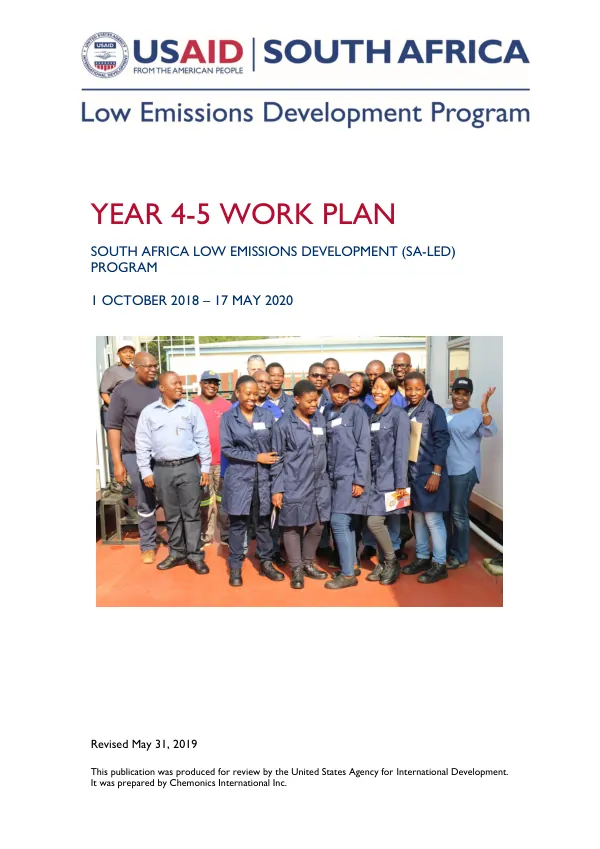
The South Africa Low Emissions Development (SA-LED) project is a USAID/South Africa-financed program awarded to Chemonics International in May 2015 as part of a five-year contract.
2018 · 41 pages
Sign in to readA free account is required to download.
Abstract
The project is designed to support the accomplishment of the U.S. Government's Development Cooperation Strategy in South Africa, specifically Intermediate Result – Transition to a low-emissions economy promoted. The objective of SA-LED is to support the Government of South Africa (GoSA) in its efforts to expand low emissions development, or "green growth" in South Africa, through improving the capacity of South African LED actors in selected municipalities and government departments to select, plan, finance, implement, expand, measure and monitor LED projects. SA-LED has two, integrated objectives: Objective 1, to strengthen public sector-related development planning and project development capacity for low emissions projects, including the mobilization of development finance and private sector participation; and Objective 2, to increase public sector core competencies through technical assistance and learning activities in support of GoSA's Green Growth initiatives. The aim of the SA-LED program is to build partner country LED project development capacity and public sector LED planning and implementation by directly training and supporting local institutions and LED projects. The Theory of Change (ToC) for the SA-LED Program was developed during a three-day work planning workshop in July 2016. The ToC outlines the ultimate desired outcome for the program, which is "Reduced Greenhouse Gas Emissions through implementation of SA-LED initiatives." The ToC articulates the relationship between the activities and the intermediate results designed to reach the ultimate outcome. The ToC diagram shows how the ultimate, intermediate, and immediate outcomes are related to each other over the lifespan of the LED program. The SA-LED Program has five intermediate outcomes, which are further disaggregated into immediate outcomes that describe what the program aims to achieve in Year 3. These outcomes are linked to the strategic objectives and Key Result Areas (KRAs) for the Program. A consolidated list of indicators and targets for the program is provided later in this document. The underlying assumptions of the SA-LED Program are that implementation of LED initiatives will ultimately contribute towards reducing relative levels of greenhouse gas emissions, and that the program's activities will lead to increased public sector core competencies and improved capacity for LED project development. The monitoring and evaluation (M&E) plan for the SA-LED Program must clearly articulate activity goals, baselines, specific targets, and anticipated outcomes and impacts over the life of the project. The plan should include a comprehensive set of indicators that will allow progress toward project objectives to be rigorously assessed. The plan is also a key tool for adaptive management, whereby information is captured and analyzed to continuously enhance project design and resource allocation. The M&E plan is intended to be a "living" document that will be reviewed regularly as part of the SA-LED program review process to ensure continued fidelity to the implementation process.