USAID DEC
Anthropometry: Children Under 5
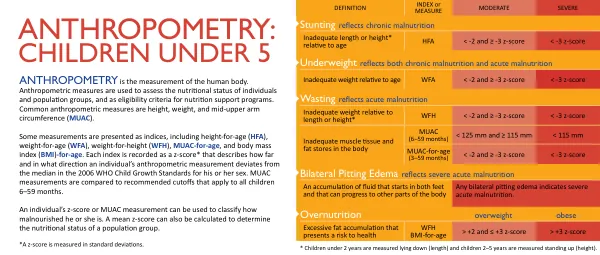
Chronic malnutrition in children is characterized by inadequate length or height relative to age, often resulting in a z-score of less than -2 and greater than -3.
2011 · 2 pages
Sign in to readA free account is required to download.
Abstract
This condition is also known as stunting. Severe stunting is defined by a z-score of less than -3. Chronic malnutrition can lead to a range of health problems, including impaired physical and cognitive development. Underweight children, on the other hand, reflect both chronic and acute malnutrition. This condition is characterized by inadequate weight relative to age, often resulting in a z-score of less than -2 and greater than -3. Severe underweight is defined by a z-score of less than -3. Underweight children are at a higher risk of mortality and morbidity. Wasting, a condition of acute malnutrition, is characterized by inadequate weight relative to length or height. This condition is often seen in children who have experienced a recent episode of illness or famine. Severe wasting is defined by a z-score of less than -3. Wasting can lead to a range of health problems, including increased susceptibility to infections and impaired physical and cognitive development. Anthropometry, the measurement of the human body, is used to assess the nutritional status of individuals and population groups. Common anthropometric measures include height, weight, and mid-upper arm circumference (MUAC). These measures are often presented as z-scores, which describe how far and in what direction an individual's measurement deviates from the median in the 2006 WHO Child Growth Standards. Malnutrition occurs when an individual's dietary intake is not balanced with their nutritional needs. This condition can be caused by inadequate dietary intake or disease. Malnutrition includes undernutrition and overnutrition. Undernutrition encompasses a range of conditions, including chronic malnutrition, acute malnutrition, and micronutrient deficiency. Overnutrition occurs when the body has more nutrients than it needs, and can lead to conditions such as overweight and obesity. Moderate acute malnutrition (MAM) is identified by moderate wasting, with a z-score of less than -2 and greater than -3 for children under 5 years, or a MUAC of less than 125 mm and greater than 115 mm for children 6-59 months. Severe acute malnutrition (SAM) is identified by severe wasting, with a z-score of less than -3 for children under 5 years, or a MUAC of less than 115 mm for children 6-59 months, or the presence of bilateral pitting edema. Global acute malnutrition (GAM) is the prevalence of both MAM and SAM in a population. BMI, or body mass index, is calculated as weight (kg) divided by length or height (m2). BMI is used in adult populations, while BMI-for-age is used in children and adolescents. Undernourishment is a condition where an individual's caloric intake is insufficient to meet their nutritional needs. This condition is often used as a measure of food insecurity and can be estimated using data on caloric availability and access to food.
Related documents
Documents in this collection
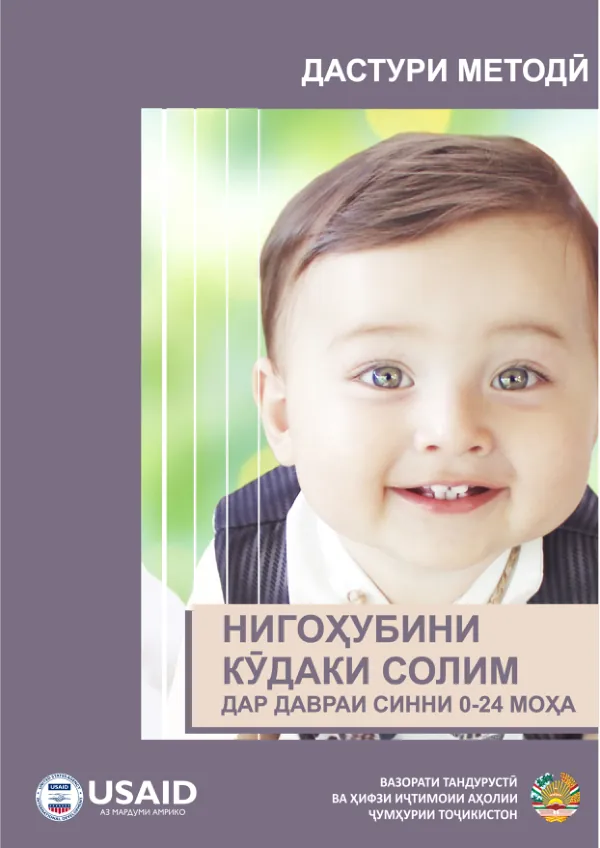
USAID DEC
Дастури мазкур бо кӯмаки мардуми Амрико эҷод шудааст, ки он аз тариқи Оҷонсии ИМА оид ба рушди байналмилалӣ (USAID) дар доираи ташаббуси “Озуқаворӣ ба хотири оянда” Лоиҳа оид ба саломатӣ ва ғизо дар Тоҷикистон расонида мешавад.
Open record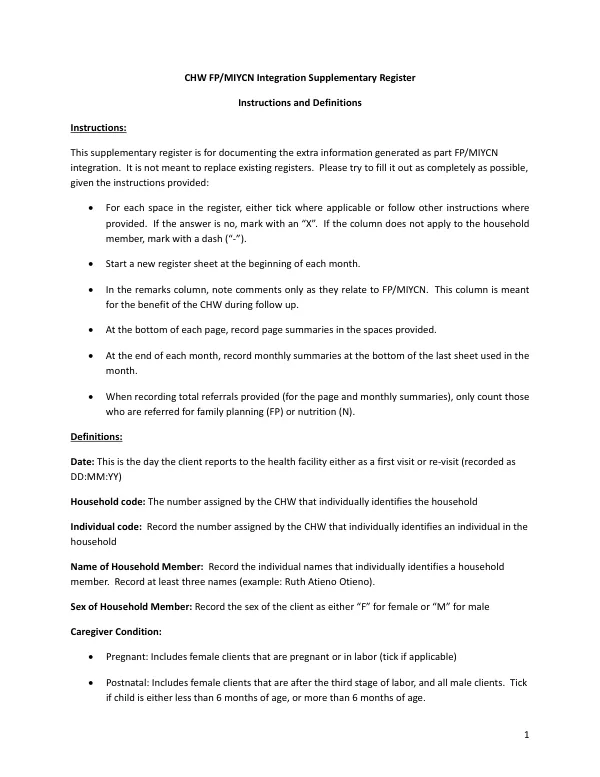
USAID DEC
CHW FP/MIYCN Integration Supplementary Register Instructions and Definitions
Open record
USAID DEC