USAID DEC
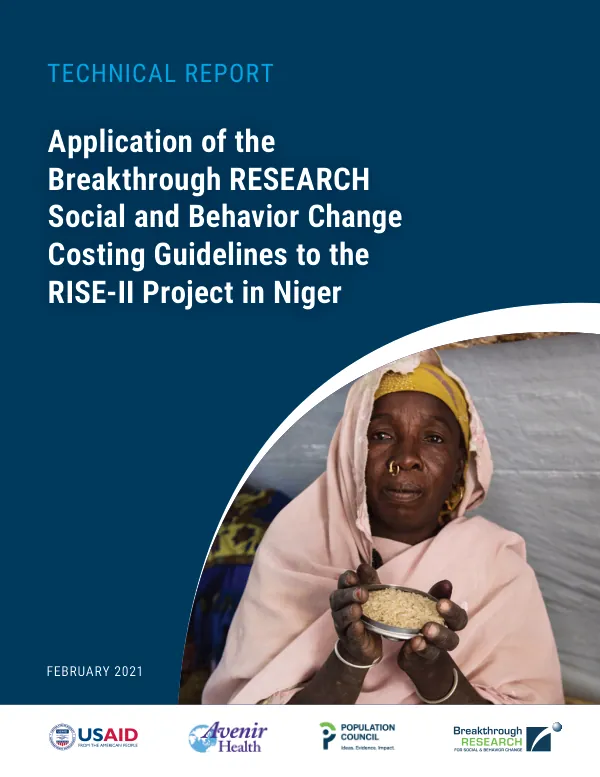
Application of the Breakthrough RESEARCH Social and Behavior Change Costing Guidelines to the RISE-II Project in Niger
Sign inAVENIR HEALTH
Application of the Breakthrough RESEARCH Social and Behavior Change Costing Guidelines to the RISE-II Project in Niger
The RISE-II program in Niger aimed to improve resilience and food security among vulnerable populations.
2021 · 22 pages
Sign in to readA free account is required to download.
Abstract
The program was implemented by a consortium of organizations, including the Resilience Food Security Activities in Niger, which included Hamzari (led by Care), Girma (led by Catholic Relief Services), and Wadata (led by Save the Children). The program received funding from the United States Agency for International Development (USAID) under the terms of cooperative agreement no. AID-OAA-A-17-00018. The Breakthrough RESEARCH Social and Behavior Change Costing Guidelines were applied to the RISE-II program to assess its effectiveness. The guidelines provide a framework for costing social and behavior change interventions, which is essential for understanding the costs and benefits of such programs. The guidelines consist of 17 principles, which are divided into four sections: study design, resource use measurement, pricing and valuation, and analyzing and presenting results. The study design section of the guidelines emphasizes the importance of defining the costing study purpose, intervention, and study perspective. It also highlights the need to determine the scope of the costs, measure and allocate resources, and select a sampling method. The resource use measurement section focuses on determining the scope of the costs, measuring and allocating resources, and selecting a sampling method. The pricing and valuation section of the guidelines deals with determining the source of price data, valuing capital inputs, selecting discount, inflation, and currency conversion rates, and using shadow prices. The analyzing and presenting results section emphasizes the importance of exploring cost functions and heterogeneity, dealing with uncertainty, and employing transparency. The Breakthrough RESEARCH Social and Behavior Change Costing Guidelines were applied to the RISE-II program to assess its effectiveness. The program's objectives were to improve resilience and food security among vulnerable populations in Niger. The program's effectiveness was assessed using the guidelines, which provided a framework for costing social and behavior change interventions. The RISE-II program's effectiveness was evaluated using the guidelines' principles. The program's costs and benefits were assessed, and the results were presented in a transparent and unbiased manner. The evaluation of the program's effectiveness was essential for understanding the costs and benefits of the program and for making informed decisions about future investments. The Breakthrough RESEARCH Social and Behavior Change Costing Guidelines provide a framework for costing social and behavior change interventions. The guidelines are essential for understanding the costs and benefits of such programs and for making informed decisions about future investments. The guidelines were applied to the RISE-II program in Niger to assess its effectiveness, and the results of the evaluation were presented in a transparent and unbiased manner. The Breakthrough RESEARCH Social and Behavior Change Costing Guidelines are a valuable resource for organizations implementing social and behavior change interventions. The guidelines provide a framework for costing such interventions, which is essential for understanding the costs and benefits of the programs. The guidelines were applied to the RISE-II program in Niger to assess its effectiveness, and the results of the evaluation were presented in a transparent and unbiased manner.
Related documents