USAID DEC
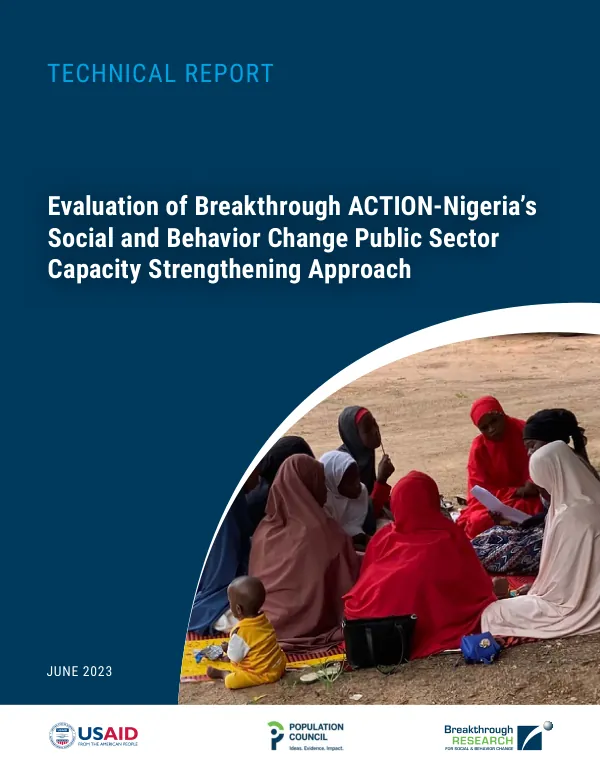
Evaluation of Breakthrough ACTION-Nigeria’s Social and Behavior Change Public Sector Capacity Strengthening Approach
Sign inAVENIR HEALTH
Evaluation of Breakthrough ACTION-Nigeria’s Social and Behavior Change Public Sector Capacity Strengthening Approach
Breakthrough ACTION-Nigeria's Social and Behavior Change Public Sector Capacity Strengthening Approach was implemented to enhance the capacity of public sector institutions to design and implement effective social and behavior change (SBC) programs.
2023 · 66 pages
Sign in to readA free account is required to download.
Abstract
The approach aimed to strengthen the capacity of the Federal Ministry of Health (FMOH) and State Ministries of Health (SMOH) to develop and implement SBC programs that address key health issues in Nigeria. The study was conducted in six states in Nigeria, including Ebonyi, Kebbi, Nasarawa, Sokoto, and two other states. The study setting was characterized by a high burden of infectious diseases, including HIV, tuberculosis, and malaria, as well as a high maternal and child mortality rate. The study aimed to evaluate the effectiveness of the SBC PSCS approach in strengthening the capacity of public sector institutions to design and implement effective SBC programs. The Outcome Harvesting (OH) approach was used to evaluate the effectiveness of the SBC PSCS approach. The OH approach involves identifying and documenting the outcomes of a program or intervention, as well as the factors that contribute to these outcomes. The study used a mixed-methods approach, combining both qualitative and quantitative data collection and analysis methods. The study found that the SBC PSCS approach was effective in strengthening the capacity of public sector institutions to design and implement effective SBC programs. The approach helped to increase the capacity of FMOH and SMOH staff to develop and implement SBC programs, as well as to improve the quality of SBC programs. The study also found that the approach helped to increase the participation of social actors, including community leaders and health workers, in SBC activities. The study identified several factors that contributed to the success of the SBC PSCS approach. These factors included the provision of technical assistance and training to FMOH and SMOH staff, as well as the establishment of a strong partnership between Breakthrough ACTION-Nigeria and FMOH and SMOH. The study also found that the approach helped to increase the use of evidence-based SBC materials and tools, as well as to improve the monitoring and evaluation of SBC programs. The study made several recommendations for the improvement of the SBC PSCS approach. These recommendations included the need to continue to provide technical assistance and training to FMOH and SMOH staff, as well as to establish a strong partnership between Breakthrough ACTION-Nigeria and FMOH and SMOH. The study also recommended the need to increase the use of evidence-based SBC materials and tools, as well as to improve the monitoring and evaluation of SBC programs. The study's findings have implications for the improvement of SBC programs in Nigeria. The study's recommendations for the improvement of the SBC PSCS approach can inform the development of future SBC programs in Nigeria. The study's findings also highlight the importance of strengthening the capacity of public sector institutions to design and implement effective SBC programs. The study's limitations include the fact that it was conducted in a limited number of states in Nigeria, and that the study's findings may not be generalizable to other states or contexts. The study also relied on self-reported data from FMOH and SMOH staff, which may be subject to bias. Overall, the study provides valuable insights into the effectiveness of the SBC PSCS approach in strengthening the capacity of public sector institutions to design and implement effective SBC programs in Nigeria. The study's findings have implications for the improvement of SBC programs in Nigeria, and highlight the importance of strengthening the capacity of public sector institutions to design and implement effective SBC programs.