USAID DEC
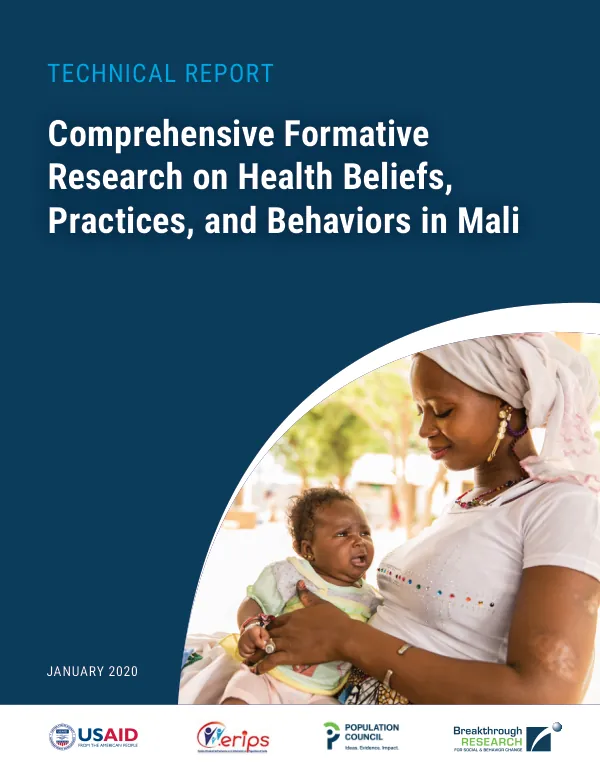
Comprehensive Formative Research on Health Beliefs, Practices, and Behaviors in Mali
Sign inBREAKTHROUGH RESEARCH
Comprehensive Formative Research on Health Beliefs, Practices, and Behaviors in Mali
The Breakthrough RESEARCH project in Mali aimed to conduct comprehensive formative research on health beliefs, practices, and behaviors.
2020 · 96 pages
Sign in to readA free account is required to download.
Abstract
The study was conducted in collaboration with the Population Council, USAID, and local researchers. The research focused on understanding the health needs and behaviors of adolescent girls, mothers, fathers, grandmothers, and grandfathers in Mali. The study used a mixed-methods approach, combining qualitative and quantitative data collection methods. The research team conducted exit interviews with women and child caregivers at Community Health Centers, as well as in-depth interviews with community leaders, traditional healers, and traditional birth attendants. The study also collected data on demographic profiles of study participants, household context, and social/power dynamics within households. The study found that newly married couples in Mali hope for a healthy and prosperous life, with a focus on having children and building a stable home. However, they also face significant challenges, including limited access to healthcare services and financial resources. The study also highlighted the importance of social/power dynamics within households, with women often having limited decision-making power and control over household resources. The study's findings have implications for the design and implementation of health programs in Mali, highlighting the need for programs that address the social and economic determinants of health. The study also underscores the importance of involving community leaders and traditional healers in health programming, as they play a critical role in shaping health beliefs and practices. The study's results will inform the development of evidence-based solutions to improve health and development programs in Mali. The research will also contribute to the improvement of the living conditions of the populations of the sub-region through the collection and analysis of relevant information and the development of skills in study and research and monitoring/evaluation of development programs. The study's methodology involved a scoping visit to identify key stakeholders and understand the local context. The research team also conducted a topical literature review to identify existing research on health beliefs, practices, and behaviors in Mali. The study's results will be used to inform the development of health programs and policies in Mali, with a focus on improving the health and well-being of adolescent girls, mothers, fathers, grandmothers, and grandfathers.