USAID DEC
Application of USP apparatus 7 in Performing Real Time and Accelerated Release Studies of an Intravaginal Ring
Sign inUSAID DEC
Application of USP apparatus 7 in Performing Real Time and Accelerated Release Studies of an Intravaginal Ring
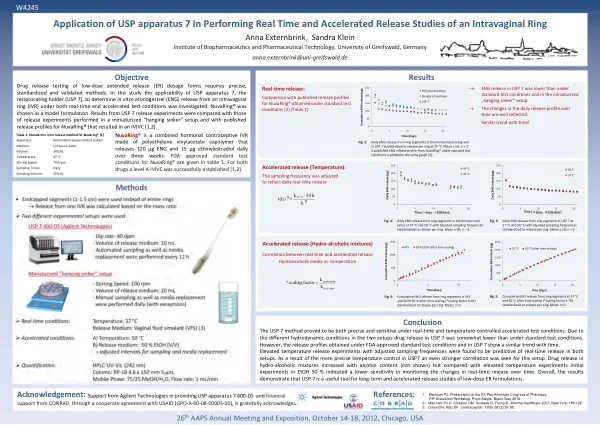
The study investigated the applicability of USP apparatus 7, the reciprocating holder, to determine in vitro etonogestrel (ENG) release from an intravaginal ring (IVR) under both real-time and accelerated test conditions.
2012 · 1 pages
Sign in to readA free account is required to download.
Abstract
The model formulation used was NuvaRing, a combined hormonal contraceptive IVR made of polyethylene vinylacetate copolymer that releases 120 µg ENG and 15 µg ethinylestradiol daily over three weeks. The study compared results from USP 7 release experiments with those of release experiments performed in a miniaturized "hanging sinker" setup and with published release profiles for NuvaRing that resulted in an IVIVC. The USP 7 method proved to be both precise and sensitive under real-time and temperature-controlled accelerated test conditions. However, drug release in USP 7 was somewhat lower than under standard test conditions due to the different hydrodynamic conditions in the two setups. The release profiles obtained under FDA-approved standard test conditions and in USP 7 showed a similar trend with time. Elevated temperature release experiments with adjusted sampling frequencies were found to be predictive of real-time release in both setups. As a result of the more precise temperature control in USP 7, an even stronger correlation was seen for this setup. Drug release in hydro-alcoholic mixtures increased with alcohol content, but compared with elevated temperature experiments, initial experiments in EtOH 50% indicated a lower sensitivity in monitoring the changes in real-time release over time. The results demonstrate that USP 7 is a useful tool for long-term and accelerated release studies of low-dose ER formulations. The study used an automated release control system with ultrapure water as the medium, a volume of 200 mL, a temperature of 37°C, a stirring speed of 750 rpm, and daily sampling with a sampling volume of 200 mL. The study also compared the ENG release from ring segments in the miniaturized setup and in USP 7 under standard test conditions and at elevated temperatures. The study found that the changes in the daily release profile over time are well reflected in USP 7, and the release profiles obtained under standard test conditions and in USP 7 showed a similar trend with time. The study also found that elevated temperature release experiments with adjusted sampling frequencies were predictive of real-time release in both setups. The results of this study suggest that USP 7 is a useful tool for long-term and accelerated release studies of low-dose ER formulations.