USAID DEC
Applying the Innovation Adoption Measurement Approach to Strengthen Resilience Programming
Sign inCHEMONICS
Applying the Innovation Adoption Measurement Approach to Strengthen Resilience Programming
The Innovation Adoption Measurement Approach (IAMA) was developed by Dr.
2021 · 11 pages
Sign in to readA free account is required to download.
Abstract
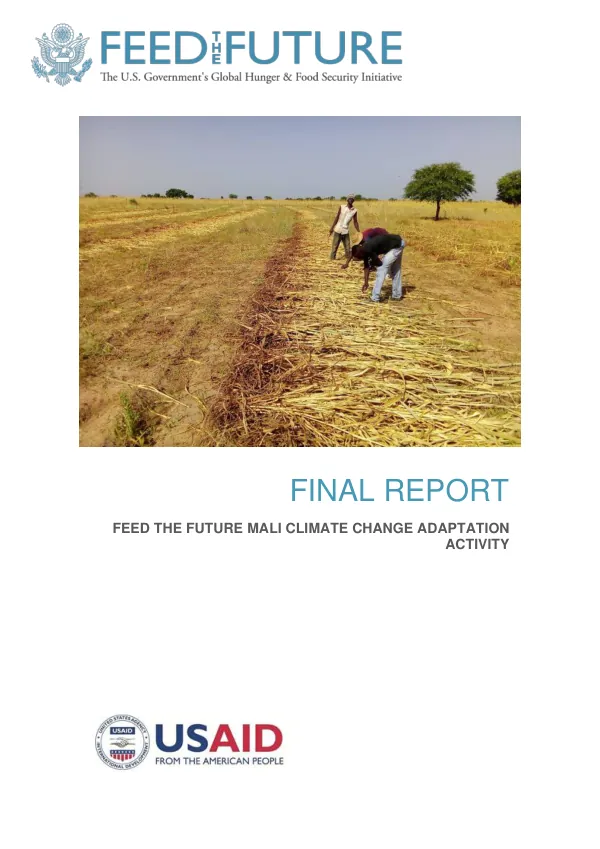
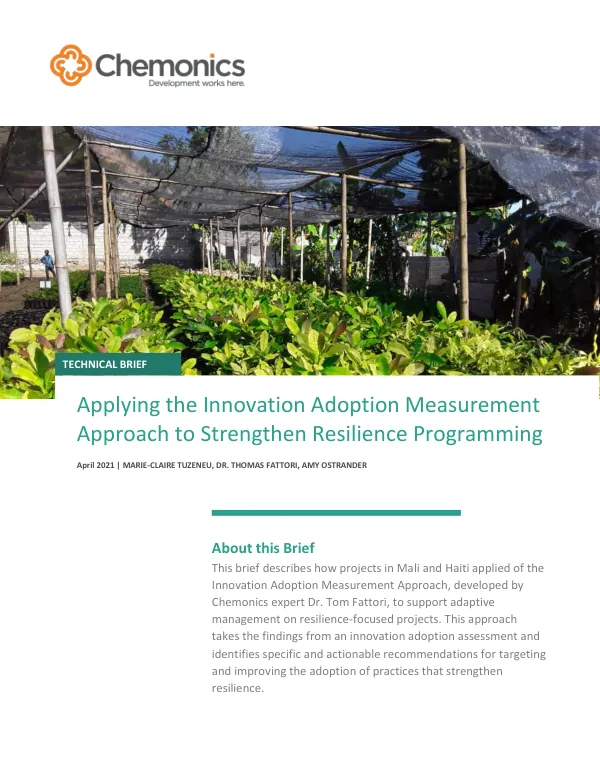
Tom Fattori at Chemonics to support adaptive management on resilience-focused projects. This approach takes the findings from an innovation adoption assessment and identifies specific and actionable recommendations for targeting and improving the adoption of practices that strengthen resilience. Resilience is defined as the ability of people, households, communities, countries, and systems to mitigate, adapt to, and recover from shocks and stresses in a manner that reduces chronic vulnerability and facilitates inclusive growth. Resilience capacities can be broken down into three categories: absorptive, adaptive, and transformative. These capacities allow people to anticipate and respond more effectively when faced with shocks and stresses. The IAMA builds on several existing theories and approaches, including Roger's theory of innovation diffusion. According to Roger's theory, an individual must work through a five-step process to adopt an innovation: awareness, access, utility, application, and adoption. The IAMA provides targeted data to measure the adoption of best practices by surveying respondents on each of these steps. In 2019, Chemonics piloted IAMA in Mali on the USAID Mali Climate Change Adaptation Activity (MCCAA) and in Haiti on the USAID Reforestation Project (URP). The surveys included measures at each step in the pathway for all major project interventions, along with questions to capture other key elements of a resilience assessment, such as community assets, household livelihood assets, and social capital. The surveys were conducted in Mali and Haiti, with a total of 560 households surveyed in Mali and 540 households surveyed in Haiti. The surveys were designed to capture the adoption of best practices and identify barriers to adoption, allowing project teams to make targeted adjustments in their approach. The IAMA provides a powerful tool to identify the specific steps where behavior change is being held up, enabling teams to target it, adjust, and achieve improved adoption and results. By providing more detail into the process of adopting new skills, the IAMA empowers projects to make targeted adjustments in their approach, improving the way interventions for resilience are designed and managed. The approach has been applied to measure the adoption of any set of practices, making it a versatile tool for development programming. Whether it's starting something new or stopping something harmful, the root is behavior change, and the IAMA provides a powerful tool to identify the specific steps where behavior change is being held up. The IAMA has been developed and tested as part of an effectiveness study for USAID's Mali Climate Change Adaptation Activity and a resilience baseline in Haiti for the USAID Reforestation Project. The approach has been shown to provide targeted data to measure the adoption of best practices, enabling project teams to identify barriers to adoption and make targeted adjustments in their approach. Overall, the IAMA is a valuable tool for resilience-focused projects, providing a powerful way to measure the adoption of best practices and identify barriers to adoption. By applying the IAMA, project teams can make targeted adjustments in their approach, improving the way interventions for resilience are designed and managed.