ABT ASSOCIATES
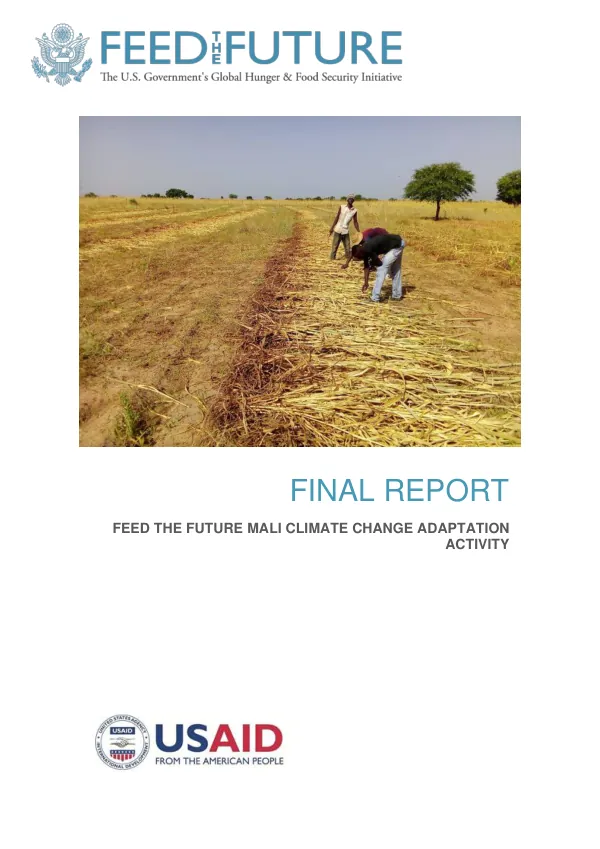
Final Report: Feed the Future Mali Climate Change Adaptation Activity
The USAID Mali Climate Change Adaptation Activity (MCCAA) aimed to build resilience to climate change by providing individuals, households, organizations, and the government of Mali with reinforced capacity to adapt to the shocks and stresses that come with climate change.
2020 · 81 pages
Sign in to readA free account is required to download.
Abstract
The activity was a consortium effort led by Chemonics and supported by key partners, including Abt Associates, the Humanitarian Response and Development Lab at Clark University, and others. MCCAA promoted the provision and use of accurate, appropriate, and timely climate information to vulnerable populations. This was achieved through the supply of climate data and predictions, analysis, and decision-support tools. Stakeholders' access to climate data and predictions, analysis, and decision-support tools was also improved. Furthermore, the capacity of stakeholders to use climate data and predictions, analysis, and decision-support tools was enhanced. The activity increased the inclusion of climate change considerations into commune-level governance systems. This was achieved through the integration of climate change into commune-level planning in targeted areas. The capacity of local NGOs in climate change adaptation was also strengthened. Additionally, the activity increased the adoption of local solutions to climate variability and change by communities and individual households. MCCAA carried out a significant amount of training during the life of the activity. The activity's overall goal was to ensure that each beneficiary and the household in which that beneficiary resided were more resilient to climate change and the shocks and stresses that can occur with climate variability. Key accomplishments of MCCAA include the establishment of a network of climate information providers, the development of a climate information platform, and the implementation of climate-resilient agriculture practices. The activity also focused on gender and youth inclusion. Youth inclusion was also a key aspect of the activity, with a focus on empowering young people to take an active role in climate change adaptation. MCCAA operated in a challenging security environment, with the activity's staff and partners facing security risks in some areas. However, the activity was able to adapt to these challenges and continue to implement its activities. The activity's environmental compliance was also a key consideration, with a focus on minimizing the activity's environmental impact. The final report of MCCAA highlights the activity's key accomplishments and lessons learned. The report provides a detailed account of the activity's results, including the increase in the use of effective climate information by vulnerable populations, the inclusion of climate change considerations in governance systems, and the adoption of local solutions to climate variability and change. The report also provides recommendations for future activities and initiatives. MCCAA's results were achieved through a combination of training, capacity building, and the provision of climate information and decision-support tools. The activity's overall goal was to build resilience to climate change and promote sustainable economic development in Mali. The activity's accomplishments demonstrate the importance of climate change adaptation and the need for continued support for activities that promote climate resilience and sustainable development.