USAID DEC
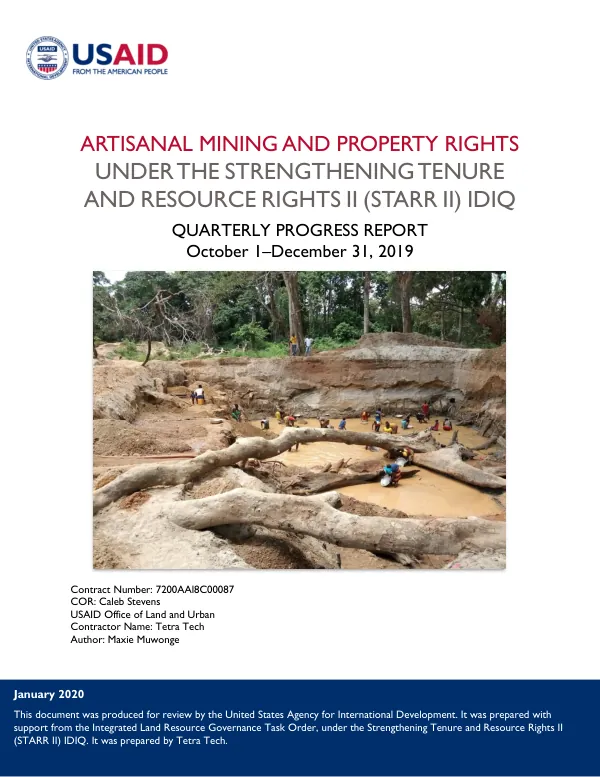
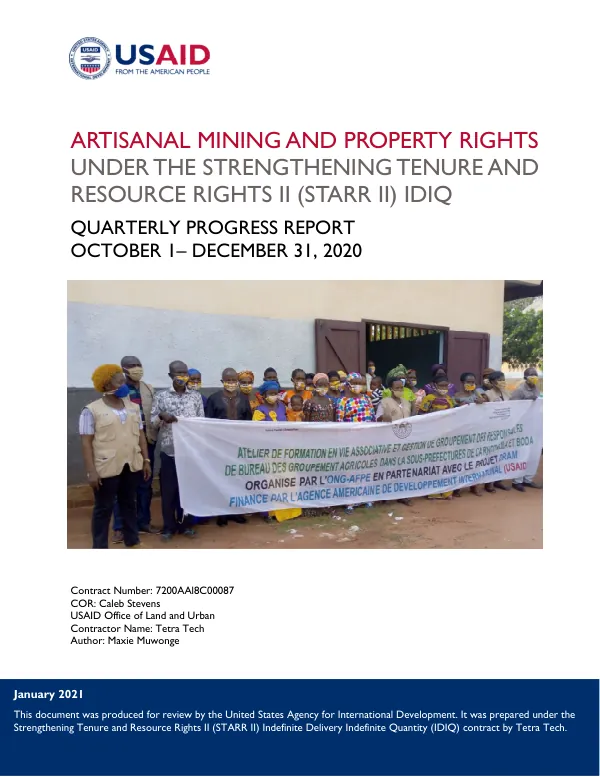
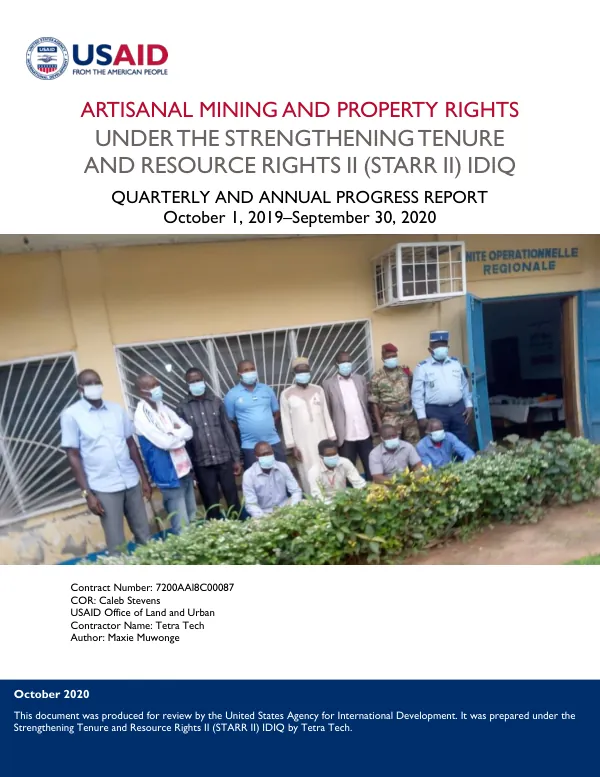
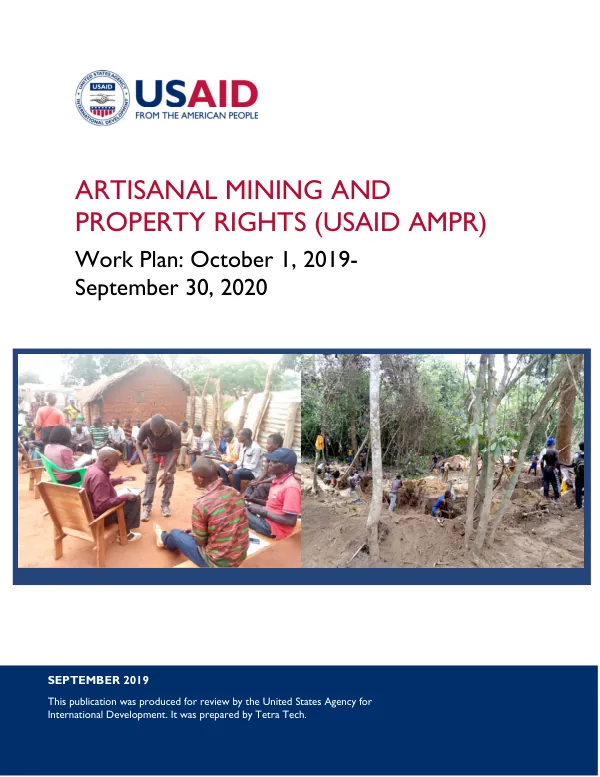
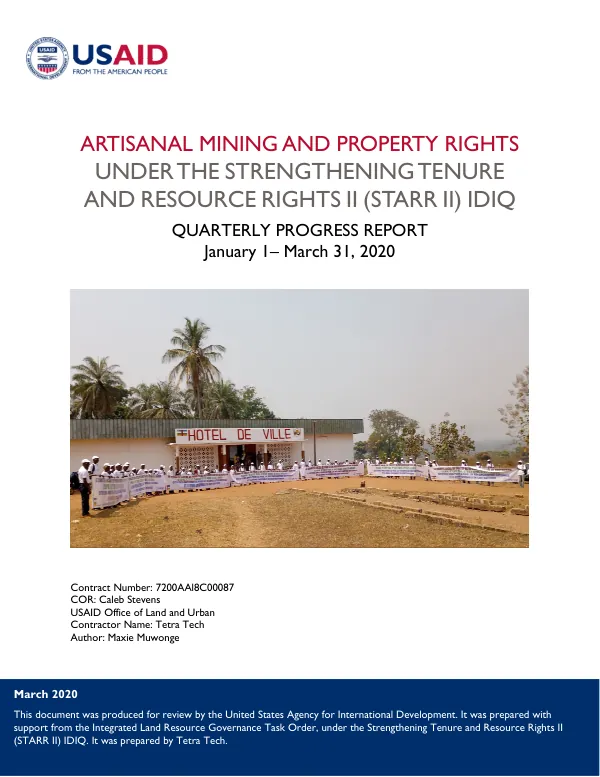
Artisanal Mining and Property Rights Quarterly Progress Report (January 1–March 31, 2020)
Sign inTETRA TECH
Artisanal Mining and Property Rights Quarterly Progress Report (January 1–March 31, 2020)
The Artisanal Mining and Property Rights (AMPR) project in the Central African Republic (CAR) aims to improve compliance with Kimberley Process requirements to promote licit economic activities.
2020 · 38 pages
Sign in to readA free account is required to download.
Abstract
The project is implemented by Tetra Tech under the Strengthening Tenure and Resource Rights II (STARR II) IDIQ, with funding from the United States Agency for International Development (USAID). The project has four objectives: Objective I focuses on assisting the Government of CAR (GoCAR) to improve compliance with Kimberley Process requirements, while Objective II aims to strengthen community resilience, social cohesion, and response to violent conflict in CAR. Objective III seeks to increase awareness and understanding of the opportunities and challenges of establishing responsible gold supply chains in CAR, and Objective IV aims to improve USAID programming through increased understanding of linkages between artisanal mining and key development issues. To achieve these objectives, the project has established several intermediate results, including improving the legal, policy, and institutional framework for conflict-free diamond production, expanding formalization of land and resource rights in artisanal diamond mining communities, and increasing awareness of Kimberley Process requirements among stakeholders. The project also aims to strengthen the capacity of GoCAR to manage and expand KP-compliant zones effectively. In terms of project activities, the AMPR project has been working with various stakeholders, including government agencies, civil society organizations, and local communities. The project has established a number of committees, including the Peace and Reconciliation Committee, to promote social cohesion and conflict resolution. The project has also provided training and capacity-building programs for local communities, including women and other vulnerable populations. The project has made significant progress in its first quarter, with several key achievements reported. These include the establishment of KP-compliant zones in several communities, the training of over 100 community leaders on conflict resolution and social cohesion, and the development of a number of policy and legal frameworks to support conflict-free diamond production. The project has also faced several challenges, including the COVID-19 pandemic, which has disrupted project activities and affected the availability of resources. However, the project team has been working to adapt to these challenges and ensure the continued implementation of project activities. In terms of project management, the AMPR project has a number of key staff members, including a project manager, a chief of party, and a number of technical advisors. The project also has a number of partners, including USAID, the European Union, and several international nongovernmental organizations. The project has established a number of performance indicators to measure its progress and impact. These include the number of KP-compliant zones established, the number of community leaders trained on conflict resolution and social cohesion, and the number of policy and legal frameworks developed to support conflict-free diamond production. Overall, the AMPR project is making significant progress in its first quarter, with several key achievements reported. However, the project team continues to face challenges, including the COVID-19 pandemic, and will need to adapt to these challenges to ensure the continued implementation of project activities. The project's geographic focus is on the Central African Republic, with a particular emphasis on the artisanal diamond mining sector. The project's timeframes are quarterly, with the first quarter covering January 1-March 31, 2020. The project's recommendations include the need for continued support for the GoCAR to improve compliance with Kimberley Process requirements, as well as the need for increased awareness and understanding of the opportunities and challenges of establishing responsible gold supply chains in CAR.